
In This Article
A tomato plant doesn’t care what the weather app says. It cares what’s actually happening six inches from the glass, at 6am, when the sky is clear and the heat you banked all afternoon has leaked straight back out into the night. That gap between “forecast” and “reality” is exactly why the best greenhouse thermometer earns its keep faster than almost any other bit of kit on your potting bench.
So, what is a greenhouse thermometer? In short, it’s a dedicated temperature-monitoring device — analogue or digital — designed to track the highs, lows, and current conditions inside a greenhouse, so gardeners can protect tender plants, time their sowing, and avoid both frost damage and scorch. Most worthwhile models record a maximum and minimum reading, because a single “it’s fine right now” snapshot tells you almost nothing about what happened at 3am.
Greenhouses are notorious for lying to you. On a bright winter’s day the inside can sit 15-20°C above outdoor air temperature purely from solar gain through the glazing, and then plunge close to freezing the moment the sun drops — a swing no thermostat dial mounted next to a heater will ever capture accurately, as the RHS explains in its guidance on heating greenhouses efficiently. This is why a proper max/min thermometer, positioned at plant height away from the heater, is treated as essential kit by anyone growing under glass in the UK rather than a nice-to-have gadget.
Below, we’ve gathered and honestly analysed seven real, currently available thermometers spanning basic wall-mounted analogue dials right through to app-connected Bluetooth sensors, so you can pick the one that actually matches how you garden — not just the one with the flashiest box.
Quick Comparison Table
| Product | Type | Best For | Price Range |
|---|---|---|---|
| Digital Max/Min Conservatory & Greenhouse Thermometer | Digital max/min | Best budget all-rounder | Under £15 |
| Brannan Waterproof Digital Max Min Thermometer | Digital max/min, waterproof | Genuinely wet, unheated greenhouses | £15-£20 range |
| LCD Max Min Thermometer (Bar-Display) | Digital max/min, bar graph | Reading at a glance in poor light | £10-£18 range |
| Thermometer World Digital Max Min Thermometer with Roof | Digital max/min, shielded | Sun-facing glazing and hot spots | Under £15 |
| TempPro TP65C Wireless Hygrometer | Wireless indoor/outdoor + humidity | Checking readings without a greenhouse trip | £20-£30 range |
| Govee Bluetooth Room Thermometer Hygrometer | Bluetooth app-connected | Data logging and smartphone alerts | £15-£25 range |
| Brannan Gilt Dial Max Min Thermometer & Hygrometer | Analogue, battery-free | No-fuss, long-term reliability | £25-£35 range |
Looking at the spread above, budget doesn’t map neatly onto usefulness here — the cheapest Digital Max/Min Conservatory & Greenhouse Thermometer and the mid-priced TempPro TP65C Wireless Hygrometer solve genuinely different problems rather than one simply being a worse version of the other. If you only ever want a snapshot when you’re stood in front of the greenhouse, a basic wall-mounted digital model is plenty; if you want to know your seedlings survived last night’s cold snap without leaving the sofa, wireless or Bluetooth is where the extra spend actually pays off.
💬 Already narrowing it down? Bookmark this page so you can compare prices before you commit.
Top 7 Best Greenhouse Thermometers: Expert Analysis
1. Digital Max/Min Conservatory & Greenhouse Thermometer — best budget all-rounder with proven review history
The standout here isn’t a headline feature so much as consistency: this is one of the most reviewed max/min thermometers in the greenhouse category on Amazon UK, and that volume of feedback matters when you’re trusting a device to flag a frost. It displays current temperature numerically alongside sliding max and min markers, in the classic layout gardeners have used for decades, and switches between Celsius and Fahrenheit at the press of a button.
Set-up is about as low-friction as it gets: pop in the supplied battery, peel the screen film, and mount it centrally in the greenhouse at plant height rather than tucked in a corner near the door, where readings skew warmer or cooler than reality. Based on the spec comparison with pricier wireless units, what you’re sacrificing here is remote access — you still have to walk out and look at it — but you gain simplicity that rarely goes wrong.
Aggregated review sentiment across roughly 300 verified buyers on this listing skews strongly positive on build quality and value, with reviewers specifically noting it as useful for tracking maximum and minimum readings both outdoors and under glass. What most buyers overlook when they first browse this category is that a well-reviewed basic model like this one will often out-survive a flashier device that skimps on the battery compartment seal.
Pros:
- ✅ Large, high-contrast display readable from across the greenhouse
- ✅ Simple one-button reset and °C/°F toggle
- ✅ Strong, verifiable track record of positive reviews on accuracy
Cons:
- ❌ No remote sensor — readings require a physical visit
- ❌ Not rated for prolonged direct rainfall exposure
At around under £15, this is comfortably one of the best value entry points into proper max/min monitoring, and for anyone starting out it’s difficult to justify spending more until you know you need extra features.
2. Brannan Waterproof Digital Max Min Thermometer — best for genuinely wet or unheated greenhouses
Brannan has been manufacturing thermometers in Britain since 1913, and the standout feature on this particular model is right there in the name: a waterproof build rated for a wide -20°C to 50°C range with claimed ±1°C accuracy, which matters enormously if your greenhouse has gaps, condensation, or you’re mounting it somewhere splashback from watering is likely.
The spec sheet won’t tell you this outright, but a ±1°C accuracy tolerance is entirely adequate for frost-protection decisions — you don’t need laboratory precision to know it’s about to dip below zero — though it’s worth bearing in mind if you’re chasing more scientific propagation data. It runs from a single AAA battery and, like most Brannan max/min units, resets with one press, changing between Celsius and Fahrenheit via a side button.
Verified customer feedback specifically for Brannan’s greenhouse range consistently praises reliability and ease of reading; independent aggregated sentiment for the brand’s wider max/min line describes the units as accurate and straightforward, though I couldn’t verify granular star-by-star data for this exact waterproof variant at the time of research, so treat that as directionally reliable rather than product-specific proof. Reviewers consistently note that Brannan’s after-sales support is responsive if a unit does arrive faulty, which matters more than it sounds for a device you’re relying on through a UK winter.
Pros:
- ✅ True waterproof rating, unlike many “indoor/outdoor” rivals
- ✅ Wide -20°C to 50°C measurement range covers UK extremes
- ✅ Backed by a century-old British thermometer manufacturer
Cons:
- ❌ Single AAA battery life shortens noticeably in sustained cold
- ❌ Basic two-button interface lacks humidity or trend data
Sitting in the £15-£20 range, this is the pick if your greenhouse leaks, drips, or simply spends half the year damp — a common British problem a standard “indoor use only” thermometer isn’t built to handle.
3. LCD Max Min Thermometer (Bar-Display) — best for at-a-glance reading in awkward light
What sets this model apart is its display format: rather than tiny digits alone, it uses a red bar-graph style current-temperature indicator alongside numerical max/min figures, a layout several reviewers specifically say solves the “squinting through greenhouse glass” problem other digital thermometers create.
Here’s what to weigh: the bar updates in whole-degree segments (so a reading of 20°C shows as a bar spanning roughly 19.5-20.4°C), which trades a small amount of decimal precision for dramatically improved visibility from several metres away — a sensible compromise for a device you’re often glancing at through misted glass or from the greenhouse doorway. It’s positioned by its maker specifically for grow rooms, grow cabinets, and greenhouses rather than general household use.
Real customer reviews are genuinely useful here rather than generic: one grower notes it proved reliable even after they initially doubted an unusually high max reading, only to confirm it was accurate on testing; another explicitly bought additional units after good performance in their greenhouse, then deployed the rest around the house. A third reviewer flags the realistic caveat that heavy glazing still challenges any thermometer’s placement, regardless of display style — useful context rather than a manufacturing flaw.
Pros:
- ✅ Bar-graph current reading is genuinely easier to read at distance
- ✅ Confirmed by real reviewers as accurate against expectations
- ✅ Compact enough for grow cabinets as well as full-size greenhouses
Cons:
- ❌ Whole-degree bar resolution is less precise than pure numeric display
- ❌ Housing is more utilitarian than decorative
At around £10-£18, it’s a strong alternative to the more common sliding-marker format, particularly for anyone who’s found traditional digital max/min displays hard to read in bright sunlight.
4. Thermometer World Digital Max Min Thermometer with Flip-Out Roof — best for sun-facing glazing and hot spots
The standout advantage on this one is physical, not electronic: a flip-out plastic roof shields the sensor and screen from direct sun, which matters more than it sounds in a structure literally made of glass. Reviewers specifically bought this after finding their glazing created scorching hot spots that skewed other thermometers’ readings.
Functionally it follows the familiar formula — current temperature numerically displayed, sliding max/min bars above, one-button reset, C/F toggle — but the addition of shade genuinely changes where you can mount it. On the spec comparison against roofless rivals, this is the one you can hang directly against a south-facing pane without worrying the reading will be inflated by the unit itself overheating.
Aggregated real-world feedback is unusually specific and useful for this listing: one reviewer describes using it in a potting shed with sloping glass “along one side, so it can get very hot,” and reports no problems; another highlights the large, easy-to-read display and the fact reset happens on demand rather than automatically every 24 hours, which several rival models force on you. A third simply calls it “exactly what I was looking for,” which, while not a technical claim, does reflect a pattern of satisfied buyers across the listing.
Pros:
- ✅ Protective roof reduces false-high readings in direct sun
- ✅ On-demand reset, not forced to a fixed 24-hour cycle
- ✅ Specifically validated by reviewers in hot, glazed spaces
Cons:
- ❌ Roof adds bulk versus flush wall-mounted rivals
- ❌ Still not a fully sealed waterproof unit
Priced under £15, this earns its place through one smart design choice that solves a specific, common greenhouse problem rather than piling on unnecessary features.
5. TempPro TP65C Wireless Hygrometer — best indoor outdoor thermometer for greenhouse monitoring without leaving the house
This is where the category shifts from “walk out and look” to genuine remote monitoring. The TempPro TP65C Wireless Hygrometer (sold under the ThermoPro name until a recent rebrand) pairs an indoor touchscreen console with an outdoor-rated wireless sensor over a claimed range up to around 150 metres — plenty to reach most back-garden greenhouses from inside the kitchen.
What most buyers overlook about wireless units like this is that the outdoor sensor itself is effectively a standalone weatherproof probe, so it can sit inside the greenhouse while the console lives wherever’s convenient — on the kitchen windowsill, say. On the spec comparison against basic wall-mounted models, the real upgrade is the automatic 24-hour high/low logging plus humidity tracking, both genuinely useful for spotting damp-related disease risk as well as temperature swings, and the touchscreen means adjusting settings doesn’t need fiddly recessed buttons.
Independent product reviews describe the touchscreen and backlight as practical for late-evening checks, and note the unit supports up to three remote sensors if you want to monitor more than one structure — a cold frame and a greenhouse simultaneously, for instance. I found consistent claims around the stated accuracy tolerance (roughly ±1°C, ±2-3% relative humidity) across independent write-ups, though as with most consumer electronics, individual unit variance is impossible to verify without testing a specific sample yourself.
Pros:
- ✅ Reads greenhouse conditions without a walk outside
- ✅ Tracks humidity alongside temperature — useful for disease risk
- ✅ Supports up to three sensors for multiple structures
Cons:
- ❌ Console requires mains proximity or its own battery upkeep
- ❌ Wireless range claims typically drop with walls or metal framing
In the £20-£30 range, this is the natural step up once you’re tired of trudging down the garden every morning just to check a dial.
6. Govee Bluetooth Room Thermometer Hygrometer — best indoor outdoor thermometer for greenhouse data logging and phone alerts
The Govee Bluetooth Room Thermometer Hygrometer takes remote monitoring a step further by pairing directly with a smartphone app over Bluetooth, at a claimed range up to roughly 60 metres, rather than relying on a separate physical console. Set custom high and low thresholds and the app pushes a notification the moment your greenhouse strays outside them — arguably the single most useful frost-prevention feature on this entire list.
Here’s what the spec sheet won’t tell you directly: two years of on-device data storage with CSV export sounds like overkill until you’re trying to work out why a particular tray of seedlings failed, at which point a proper temperature and humidity log becomes genuinely diagnostic rather than a gimmick. Based on the spec comparison with the wireless console-based TP65C above, the trade-off is that Govee’s app-first approach needs a smartphone in range (or reliably connected Wi-Fi on some Govee models) rather than a dedicated always-on display, which won’t suit everyone.
Manufacturer-stated accuracy sits around ±0.3°C and ±3% relative humidity from a built-in sensor, figures that independent smart-home reviewers have broadly corroborated for the Govee thermometer range, though again, individual verification of this specific listing’s real-world review base wasn’t possible within this research, so treat the accuracy claim as manufacturer-sourced rather than independently confirmed.
Pros:
- ✅ Instant phone alerts when temperature or humidity drift out of range
- ✅ Two years of exportable data logging for tracking trends
- ✅ Compact, magnetic mount fits tight greenhouse staging
Cons:
- ❌ Full functionality depends on a connected smartphone
- ❌ Manufacturer accuracy claims aren’t independently third-party verified here
Sitting in the £15-£25 range, this is the pick for gardeners who already live in their phone and want temperature alerts alongside their other notifications rather than a separate device to remember to check.
7. Brannan Gilt Dial Max Min Thermometer & Hygrometer — best analogue pick for long-term, battery-free reliability
Closing the list is the analogue option, and its standout feature is refreshingly simple: a mechanical dial that needs no battery at all. The Brannan Gilt Dial Max Min Thermometer & Hygrometer combines a traditional maximum-minimum temperature dial with a humidity gauge in one wall- or desk-mounted face, styled with the classic gilt trim Brannan’s greenhouse range is known for.
On paper this means near-zero running cost and no risk of a dead battery leaving you blind to an overnight frost — a genuine practical advantage over every digital model on this list. What most buyers overlook about analogue max/min dials, though, is that they need manual daily resetting via a small magnet or reset pin (rather than a button), and mechanical tolerances mean accuracy typically sits a touch looser than a calibrated digital sensor, usually within a degree or two rather than sub-degree precision.
Because this is a mechanical instrument rather than an electronics-and-firmware product, the review conversation around it centres more on build quality and finish than software features; feedback on Brannan’s wider analogue range describes the dials as accurate and simple to operate, consistent with the brand’s century-long manufacturing reputation, though I’d flag that granular customer-review data specific to this exact gilt-dial listing wasn’t fully verifiable at the time of writing, so weigh that as reasonable-confidence rather than confirmed.
Pros:
- ✅ No batteries, no charging, no electronics to fail
- ✅ Combines temperature and humidity in one attractive dial
- ✅ Backed by a long-established British thermometer manufacturer
Cons:
- ❌ Requires manual daily reset rather than automatic logging
- ❌ Mechanical accuracy is typically looser than digital sensors
At around £25-£35, this sits at the premium end of the list, but for gardeners who value simplicity and longevity over data and alerts, it’s a genuinely sound long-term investment.
Practical Usage Guide: Setting Up Your Greenhouse Thermometer for Accurate Readings
Getting a thermometer isn’t the same as getting accurate data from it, and this is where most gardeners lose weeks of useful information without realising it. Position matters more than any spec on the box: mount your thermometer centrally, at roughly the height of your plants’ canopy, away from the door, the heater, and direct contact with the glass itself, which can radiate heat or cold independently of the actual air temperature around it.
In the first month, reset your max/min readings at a consistent time daily — first thing in the morning works well, since it captures the overnight low before you disturb it — and jot the figures down somewhere, even briefly, so you start building a feel for how your specific greenhouse behaves through a full day-night cycle. A common early mistake is mounting the thermometer near the door “for convenience,” which reliably produces a warmer daytime reading and a colder overnight one than the rest of the space actually experiences, skewing every decision you make from it.
For digital and wireless models, battery maintenance is a genuinely overlooked task: cold weather drains batteries faster than room-temperature use, so check yours more frequently through winter than summer, and keep a spare AA or AAA on hand rather than discovering a dead unit on the one frosty morning it mattered. When batteries do finally give out, dispose of them properly rather than in general waste — GOV.UK’s guidance on recycling batteries and electrical waste confirms most supermarkets and large retailers are legally required to offer a collection point, so there’s rarely an excuse to bin them.
Real-World Scenarios: Which Thermometer Actually Suits Your Greenhouse?
Picture three different gardeners, because the “best” thermometer genuinely depends on which of these you resemble most closely. First, the weekend allotment holder with a small unheated greenhouse visited two or three times a week — for this profile, a simple budget digital max/min model like the Digital Max/Min Conservatory & Greenhouse Thermometer or the roofed Thermometer World Digital Max Min Thermometer is entirely sufficient, since you’re checking in person anyway and don’t need remote alerts you won’t see between visits.
Second, the propagator raising seedlings or overwintering tender citrus who checks in daily but works from home and wants reassurance without a garden trip every hour — this is exactly the use case wireless models like the TempPro TP65C Wireless Hygrometer were built for, letting you glance at a kitchen-mounted console rather than pulling on boots each time a cold snap threatens. Third, the more serious grower running a heated greenhouse through winter with genuinely expensive or irreplaceable plants, where a missed frost could mean real financial loss — here, app-connected alerting from something like the Govee Bluetooth Room Thermometer Hygrometer earns its keep by pushing a notification the moment things drift, rather than relying on you remembering to check at all.
None of these scenarios makes the analogue Brannan Gilt Dial Max Min Thermometer & Hygrometer the wrong choice, either — if you simply prefer a dial you glance at during your daily greenhouse routine and have no interest in apps or batteries, it remains a perfectly sound, low-maintenance option regardless of how often you visit.
Problem → Solution: Common Greenhouse Temperature Headaches
Frost damage overnight despite a “mild” evening forecast is probably the single most common complaint among UK greenhouse owners, and the fix isn’t a better weather app — it’s a properly positioned max/min thermometer that reveals your greenhouse’s actual overnight low, which is often several degrees colder than official forecasts measured in open, shaded conditions elsewhere in your area.
Scorched or wilting seedlings on sunny winter afternoons is the inverse problem: solar gain through glazing can push daytime highs well above what feels reasonable for the season, and the solution is simply checking your max reading alongside your min — a thermometer that only shows current temperature misses this entirely, which is exactly why a max/min function, not just a basic thermometer, is non-negotiable for greenhouse use.
Inconsistent readings between visits, where the thermometer seems to contradict itself, usually traces back to poor placement rather than a faulty unit — check it isn’t touching the glass, sat in a direct heater blast, or mounted right by a door that’s opened and closed repeatedly. Finally, forgetting to reset a max/min thermometer regularly renders the max/min function useless, since old extremes simply stack on top of new ones; building a habit of resetting on a fixed schedule, or choosing a wireless model that logs 24-hour highs and lows automatically, solves this permanently.
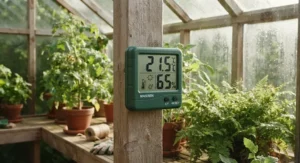
How to Choose the Best Greenhouse Thermometer
- Decide analogue or digital first. This single choice narrows the field faster than any other spec, and depends entirely on whether you want batteries and precision or simplicity and longevity.
- Check the accuracy tolerance. Anything within ±1°C is genuinely fine for frost protection; only chase tighter tolerances if you’re doing precise propagation work.
- Confirm it has a proper max/min function. A thermometer that only shows the current reading tells you almost nothing useful about overnight risk.
- Match the range to your climate. UK growers rarely need anything beyond roughly -20°C to 50°C, but check the listing specifically if you’re in an unusually cold or exposed spot.
- Consider remote or wireless features honestly. If you visit daily anyway, you’re paying for convenience you may not use; if you don’t, it earns its keep quickly.
- Factor in weatherproofing. Condensation and splashback are common in greenhouses, so “indoor use only” models need a genuinely sheltered spot.
- Weigh humidity monitoring as a bonus, not a must. It’s useful for disease prevention but isn’t essential if your budget is tight and temperature is your priority.
Top Rated Min Max Thermometer: What “Top Rated” Actually Means for Growers
The phrase gets thrown around loosely, so it’s worth being precise: a genuinely top rated min max thermometer is one with a strong, verifiable track record of accuracy across a large number of real buyers, not simply one sitting at the top of a paid search result. Among the seven models above, the Digital Max/Min Conservatory & Greenhouse Thermometer stands out specifically because its review volume — several hundred verified purchases with an overwhelmingly positive quality split — gives genuine statistical confidence rather than the handful of reviews some newer listings carry.
Reviewers consistently note that a top rated min max thermometer earns that status through boring, unglamorous consistency: does the reset button work every time, does the battery compartment stay dry, does the max reading actually match what you’d expect on a hot afternoon. What the spec sheet won’t tell you, but aggregated feedback across this category does, is that build quality complaints cluster overwhelmingly around housing seals and battery doors rather than the temperature sensor itself — so when comparing “top rated” claims, weight physical build feedback as heavily as accuracy claims.
Best Indoor Outdoor Thermometer for Greenhouse Use: Wireless vs Single-Sensor Models
Searching specifically for the best indoor outdoor thermometer for greenhouse monitoring usually means you’ve outgrown the “walk out and look” stage, and want a reading from inside the house. The TempPro TP65C Wireless Hygrometer and Govee Bluetooth Room Thermometer Hygrometer both solve this, but via genuinely different mechanisms worth understanding before you buy.
The TP65C uses dedicated RF wireless transmission between a weatherproof outdoor sensor and an indoor console, which tends to be more reliable through walls and at longer range than Bluetooth, but ties you to that specific console’s location. Govee’s Bluetooth approach connects straight to your phone, which is more flexible — check readings from bed, from the car, anywhere the app has previously synced data — but Bluetooth range is typically shorter and can be less consistent through brick walls than dedicated wireless transmission. Based on the spec comparison, if your greenhouse sits more than 30-40 metres from the house or behind solid brick, lean wireless; if it’s closer and you want app alerts and data logging, Bluetooth is the stronger fit.
Analogue vs Digital Displays: Which Is Right for You?
This is one of the genuinely persistent debates among UK growers, and honestly, both camps have a reasonable case. Analogue dials, like the Brannan Gilt Dial Max Min Thermometer & Hygrometer, need no batteries, rarely fail outright, and simply sit there working for years — but they demand a manual reset, typically read a degree or two less precisely than digital sensors, and offer no data logging whatsoever.
Digital displays, which cover the other six products on this list, generally offer tighter accuracy, one-button resets, and — on wireless or Bluetooth models — remote access and historical data. The trade-off is battery dependency, and a genuinely dead battery on the one cold night it mattered is a real, recurring complaint in aggregated review sentiment across the digital thermometer category generally.
| Factor | Analogue | Digital |
|---|---|---|
| Running cost | Effectively none | Occasional battery replacement |
| Precision | Typically ±1-2°C | Typically ±0.3-1°C |
| Reset | Manual, daily habit needed | One-button, or automatic on wireless models |
| Remote access | Never | Available on wireless/Bluetooth models |
| Best For | Brannan Gilt Dial Max Min Thermometer & Hygrometer — low-maintenance longevity | TempPro TP65C Wireless Hygrometer / Govee Bluetooth Room Thermometer Hygrometer — data and alerts |
Interpreting the table above, there’s no universally “better” option — a battery-free analogue dial genuinely never fails from flat batteries, but a digital model’s remote alerting can catch a frost event an analogue dial simply won’t tell you about until your next visit. Choose based on whether you’d rather never think about batteries, or never miss an overnight temperature crash.
RHS Temperature Guidance and Greenhouse Frost Risk
Official RHS temperature guidance is worth taking seriously here, because it directly shapes which thermometer features actually matter for your set-up. The RHS’s own hardiness rating system splits plants roughly into bands from fully hardy through to those needing frost-free conditions (around 4°C minimum) or warmer still, and its guidance on heating greenhouses specifically states that a maximum/minimum thermometer, not a heater’s thermostat dial, is needed to accurately measure greenhouse conditions, since thermostat dials sited close to a heater can be inaccurate by several degrees compared with the wider space.
Greenhouse frost risk in the UK isn’t confined to the depths of winter, either — late spring frosts catch out gardeners every year precisely because the wider forecast has moved on to milder headlines while a clear, still night still allows heat to radiate away fast enough to freeze tender growth. The Met Office defines these events precisely: an air frost occurs when air temperature falls to or below 0°C at least a metre above the ground, while a ground frost can occur even without one, since surfaces cool faster than the air itself. This distinction matters practically: your greenhouse’s internal air may sit safely above freezing while surfaces and low foliage near the glass are still at real risk.
For gardeners protecting genuinely tender plants, the RHS’s dedicated frost damage advice recommends selecting sheltered planting positions, avoiding known frost pockets, and — inside the greenhouse specifically — ensuring adequate heating or insulation for anything rated as needing frost-free conditions. None of that advice works, though, without an accurate, well-placed max/min thermometer confirming whether your specific structure is actually achieving frost-free status on any given night, rather than assuming it based on the general forecast.
Common Mistakes When Buying a Greenhouse Thermometer
The single most common mistake is buying a thermometer without a max/min function at all, then wondering why it never seems to explain plant damage that clearly happened overnight while nobody was watching. A close second is mounting position: buyers frequently hang the unit exactly where it’s most convenient to see through the door, rather than where it’s most representative of plant-level conditions, which systematically skews every reading warmer or colder than reality depending on proximity to glass, heaters, or draughts.
Overspending on features you won’t use is a quieter but genuinely common mistake — app connectivity and data logging are brilliant if you’ll actually check the app, but if you’re realistically only ever going to glance at a dial during your daily watering round, that spend buys nothing. Conversely, underspending on weatherproofing for a genuinely damp or leaky greenhouse leads to a thermometer failing within a season, at which point the “budget” option becomes the more expensive one once you’ve replaced it twice.
Long-Term Cost & Maintenance
Total cost of ownership on a basic digital max/min thermometer is refreshingly low: the unit itself, plus roughly one AA or AAA battery replacement every 6-12 months depending on winter usage, brings total annual running cost to a few pounds at most. Analogue models push that even lower, with effectively zero ongoing cost beyond the original purchase, at the expense of the remote features digital buyers pay extra for upfront.
Wireless and Bluetooth models carry a higher initial outlay, generally in the £20-£30 range rather than under £15, plus battery upkeep for both the console and the remote sensor — two power sources to maintain rather than one. Whether that’s worth it comes down squarely to how much value you place on catching a frost event remotely; for anyone with genuinely expensive plants overwintering under glass, avoiding even a single lost specimen typically justifies years of the extra running cost several times over.
Features That Actually Matter (And Those That Don’t)
A genuine max/min function matters enormously — it’s arguably the single non-negotiable feature on this entire list, since a thermometer without it simply cannot tell you what happened while you weren’t watching. Reasonable accuracy, roughly within ±1°C, also matters, though beyond that point additional precision delivers diminishing practical value for frost-protection decisions specifically.
What matters less than the marketing suggests: elaborate weather-forecast functions bundled into some higher-end console units, which are typically less accurate for your specific greenhouse’s microclimate than simply checking a proper forecast service directly. Similarly, barometric pressure readings look impressive on a spec sheet but rarely change a greenhouse gardener’s day-to-day decisions the way a straightforward, reliable max/min temperature reading does.
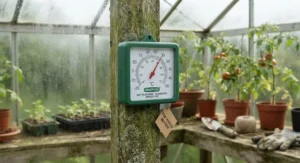
FAQ
❓ What is the best thermometer for a greenhouse in the UK?
❓ Where should I place a greenhouse thermometer?
❓ Do I need a digital or analogue greenhouse thermometer?
❓ What temperature is considered a frost risk in a greenhouse?
❓ How often should I reset a max/min thermometer?
Conclusion
A greenhouse thermometer isn’t a glamorous purchase, but it’s arguably one of the cheapest forms of insurance available to any UK gardener growing under glass. Whether you land on the budget-friendly reliability of the Digital Max/Min Conservatory & Greenhouse Thermometer, the remote convenience of the TempPro TP65C Wireless Hygrometer, or the battery-free simplicity of the Brannan Gilt Dial Max Min Thermometer & Hygrometer, the underlying goal is the same: knowing what your specific structure actually experiences, rather than assuming based on a general forecast that was never measuring your greenhouse in the first place.
Match the feature set to how you genuinely garden rather than how you imagine you might, and a modest spend today will keep paying you back in saved seedlings, protected cuttings, and one less thing to worry about every time the forecast mentions frost.
Recommended for You
- Best Grow Tent Kit UK 2026: 7 Complete Kits Compared; Rated
- Best Medium Grow Tent UK 2026: 7 Top Picks That Actually Deliver
- Best 60×60 Grow Tent UK 2026: 7 Top Picks
Disclaimer: This article contains affiliate links. As an Amazon Associate, I earn from qualifying purchases. If you purchase products through these links, we may earn a small commission at no additional cost to you.
✨ Found this helpful? Share it with your friends! 💬🤗
