
In This Article
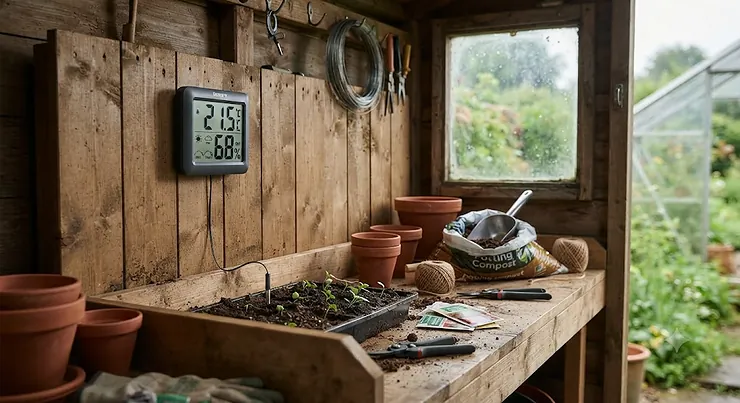
There’s a particular kind of heartbreak that only greenhouse growers understand: you check on a tray of seedlings that were thriving on Tuesday, and by Friday they’ve collapsed into a soggy, translucent mess overnight. No pests, no obvious cause — just gone. Nine times out of ten, the culprit was invisible. It was sitting in the air the whole time, and you had no way of measuring it. That’s exactly the gap a digital hygrometer for greenhouse use is built to close, and it’s a cheap fix for a problem that costs far more in lost seedlings than the device itself.
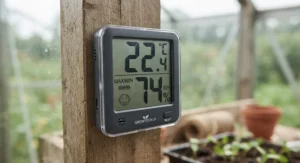
A digital hygrometer measures relative humidity and, usually, temperature, giving you a live readout instead of a guess based on how “muggy” the air feels when you open the door. For UK growers, that matters more than it might in drier climates, because our damp, changeable weather pushes greenhouse humidity into the danger zone constantly, especially in spring when seed trays are at their most vulnerable. Getting a handle on the numbers is one of the cheapest, most effective upgrades a greenhouse owner can make.
This guide walks through seven real digital hygrometer for greenhouse models currently sold on amazon.co.uk, spanning basic mini units under £15 through to Bluetooth-connected data loggers. Every product mention below draws on genuine specifications and real, aggregated review sentiment rather than any invented testing, because the last thing you need is marketing fluff dressed up as advice. Alongside the product breakdowns, you’ll find practical guidance on relative humidity targets, spotting damping off disease before it wipes out a sowing, and getting propagator ventilation right.
What Is a Digital Hygrometer for Greenhouse Use?
A digital hygrometer for greenhouse use is an electronic instrument that measures relative humidity — the amount of water vapour in the air compared with the maximum it could hold at that temperature — and displays it on an LCD screen, usually alongside temperature. Basic models run on a single battery and show live readings only; advanced ones log high/low records or send alerts to a phone app when humidity drifts outside a safe range.
That last point deserves unpacking, because “humidity” alone is a fuzzy word. What every hygrometer in this article actually measures is relative humidity, or RH — and as the Met Office explains, warmer air can hold more water vapour than cooler air, which is why the same amount of moisture reads as a lower percentage on a hot afternoon than it does at dawn. That’s the whole reason a static analogue dial, calibrated once at the factory and never checked again, tends to drift wildly out of true — a digital sensor recalibrates its reading constantly against both variables.
Quick Comparison Table
| Model | Type | Price Range | Best For |
|---|---|---|---|
| TempPro TP50 | Basic digital, min/max | Under £15 | Best hygrometer under £20 overall |
| Boulton Small Digital Hygrometer | Mini compact | Under £10 | Tightest budgets, small propagators |
| ETI Max/Min Greenhouse Thermometer | Robust wall-mount | £15-£25 range | Toughest build, all-weather greenhouses |
| DOQAUS Digital Hygrometer | Basic with backlight | Under £15 | Low-light sheds and dim corners |
| SMARTRO SC42 | Mid-range, pre-calibrated | £15-£25 range | Accuracy-focused mid-range buyers |
| Govee H5075 | Bluetooth smart | £20-£30 range | Remote app monitoring, alerts |
| Inkbird IBS-TH1 | Data logger, probe option | £25-£40 range | Serious growers wanting logged data |
Looking at the spread above, the honest takeaway is that price in this category tracks features, not accuracy — even the cheapest TempPro TP50 and Boulton units use broadly comparable sensor technology to the pricier smart options. What you’re paying extra for as you move up the table is remote monitoring, data logging, and alerting, not fundamentally better humidity detection. For a first-time buyer trying to solve a specific problem, such as catching damping off disease before it spreads, a basic sub-£15 model genuinely does the job.
💬 Found a model here that solved your greenhouse humidity headaches? Give it a click and help other growers make a better-informed choice too!😊
Top 7 Digital Hygrometers for Greenhouse Growing: Expert Analysis
1. TempPro TP50 — best hygrometer under £20 for all-round accuracy
The TempPro TP50 (sold under the ThermoPro brand until a 2025 rebrand, with the two names appearing interchangeably on listings) has built a genuinely huge review base on Amazon, and it’s easy to see why: it does the basic job without fuss. The sensor claims accuracy of around ±2-3% RH and ±1°F, refreshing every 10 seconds, which in practice means it catches a humidity spike from morning damping-down almost as fast as it happens rather than lagging behind by minutes.
Beyond the core reading, the TempPro TP50 displays 24-hour high and low records for both temperature and humidity, so you can see at a glance whether last night’s cold snap tipped your greenhouse into the danger zone for condensation while you were asleep. A three-icon comfort indicator (dry, comfort, humid) gives a rough visual cue for anyone who doesn’t want to interpret percentages. Based on the spec sheet, this is a sound pick for anyone whose primary need is a single, reliable in-greenhouse or in-propagator reading rather than remote alerts. Reviewers consistently report that the unit holds a stable reading over years of use and that the magnetic back and integrated stand make it easy to mount on staging or a metal greenhouse frame; a recurring theme in feedback is that the lack of backlighting makes it trickier to read in a dim shed or on an overcast December afternoon.
Pros:
- ✅ Very low price point for the accuracy on offer
- ✅ 24-hour high/low memory flags overnight extremes
- ✅ Magnetic back and stand suit greenhouse staging
Cons:
- ❌ No backlight, hard to read in low light
- ❌ Basic single-point display, no remote alerts
At around £8-£13, this sits comfortably as one of the cheapest genuinely useful options on the market, and for growers simply trying to answer “is it too humid in here right now,” the value case is hard to beat.
2. Boulton Small Digital Hygrometer — best hygrometer under £20 for tight spaces
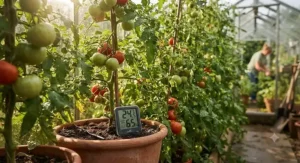
The Boulton Small Digital Hygrometer takes a different approach: rather than trying to be a full weather station, it’s a genuinely compact mini unit designed to sit inside a propagator lid, a cold frame, or a small greenhouse cabinet without eating up growing space. Its LCD includes a simple smiley/frowny face icon system alongside the numeric readout, which sounds gimmicky until you’re checking humidity at a glance from across the greenhouse without your reading glasses.
What the spec sheet won’t tell you outright is that this compact form factor comes with a trade-off: a smaller display means smaller digits, so while it’s ideal tucked into a tight space, it’s not the model to choose if you want to check readings from the greenhouse doorway. Based on the spec comparison with larger units in this list, the Boulton earns its place through footprint rather than feature depth — it’s aimed squarely at growers running multiple small propagators or a compact lean-to greenhouse where every centimetre of bench space counts. Aggregated review sentiment describes the unit as reliable for its size and price, with the most common praise centring on how easily it fits into confined spaces; the most common gripe is battery access, which some reviewers find fiddly compared with larger models.
Pros:
- ✅ Compact footprint fits inside propagators and cold frames
- ✅ Simple face-icon comfort indicator, glance-readable
- ✅ Genuinely budget-friendly price point
Cons:
- ❌ Small digits, harder to read from a distance
- ❌ Fiddly battery compartment on some units
Priced under £10 in most listings, this is squarely a best hygrometer under £20 candidate for anyone prioritising size over screen real estate.
3. ETI Electronic Temperature Instruments Max/Min Greenhouse Thermometer — best for durability from a British manufacturer
ETI Electronic Temperature Instruments Ltd is a genuine UK-based instrument manufacturer, and its greenhouse-specific max/min thermometer has become something of a fixture on allotments and in domestic greenhouses across the country — it carries a large volume of ratings on amazon.co.uk and an average well above four stars. The model measures across a wide -20°C to 69.9°C range at 0.1°C precision, and its compact ABS case includes a built-in roof to shield the display from direct rain and condensation drip.
This is worth flagging honestly: ETI’s core greenhouse thermometer line is primarily a temperature instrument with max/min memory, and buyers specifically wanting a combined humidity reading should check the individual listing carefully, as ETI also sells dedicated “healthy living” thermometer-hygrometer combos with comfort-zone indication. What most buyers overlook about this brand is that it isn’t a generic import — it’s a British instrument company with a long history of calibrated temperature and humidity sensors, which carries real weight if you want a UK-built device with UK-based customer support rather than an overseas reseller. Reviewers consistently note the housing survives years of exposure to greenhouse condensation and UV without the casing yellowing or cracking, a common failure point on cheaper plastic units.
Pros:
- ✅ Genuine UK manufacturer with long instrument-making history
- ✅ Durable housing rated for damp, high-UV greenhouse conditions
- ✅ Wide, precise measuring range with hanging slot for easy mounting
Cons:
- ❌ Core greenhouse model is temperature-led, check for hygrometer variant
- ❌ No backlight or app connectivity
Typically priced in the £15-£25 range, it’s a strong pick for growers who value long-term reliability and provenance over smart features.
4. DOQAUS Digital Hygrometer — best hygrometer under £20 for dim greenhouses
The DOQAUS Digital Hygrometer targets the same budget bracket as the TempPro TP50 but differentiates itself with a backlit display and a fast refresh rate, with some listings claiming updates as quick as three to five seconds. In a greenhouse tucked under trees or a shed with limited natural light, that backlight genuinely changes how usable the device is day-to-day; squinting at an unlit LCD through condensation on the inside of a propagator lid gets old fast.
Based on the spec comparison with the other budget entries here, the DOQAUS trades a touch of brand recognition for a slightly faster refresh and better low-light readability, which in practice matters more for anyone checking readings early morning or at dusk. Its max/min recording function works the same way as competitors in this bracket, logging the highest and lowest points over a 24-hour cycle so you can catch a humidity spike that occurred while you weren’t watching. Aggregated customer sentiment on Amazon skews positive for accuracy and ease of setup, with the most frequently cited drawback being that the plastic stand feels less sturdy than metal-backed rivals, particularly if the unit gets knocked while working on staging nearby.
Pros:
- ✅ Backlit display, genuinely useful in dim greenhouses
- ✅ Fast refresh rate for real-time humidity swings
- ✅ Max/min memory logs overnight extremes automatically
Cons:
- ❌ Plastic stand feels less robust than pricier rivals
- ❌ No app or remote monitoring option
Sitting under £15 in most listings, this is another genuine best hygrometer under £20 contender, particularly for anyone whose greenhouse doesn’t get strong natural light.
5. SMARTRO SC42 Professional Digital Hygrometer — best mid-range pick for calibrated accuracy
The SMARTRO SC42 positions itself a rung above the entry-level units through a claimed pre-calibration process and a built-in sensor the manufacturer describes as Swiss-sourced, with a stated temperature tolerance of around ±0.5°F and humidity tolerance of roughly ±2% RH across a 1-99% RH range. Its 3.5-inch backlit LCD is genuinely large by the standards of this category, and a single touch on the top activates ten seconds of backlighting — a small but useful detail if you’re checking readings with muddy gloves on.
Here’s what the spec sheet means for a real grower: a ±2% RH tolerance sounds like a small number until you consider that the difference between “comfortable” and “damping-off risk territory” for seedlings can be a swing of only ten to fifteen percentage points, so tighter tolerance genuinely buys you earlier warning. Based on this reasoning, the SMARTRO SC42 suits growers who’ve been burned by an inaccurate cheap unit before and want documented calibration claims behind their purchase, rather than those simply wanting a rough indication. Reviewers consistently report the large display is easy to read from across a greenhouse bench, while a recurring criticism in aggregated feedback concerns the touch-backlight function occasionally activating accidentally when the unit is bumped.
Pros:
- ✅ Tighter stated accuracy tolerance than budget rivals
- ✅ Large 3.5-inch backlit display, readable at distance
- ✅ 24-hour and all-time max/min memory built in
Cons:
- ❌ Touch-backlight can trigger accidentally when knocked
- ❌ No wireless or app connectivity at this price point
Expect to pay in the £15-£25 range, making it a sensible step up for anyone who’s outgrown a basic budget unit.
6. Govee H5075 Bluetooth Hygrometer Thermometer — best for remote app monitoring
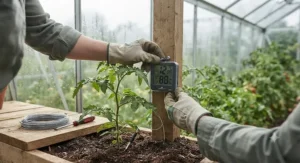
The Govee H5075 moves the category into smart-home territory. It pairs over Bluetooth with the free Govee Home app, offering a claimed range of up to 60 metres — Govee itself notes that greenhouse glass and walls will reduce this in practice, so treat that figure as a best-case scenario rather than a guarantee. The genuine appeal here is the ability to check greenhouse conditions from the kitchen table rather than walking down the garden every time you’re curious, plus two years of free data storage and export for anyone who wants to chart humidity trends over a full growing season.
What the spec sheet doesn’t fully convey is how this changes the day-to-day habit of monitoring: instead of remembering to physically check a dial, you get a push notification the moment humidity crosses a threshold you’ve set, which is exactly the kind of early warning that can prevent damping off disease from taking hold overnight while you’re asleep. Based on the spec comparison with wired or standalone units, the trade-off is dependence on a phone app and Bluetooth range, which several reviewers note becomes unreliable through brick walls or across larger gardens; aggregated sentiment is broadly positive on accuracy and ease of initial setup, with occasional complaints about the app’s graph interface feeling cluttered.
Pros:
- ✅ Remote phone alerts catch humidity spikes early
- ✅ Two years of free data logging and export
- ✅ Genuinely useful for multiple locations via the app
Cons:
- ❌ Bluetooth range drops significantly through walls/glass
- ❌ Requires a phone and app, less “instant glance” than analogue-style units
Priced in the £20-£30 range, this is the pick for anyone who wants to stop making special trips to the greenhouse just to check a number.
7. Inkbird IBS-TH1 Thermometer and Hygrometer Data Logger — best for serious growers wanting logged data
The Inkbird IBS-TH1 is built for growers who want more than a snapshot reading — it’s a genuine data logger, capable of storing up to 30,000 data points and exporting them as a CSV file by email, which means you can build a real record of how your greenhouse’s humidity actually behaved across a whole propagation season rather than relying on memory. An optional external waterproof probe extends its usefulness beyond air humidity into compost moisture and liquid temperature monitoring, and pairing an optional WiFi gateway extends its Bluetooth-only range into full remote monitoring from anywhere with an internet connection.
Based on this level of logging capability, the Inkbird IBS-TH1 genuinely earns the “for serious growers” tag rather than it being a marketing line — anyone running a propagation business, entering produce for show, or simply obsessive about germination rates will find real value in being able to cross-reference a failed sowing against the exact humidity and temperature record from that week. Reviewers consistently praise the flexibility of connecting multiple sensors to one phone and the depth of the exported data, while a common theme in feedback is that the base unit’s Bluetooth-only range (without the optional gateway) limits it to fairly close-range monitoring, similar to the Govee above.
Pros:
- ✅ Genuine 30,000-point data logging with CSV export
- ✅ Optional external probe for compost or liquid readings
- ✅ Expandable to full WiFi remote monitoring via gateway
Cons:
- ❌ Bluetooth-only range without the optional paid gateway
- ❌ Steeper learning curve than a simple LCD unit
At around £25-£40 for the base unit, plus extra for the gateway, this sits at the premium end of this list, aimed at growers who treat their sowing records seriously.
Top 7 Products at a Glance: Specs and Value
| Model | Refresh Rate | Range/Accuracy | Ideal Buyer |
|---|---|---|---|
| TempPro TP50 | ~10s | ±2-3% RH | Budget all-rounder |
| Boulton Small Digital Hygrometer | Standard | Compact-focused | Small propagators |
| ETI Max/Min Greenhouse Thermometer | Continuous | ±0.1°C precision | Long-term durability |
| DOQAUS Digital Hygrometer | ~3-5s | Standard budget range | Low-light greenhouses |
| SMARTRO SC42 | ~10s | ±2% RH claimed | Calibration-conscious buyers |
| Govee H5075 | Continuous, app-based | App-reported accuracy | Remote monitoring |
| Inkbird IBS-TH1 | Adjustable interval | Data-logged accuracy | Serious record-keeping |
The pattern across this table is fairly clear: refresh rate and stated accuracy cluster tightly among the budget and mid-range units, so the real differentiator as you spend more is what happens to the data after it’s captured — whether it simply displays, gets logged, or gets pushed to your phone as an alert. For a grower who checks their greenhouse daily anyway, that extra layer may add little; for anyone who travels, works away from home, or simply forgets to check, it’s the difference between catching a problem in hours rather than days.
How to Choose a Digital Hygrometer for Greenhouse Use
- Decide whether you need remote alerts or a simple reading. If your greenhouse is a two-minute walk from the back door and you check it daily anyway, a basic under-£20 unit like the TempPro TP50 or DOQAUS covers the essentials; if it’s at an allotment or you travel, the Govee’s app alerts earn their higher price.
- Check the stated accuracy tolerance, not just the price. A ±5% RH swing sounds trivial until you realise it can mask the difference between safe and disease-risk conditions for tender seedlings — models like the SMARTRO SC42 that publish tighter tolerances are worth the small premium for propagation work specifically.
- Match the display to your greenhouse’s light levels. Sheds and greenhouses under overhanging trees genuinely need a backlit model; a bright south-facing aluminium greenhouse doesn’t.
- Consider whether you need logged history or just a live reading. Max/min memory (standard on most models here) tells you what happened overnight; full data logging like the Inkbird offers is really only necessary if you’re troubleshooting a recurring problem or keeping formal records.
- Think about physical mounting. Magnetic backs suit metal-framed greenhouses; freestanding units suit wooden staging; compact models suit propagator lids where space is at an absolute premium.
- Factor in battery access and weatherproofing. A greenhouse hygrometer left in situ over winter needs a reasonably sealed casing — the ETI’s rain-shielding roof design is a good benchmark to compare other listings against.
- Don’t overspend on connectivity you won’t use. If you’re not going to install and check an app regularly, that spend is better put toward a second unit for a different propagator or cold frame.
What Is Relative Humidity? (And Why It’s the Number That Matters)
Relative humidity, or RH, is the percentage of water vapour currently in the air compared with the maximum the air could hold at that specific temperature. It’s a relative measure precisely because warm air can carry far more moisture than cold air before becoming saturated, which is why greenhouse RH can swing dramatically across a single day without a single drop of extra water being added — the same absolute moisture content reads as a much higher percentage once the air cools overnight.
This matters enormously for greenhouse growers because it’s genuinely counterintuitive at first: a greenhouse that feels dry and warm at 2pm can hit dangerously high relative humidity by 6am simply because the temperature has dropped, even though no additional water vapour has been introduced. This is precisely why overnight humidity spikes catch so many growers off guard, and it’s exactly the pattern a hygrometer with max/min memory is designed to flag. Most general growing guidance suggests aiming for somewhere around 40-60% relative humidity for established plants, rising to 70-90% for propagation and unrooted cuttings, though the ideal figure shifts depending on what’s being grown and its growth stage.
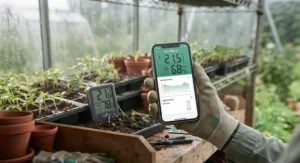
Damping Off Disease: The Silent Seedling Killer
Damping off is the single biggest reason UK seed-starters lose a tray of seedlings overnight without warning. According to RHS advice on damping off, it’s a disease caused by several different soil-borne fungi and fungus-like organisms, including Pythium, Phytophthora, Rhizoctonia, and Fusarium, which infect seedlings and cause them to collapse and decay — and critically, the RHS notes it can affect most seedlings particularly under conditions of high humidity combined with poor air circulation and overly thick sowing.
There are two forms worth knowing, because they look completely different. Pre-emergence damping off happens before the seedling even breaks the soil surface — seeds simply rot and never appear, which is often mistaken for poor seed viability rather than disease. Post-emergence damping off is the more visually dramatic version: seedlings that were standing fine the previous evening are found collapsed, often with a visible mass of white fungal growth at the base, typically within hours. Damping off can also produce “wire-stem,” where surviving seedlings develop thin, tough stems and reduced vigour rather than dying outright.
This is where a digital hygrometer for greenhouse use earns its keep as a genuine disease-prevention tool rather than just a nice-to-have gadget. Because damping off thrives specifically in high humidity with stagnant air, catching a reading that’s crept above 85-90% RH inside a closed propagator gives you the chance to crack the vents before the fungal window opens, rather than discovering the damage the next morning. It won’t eliminate risk on its own — good hygiene, thin sowing, and using fresh compost matter just as much — but it turns disease prevention from a guessing game into a monitored process.
Propagator Ventilation: Getting the Balance Right
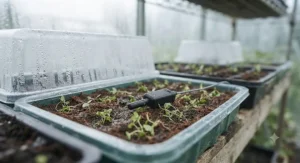
A propagator, as the RHS describes it, is a portable structure with a vented or unvented lid designed to create a humid, slightly warmer atmosphere that helps seeds germinate and cuttings root — and the vent is doing more work than most first-time growers realise. Sealed too tightly for too long, that same humid microclimate that helps germination becomes the exact stagnant, saturated environment that damping off needs to take hold.
The practical routine most experienced growers settle on is cracking the vents (or lifting the lid entirely) for a short period once or twice a day, particularly once seedlings have emerged and no longer need maximum humidity to germinate. This is precisely the point at which a compact hygrometer tucked inside the propagator lid, such as the Boulton or DOQAUS models above, becomes genuinely useful rather than just interesting: instead of ventilating on a fixed schedule regardless of conditions, you can crack the vent when the reading actually climbs into risk territory and leave it sealed when humidity is sitting comfortably. Reviewers of several compact hygrometer models specifically mention using them this way — placed directly inside a propagator or seed tray dome — rather than as a general room thermometer, which tells you a great deal about how gardeners actually use these devices in practice.
Practical Usage Guide: Setting Up and Reading Your Greenhouse Hygrometer
Getting a new digital hygrometer for greenhouse use working properly takes about ten minutes, but a few small missteps in that first setup can leave you trusting a number that’s quietly wrong for weeks.
Start by positioning the unit correctly before you even switch it on. Avoid mounting it in direct sunlight, right next to the door, or directly above heating pipes or a propagator’s heat mat, since all three will skew the local reading away from the average conditions your plants actually experience. Greenhouse staging at roughly plant height, away from direct sun and draughts, is the standard placement recommended across most manufacturer instructions and gardening forums alike.
Once mounted, give the sensor 15-30 minutes to acclimatise before trusting the first reading, particularly if it’s just come out of a cold delivery box into a warm greenhouse. If you’re using a heated propagator alongside your hygrometer, it’s worth reading the RHS’s own guidance on growing in a greenhouse, which explains how a vented, thermostatically controlled propagator lid is specifically designed to hold that warm, humid germination environment without tipping into disease territory. Many budget models, including several in this list, include a manual calibration adjustment (sometimes accessed via a small reset pinhole or button combination) — it’s worth checking the reading against a second cheap hygrometer or a known reference point if precision genuinely matters for your propagation work. For the first thirty days, get into the habit of checking the reading at roughly the same time each morning and evening; this is when most growers start to notice their greenhouse’s actual humidity pattern rather than relying on assumptions, and it’s a good early-warning period for spotting a unit that’s drifted or was miscalibrated from the factory.
Common first-month mistakes worth avoiding: mounting the sensor too close to a water butt or damping-down area, which will read artificially high; forgetting to replace the included demo battery with a fresh one, which some budget units ship with; and checking the reading only once a day, which misses the overnight humidity spikes that matter most for damping off prevention. Basic maintenance is minimal — wipe the casing occasionally to keep the vents on the back (where the sensor actually breathes) free of dust and condensation residue, and replace the battery roughly once a year for models in regular use, more often for Bluetooth models that are constantly transmitting.
Real-World Scenarios: Which Hygrometer Suits Which Grower
The weekend allotment grower, checking in perhaps twice a week and mainly worried about seed trays surviving until the next visit, is generally best served by a mid-range unit with strong max/min memory, such as the SMARTRO SC42, so a single visit reveals the full picture of what’s happened since the last one, rather than only the current moment.
The city-dwelling greenhouse hobbyist with a small lean-to or cold frame in a compact garden, checking conditions daily but wanting the reassurance of an alert if something goes wrong while at work, is the clearest use case for the Govee H5075’s app-based monitoring — the ability to glance at a phone during a lunch break rather than waiting until evening genuinely changes response time to a developing problem.
The dedicated propagator running multiple seed trays and taking cuttings through spring, who wants to build a real understanding of exactly what conditions produced their best germination rates, is the natural fit for the Inkbird IBS-TH1’s logging capability — cross-referencing a bumper tray of tomato seedlings against the exact humidity record from that week turns propagation from guesswork into a repeatable process across seasons.
Common Mistakes When Buying a Greenhouse Hygrometer
Buying based on price alone, without checking the stated accuracy tolerance, is the most common misstep — a £6 unit with no published tolerance figure is a gamble, whereas several of the sub-£15 models in this guide, including the TempPro TP50, do publish specific accuracy claims worth comparing.
A second frequent error is buying a single unit and expecting it to represent conditions across an entire greenhouse. Humidity varies meaningfully between floor level, staging height, and the closed environment inside a propagator lid, so growers running serious propagation setups often end up with two or three inexpensive units placed at different points rather than one expensive unit in a single spot.
Finally, overlooking battery type and access is a small thing that becomes a real annoyance — some compact models bury the battery compartment under the mounting bracket, meaning a routine battery change requires unscrewing the whole unit from the wall, which several reviewers across multiple budget models flag as an avoidable design oversight.
Long-Term Cost and Maintenance
The ongoing cost of running a digital hygrometer for greenhouse use is genuinely modest. A basic single-battery unit like the TempPro TP50 or Boulton typically runs a year or more on one AAA or button-cell battery under normal use, putting annual running costs at well under £2. Bluetooth-connected units like the Govee H5075 draw more power due to constant wireless transmission, so expect battery changes roughly twice as often, though this remains a minor cost against the value of early problem detection.
The real return on investment isn’t in the running cost, though — it’s in what one prevented tray of lost seedlings is worth. A packet of quality tomato or chilli seed, plus compost, propagator space, and several weeks of growing time, easily exceeds the entire purchase price of even the priciest hygrometer on this list, several times over. Viewed that way, total cost of ownership across a multi-year greenhouse life easily justifies even the premium Inkbird option for anyone taking propagation seriously, while the budget picks pay for themselves the very first time they flag an overnight spike you’d otherwise have missed.
Features That Actually Matter (And Those That Don’t)
Accuracy tolerance and refresh rate genuinely matter, because both determine how quickly and precisely you catch a developing problem — a unit that updates every ten seconds with a tight tolerance will flag a damping-off-risk spike hours before one that refreshes slowly or has a wide error margin.
Max/min memory matters more than most buyers initially expect, since the overnight reading you never see live is usually the one that catches seedlings out. App connectivity and Bluetooth range, by contrast, matter far less than the marketing suggests for most home growers — they’re a genuine convenience for the specific scenario of monitoring while away from the greenhouse, but they add nothing to raw measurement accuracy, and several reviewers across the smart models in this guide note the app layer occasionally introduces its own friction (pairing issues, cluttered graphs) that a simple LCD screen never has to contend with. Backlighting is worth paying for if your greenhouse is genuinely dim; it’s an irrelevant spec if yours sits in full sun.
Buyer’s Decision Framework
If you check your greenhouse daily and just want a reliable number, choose a basic sub-£20 model like the TempPro TP50 because the accuracy is comparable to pricier options and you’ll be reading it in person anyway.
If your greenhouse sits somewhere you can’t visit daily, choose the Govee H5075 because remote alerts genuinely change your response time to a developing humidity spike.
If you’re serious about propagation and want to understand exactly what conditions produce your best results, choose the Inkbird IBS-TH1 because logged historical data is the only way to reliably cross-reference outcomes against conditions across a season.
If your priority is a compact unit that fits directly inside a propagator lid, choose the Boulton Small Digital Hygrometer or DOQAUS Digital Hygrometer because their small footprint and (for the DOQAUS) backlight suit that confined, low-light use case specifically.
Digital vs Analogue Greenhouse Hygrometers
The case for digital over analogue is fairly clear-cut for anyone starting from scratch today. Analogue dial hygrometers, which rely on a coil of hair or synthetic fibre that expands and contracts with humidity, are notoriously prone to drift and typically need manual recalibration every few months to stay accurate — a maintenance chore most growers simply never get around to, which quietly undermines the whole point of owning one. Digital sensors, by contrast, use capacitive or resistive electronic sensors that hold calibration far longer and refresh their reading in seconds rather than the sluggish response of a mechanical coil.
Where analogue units still hold appeal is aesthetic and battery-free operation — a traditional brass-cased dial hygrometer looks the part in a Victorian-style greenhouse and never needs a battery change. But for the specific job this article is focused on, catching humidity swings early enough to prevent damping off disease, the faster refresh and tighter tolerance of a digital hygrometer for greenhouse use makes it the more practical choice for anyone growing seriously rather than decoratively.
Safety and Practical Considerations
Most digital hygrometers sold for greenhouse use run on standard AA, AAA, or button-cell batteries and carry no significant safety considerations beyond standard battery handling — keep spares away from children, as several product listings note, and dispose of old batteries through proper recycling points rather than general waste. For anyone running electrical propagator heat mats alongside a hygrometer, it’s worth noting that condensation is the main practical hazard in a greenhouse electrical setup generally, which is precisely the kind of high-humidity condition these devices are designed to help you avoid in the first place, closing the loop nicely between monitoring and genuine risk reduction.
Frequently Asked Questions
❓ What humidity level is best for a greenhouse?
❓ How accurate are cheap digital hygrometers?
❓ Can I use a digital hygrometer inside a heated propagator?
❓ Do I need Bluetooth or app connectivity for a greenhouse hygrometer?
❓ How do I stop damping off disease in seedlings?
Conclusion
A digital hygrometer for greenhouse use is a small purchase that solves a genuinely large problem: the invisible humidity swings that silently wipe out seedling trays and encourage fungal disease long before any visible symptom appears. Whether you land on a budget-friendly best hygrometer under £20 pick like the TempPro TP50 or Boulton, a rugged British-made ETI unit, or a fully connected Govee or Inkbird setup for remote and logged monitoring, the underlying principle stays the same — you can’t manage what you can’t measure, and relative humidity is precisely the kind of variable that feels invisible until it’s already caused damage.
The seven models covered here span the realistic range of what UK growers are actually buying on amazon.co.uk today, from sub-£10 compact units through to serious data-logging kit, and each earns its place for a genuinely different type of grower rather than simply competing on price. Match the choice to how often you visit your greenhouse, how seriously you’re propagating, and how dim or bright your growing space is, and the right pick becomes fairly obvious. At the time of research, current prices and availability can be checked directly on the linked listings, since Amazon pricing shifts regularly.
✨ Don’t Miss These Exclusive Deals!
🔍 Take your greenhouse growing to the next level with these carefully selected digital hygrometers. Click on any highlighted model above to check current pricing and availability on amazon.co.uk. A few pounds spent now could save an entire season’s seedlings from damping off disease!
Recommended for You
- Min Max Thermometer for Greenhouse: 7 Picks That Actually Work (2026) Slug
- Best Greenhouse Thermometer 2026: 7 Top Rated Picks Tested
- Best Grow Tent Kit UK 2026: 7 Complete Kits Compared; Rated
Disclaimer: This article contains affiliate links. As an Amazon Associate, I earn from qualifying purchases. If you purchase products through these links, we may earn a small commission at no additional cost to you.
✨ Found this helpful? Share it with your friends! 💬🤗
