
In This Article
There’s a particular kind of heartbreak that only gardeners understand: walking out to the greenhouse on a bright March morning, coffee in hand, only to find every seedling on the bottom shelf collapsed into a sad, blackened heap. You didn’t need a weather app to warn you. You needed a min max thermometer for greenhouse use, sat quietly on the staging, keeping a record while you slept.
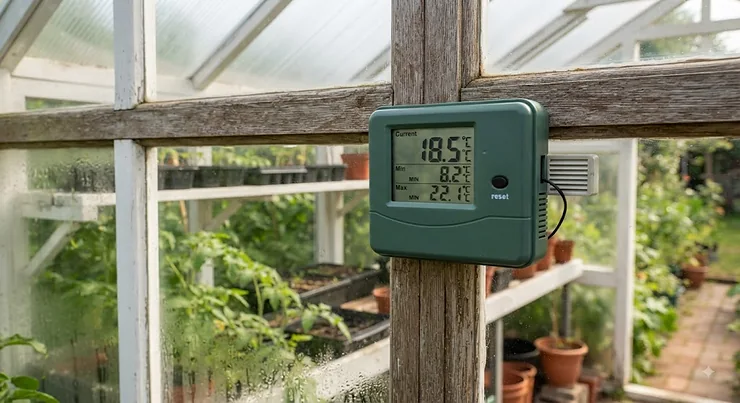
A min max thermometer for greenhouse monitoring does one job brilliantly: it remembers the coldest and warmest moments since you last checked it, even though you weren’t there to see them happen. That’s the whole trick. Your greenhouse might swing from 4°C at 6am to 34°C by 2pm on the same March day, and a standard thermometer only ever tells you what’s happening right now, at the exact second you glance at it. A max-min unit fills in the blanks — and those blanks are usually where the damage happens.
This guide walks through seven genuinely available thermometers, from budget digital basics to wireless setups you can check from the kitchen, plus the practical detail nobody puts on the box: how to actually use one, when it earns its keep, and which mistakes cost gardeners their tomato crop every single spring. All prices mentioned are indicative ranges only — always check current pricing at the time of purchase, as retail prices shift constantly.
What is a min max thermometer for greenhouse use? It’s an instrument — digital or traditional — that records and displays the highest and lowest temperatures reached over a set period, alongside the current reading, so gardeners can spot overnight frost risk or midday overheating without standing guard around the clock.
Quick Comparison Table
| Thermometer | Type | Best For | Price Range |
|---|---|---|---|
| Brannan Digital Max Min Greenhouse Thermometer (Green) | Digital, wired display | Budget all-rounder | Under £20 |
| Brannan Waterproof Digital Max Min Thermometer | Digital, weatherproof | Exposed or unheated greenhouses | £15-£25 range |
| Brannan Max Min Thermometer and Hygrometer | Digital, temp + humidity | Seedling and cutting propagation | £15-£25 range |
| Brannan Digital White Greenhouse Thermometer (with roof) | Digital, roofed housing | Style-conscious display units | £15-£25 range |
| TempPro TP50 Digital Thermo-Hygrometer | Digital, compact | Small greenhouses and cold frames | Under £15 |
| ThermoPro TP63B Wireless Indoor Outdoor Thermometer Hygrometer | Wireless, remote sensor | Checking readings from indoors | £25-£40 range |
| STOWBERRY Digital Max Min Greenhouse Thermometer | Digital, wall-mounted | Lesser-known budget alternative | Under £15 |
Looking across this table, there’s a clear split between fixed-display units you read in person and wireless models that beam data to a base station indoors. Budget doesn’t necessarily mean compromise here — several sub-£20 units cover the essentials perfectly well, and the jump in price mostly buys you convenience (not checking the greenhouse in your dressing gown) rather than dramatically better accuracy. If your greenhouse sits at the far end of the garden and winter mornings are, frankly, miserable, the wireless option earns its premium fast.
📱 Ready to stop guessing and start tracking? Compare these seven models properly below and pick the one that matches your greenhouse setup.🤗
Top 7 Min Max Thermometers for Greenhouse Use: Expert Analysis
1. Brannan Digital Max Min Thermometer — reliable British-made budget classic
The Brannan Digital Max Min Thermometer has been a fixture on greenhouse staging for years, and its no-nonsense approach is exactly why. Brannan has manufactured thermometers since 1913, and that heritage shows in the build quality even at this end of the price bracket.
The unit covers a temperature range of -20°C to 50°C with an accuracy of around ±1°C, which is more than sufficient for spotting a frost warning or a heatwave spike in a domestic greenhouse. It runs on a single AAA battery, included in the box, and the dimensions (roughly 21 x 7 x 3.5cm) make it easy to mount on staging or hang from a hook without it dwarfing the space. What most buyers overlook about a unit like this is that the resolution matters more than the headline range — a thermometer that only reads in whole degrees can mask a borderline frost that a 0.1°C model would catch.
This is the pick for anyone starting out with a min max thermometer for greenhouse use who wants a trustworthy result without overthinking the purchase. It suits allotment growers, hobbyists with a single 6x8ft greenhouse, and anyone replacing an ageing spirit-filled model that’s become hard to read.
Reviewers consistently note that the reset button is straightforward and the display remains legible even in low light, though a handful mention the plastic casing feels basic rather than premium — reasonable at this price point, and not something that affects the actual readings.
Pros:
- ✅ Trusted British thermometer manufacturer since 1913
- ✅ Wide -20°C to 50°C range covers real UK extremes
- ✅ Simple single-battery operation with no setup fuss
Cons:
- ❌ Basic plastic housing feels utilitarian rather than premium
- ❌ No humidity reading, so pair it with a hygrometer for propagation
At around £15-£20, the Brannan Digital Max Min Thermometer represents strong value for anyone who just needs dependable, accurate min-max data without paying for extras they won’t use.
2. Brannan Waterproof Digital Max Min Thermometer — weatherproof for exposed staging
The Brannan Waterproof Digital Max Min Thermometer takes the same core mechanism as its standard sibling and wraps it in a genuinely weatherproof casing, which matters more than it sounds for anyone with an unheated or poorly sealed greenhouse.
Spec-wise it’s near identical to the standard Brannan unit — a -20°C to 50°C range with ±1°C accuracy, powered by one AAA battery — but the sealed housing means condensation and splashback from watering cans won’t creep into the electronics. Based on the spec comparison with the non-waterproof version, the sealing is really the only meaningful difference, so you’re paying a small premium purely for durability in damp conditions.
This model is for growers whose greenhouse doubles as a potting shed, where hosepipes, damp compost bags, and open vents to the weather are part of daily life. It’s also a sensible choice for polytunnels, where humidity levels routinely sit far higher than in a glazed greenhouse.
Aggregated review sentiment points to solid long-term reliability in damp settings, with several users reporting continued accurate function after multiple growing seasons in unheated structures — though as with any battery-powered digital device, the display can fog briefly in extreme humidity swings before clearing.
Pros:
- ✅ Sealed housing resists condensation and splashes
- ✅ Same accurate -20°C to 50°C range as standard models
- ✅ Well suited to polytunnels and unheated greenhouses
Cons:
- ❌ Slight price premium over the non-waterproof version
- ❌ Still not fully submersible, so avoid direct hose contact
Priced in the £15-£25 range, this is the sensible upgrade if your greenhouse runs damp, and the value case is straightforward: cheaper than replacing a corroded thermometer every couple of seasons.
3. Brannan Max Min Thermometer and Hygrometer — the propagation specialist’s dual gauge
Where the previous two models track temperature alone, the Brannan Max Min Thermometer and Hygrometer adds relative humidity to the display — arguably the more useful upgrade for anyone raising seedlings or taking cuttings.
The humidity sensor works alongside the same reliable max-min temperature mechanism Brannan is known for, giving a combined reading that’s genuinely useful rather than a marketing add-on. Here’s what to weigh: temperature alone tells you if a seedling will survive the night, but humidity tells you whether damping-off disease and mould are creeping in — a silent killer of trays of young plants that a temperature-only thermometer will never flag.
This is the model for propagators specifically — anyone running a heated propagator, raising chillies and tomatoes from seed, or overwintering cuttings that need a stable, humid microclimate. Growers without a propagation habit will get less value from the humidity function and might prefer the cheaper temperature-only Brannan model instead.
Reviewers frequently mention using this alongside a heated propagator lid to fine-tune ventilation, opening vents when humidity climbs too high rather than guessing by feel — a genuinely practical use case that goes beyond what the box copy describes.
Pros:
- ✅ Combines max-min temperature with humidity in one unit
- ✅ Genuinely useful for spotting damping-off risk early
- ✅ Same dependable Brannan mechanism and battery life
Cons:
- ❌ Costs more than temperature-only equivalents
- ❌ Humidity accuracy is adequate, not lab-grade precision
At roughly £15-£25, it’s a smart buy specifically for propagation-focused gardeners — everyone else can likely save a few pounds with a temperature-only model.
4. Brannan Digital White Greenhouse Thermometer (with roof) — the tidy premium display piece
The Brannan Digital White Greenhouse Thermometer adds a small flip-out roof over the display, a stylistic touch that turns out to be more functional than it first appears — direct sun glare on a digital LCD screen is a genuinely common complaint among greenhouse thermometer owners.
Functionally it mirrors the standard Brannan range: -10°C to 50°C, accurate to around ±1°C, running on a single AAA battery, with a simultaneous three-way display of current, maximum, and minimum temperature. The white casing with the protective roof simply makes it more presentable, which matters if your greenhouse doubles as a garden feature or sits somewhere visible from the patio.
On paper this means you’re paying a small premium for aesthetics and glare protection rather than any real gain in measurement accuracy — worth knowing if budget is your only concern. But for anyone whose greenhouse gets direct afternoon sun on the thermometer’s usual mounting spot, the roof genuinely improves everyday readability.
Aggregated feedback describes the roof detail positively, with several buyers noting it looks smarter than expected for the price and holds up well outdoors, though a couple of reviewers found the “roof” styling slightly odd-looking on first impression.
Pros:
- ✅ Flip-out roof cuts glare and adds weather protection
- ✅ Tidy white finish suits visible or feature greenhouses
- ✅ Reliable core mechanism shared with proven Brannan range
Cons:
- ❌ Roof styling is a matter of taste, not universally loved
- ❌ Small price premium over the plain green equivalent
Sitting in the £15-£25 range, it’s a fair pick if presentation matters to you, though functionally it won’t outperform the standard Brannan model in a shaded spot.
5. TempPro TP50 Digital Thermo-Hygrometer — compact and budget-friendly for small spaces
The TempPro TP50 Digital Thermo-Hygrometer (the brand formerly known as ThermoPro) is a small, no-frills unit that packs max-min temperature recording and humidity monitoring into a genuinely pocket-sized housing.
With a 10-second refresh rate, it updates readings faster than most fixed-display rivals, and its accuracy sits around ±1°C/°F for temperature with ±2-3% for humidity — perfectly serviceable for a domestic greenhouse or cold frame. What most buyers overlook is that the compact size is a genuine advantage in a small growhouse or cold frame where a bulkier unit simply won’t fit on the available shelf space.
This is the pick for anyone with a mini greenhouse, a cold frame, or limited staging space who still wants proper max-min functionality rather than a basic single-reading thermometer. It also suits gardeners who want a spare unit to place inside a propagator lid alongside a main greenhouse thermometer.
Reviewers consistently describe the display as clear and easy to read despite the compact size, with several long-term owners reporting the original battery lasting well over a year of continuous use — a reassuring sign of genuine power efficiency rather than marketing spin.
Pros:
- ✅ Compact footprint fits tight cold frames and small greenhouses
- ✅ Fast 10-second refresh keeps readings current
- ✅ Reported long battery life from real long-term owners
Cons:
- ❌ Small display may be harder to read from a distance
- ❌ Not marketed as fully weatherproof for exposed outdoor mounting
At under £15, it’s one of the cheapest genuinely capable options here, and represents excellent value for anyone with a compact growing space.
6. ThermoPro TP63B Wireless Indoor Outdoor Thermometer Hygrometer — check the greenhouse without leaving the house
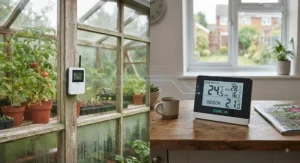
The ThermoPro TP63B Wireless Indoor Outdoor Thermometer Hygrometer is the standout pick for anyone who’s ever trudged down the garden in slippers at 7am purely to check overnight temperatures. It transmits readings from a remote sensor placed in the greenhouse to a base station you keep indoors, up to roughly 500ft away depending on obstructions.
The remote sensor is cold-resistant and built to survive genuine UK winter conditions, sending temperature and humidity data with high/low records and trend arrows so you can see at a glance whether conditions are warming or cooling. Here’s what the spec sheet won’t tell you, but reviewers note: the quoted 500ft range is measured in open, obstruction-free conditions, so a greenhouse behind a house wall or hedge will realistically deliver less — still generally plenty for most UK gardens, but worth factoring in before buying.
This is the wireless greenhouse thermometer for anyone whose greenhouse sits at the bottom of the garden, for gardeners managing multiple structures who want one base station covering several remote sensors, or simply for anyone who values not getting frost-bitten toes checking a dial at 6am in January.
Aggregated customer sentiment is strongly positive on ease of setup — no app or hub required, straightforward pairing between sensor and base — with the backlit display frequently praised for dim-morning readability. A recurring criticism is that battery life on the remote sensor drops off faster in sustained sub-zero conditions than the manual suggests.
Pros:
- ✅ Check overnight lows from indoors, no trip outside needed
- ✅ Cold-resistant sensor built for genuine UK winters
- ✅ No app or hub required, simple wireless pairing
Cons:
- ❌ Real-world range shorter than advertised through obstructions
- ❌ Sensor battery life drops in prolonged hard frost
In the £25-£40 range, this is the premium pick of the seven, and the value case is strong specifically for anyone who currently loses sleep, or loses seedlings, over not knowing what happened overnight.
7. STOWBERRY Digital Max Min Greenhouse Thermometer — the lesser-known budget alternative worth a look
The STOWBERRY Digital Max Min Greenhouse Thermometer won’t have the brand recognition of Brannan or ThermoPro, but it’s a genuine, currently listed product that covers the same fundamentals at a competitive price point, making it worth a look for budget-conscious buyers happy to step away from the bigger names.
It offers a large digital display showing high, low, and current temperature simultaneously, with a straightforward reset button and Celsius/Fahrenheit switching — the same core feature set as the established brands above, without the premium attached to a familiar name. Based on the spec comparison, there’s little functional difference between this and the entry-level Brannan model; the main trade-off is brand reputation and the depth of aftersales support behind it.
This suits budget-first buyers, gardeners buying a second or third unit to place around multiple structures without spending heavily on each one, or anyone testing whether a min max thermometer suits their routine before committing to a pricier model.
Verified review data specific to lesser-known sellers can be thinner than for established brands, and this is a case where honesty matters more than a confident claim: buyers should weigh the lower price against a shorter track record, and check current listing reviews before purchase rather than relying solely on this summary.
Pros:
- ✅ Genuinely competitive price point for core functionality
- ✅ Large, clear simultaneous high/low/current display
- ✅ Simple reset and °C/°F switching matches pricier rivals
Cons:
- ❌ Less established brand with a thinner review history
- ❌ Aftersales support likely less extensive than major brands
At under £15, it’s a reasonable budget punt, though buyers who want maximum confidence in longevity may prefer paying a little more for an established name like Brannan.
Practical Usage Guide: Getting the Most From Your Greenhouse Thermometer
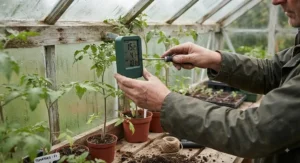
Buying the right min max thermometer for greenhouse use is only half the job — how you set it up determines whether the readings actually mean anything. Position matters more than most gardeners assume: mount the unit at plant height, roughly where your most vulnerable seedlings sit, rather than up near the roof where hot air collects and skews the maximum reading upward by several degrees. Keep it out of direct sunlight where possible, or choose a roofed model like the Brannan white unit, since direct sun on the sensor itself can inflate readings independently of actual air temperature.
Resetting is where most new owners go wrong. A max-min thermometer only tells you something useful if you reset it regularly — ideally once a day, first thing in the morning, so you capture a clean 24-hour cycle and can compare day to day. Forget to reset for a week and you’ll just see the single coldest night and single hottest day across that whole period, which flattens out useful trends. Get into the habit of checking and resetting alongside your morning watering round; it takes seconds and turns a novelty gadget into a genuinely useful monitoring tool.
Common first-30-days mistakes include mounting the thermometer too close to the greenhouse door, where draughts create artificially low minimum readings that don’t reflect conditions where your plants actually sit, and forgetting to replace the protective film some units ship with over the display, which can make readings look duller than they are. Battery maintenance is worth a mention too: cold weather drains batteries faster, so check yours going into winter rather than discovering a dead unit on the one frosty morning it mattered most.
🌱 Not sure where to mount yours? Check the full range and grab a model built for your specific greenhouse size and setup.🤗
Real-World Scenario: Which Thermometer Suits Your Greenhouse?
Picture three different gardeners, each with genuinely different needs. First, there’s Sarah, who has a modest 6x6ft greenhouse at the bottom of a suburban garden, growing tomatoes and a few chilli plants for the family kitchen. She checks the greenhouse most days anyway, so a simple, accurate fixed-display unit like the Brannan Digital Max Min Thermometer covers everything she needs without paying for wireless features she’d rarely use.
Then there’s Tom, an allotment holder with a polytunnel a fifteen-minute drive from home, who can’t pop out every morning to check overnight lows before a frost warning. For him, the case for a wireless model is much stronger in theory, but since the ThermoPro sensor’s practical range assumes he’s on-site, what he actually needs at the allotment is the rugged Brannan Waterproof Digital Max Min Thermometer, checked whenever he visits, paired with a habit of checking the Met Office forecast the night before a cold snap so he knows when a visit is worth the drive.
Finally, there’s Priya, propagating chillies and dahlias from seed every spring in a heated propagator inside her greenhouse, closely monitoring both temperature and humidity to avoid damping-off. The Brannan Max Min Thermometer and Hygrometer, or the ultra-compact TempPro TP50, both fit her propagation-focused routine far better than a temperature-only model — for her, humidity data isn’t a nice-to-have, it’s central to whether her seedlings survive to transplant.
Problem → Solution: Fixing Common Greenhouse Temperature Issues
Overnight frost damage remains the single most common reason gardeners start searching for a min max thermometer in the first place, and the fix is straightforward once you have data: track your minimum readings for a week, identify your greenhouse’s genuine frost threshold rather than guessing, and layer in horticultural fleece over vulnerable plants whenever forecast lows approach it — heavier fleece grades can add a couple of degrees of protection on their own, according to RHS guidance on fleece and crop covers.
Daytime overheating is the flip side of the same coin, and it’s just as damaging to seedlings as frost — a greenhouse can swing from near-freezing to over 35°C on a clear, sunny spring day if left sealed. Once your max readings start regularly creeping above 25-28°C, that’s your cue to add automatic vent openers or simply crack a door earlier in the day rather than waiting until the damage is visible on wilted leaves.
Seedling protection specifically benefits from a belt-and-braces approach: pair your max-min readings with a simple rule of thumb — anything under about 5°C overnight for tender young plants means moving trays to a warmer spot, propagator, or windowsill indoors rather than risking it. Reset button confusion trips up plenty of first-time owners too; if your reset doesn’t seem to be working, check you’re holding it for the full duration specified in the manual (usually two to three seconds) rather than a quick tap, and confirm you’re resetting max and min separately if your model requires it.
Finally, condensation fogging a display is a common complaint on humid mornings — wipe the display gently before reading rather than assuming the unit has failed, and consider a waterproof model if this happens regularly in your particular greenhouse.
How to Choose a Min Max Thermometer for Greenhouse Use
- Decide fixed-display or wireless first. If you’re in the greenhouse daily anyway, a fixed-display unit like the Brannan range saves money without sacrificing accuracy. If access is limited, prioritise a wireless model with genuine cold-weather sensor ratings.
- Check the temperature range against your actual climate. A -20°C to 50°C range comfortably covers the vast majority of UK conditions; anything narrower risks missing genuine extremes in an exposed or northern location.
- Consider whether you need humidity too. Propagators and anyone raising cuttings benefit substantially from a combined thermo-hygrometer; simple crop growers may not need it.
- Prioritise a clear reset mechanism. A thermometer you forget to reset, or fumble to operate, quickly becomes useless — read reviews specifically for comments on the reset button’s reliability.
- Match weatherproofing to your structure. Polytunnels and unheated, poorly sealed greenhouses benefit from a waterproof housing; a dry, well-glazed greenhouse can manage with a standard model.
- Factor in display readability in your specific light conditions. A roofed or backlit model earns its keep if your thermometer’s mounting spot gets direct sun or you’re checking readings in low winter light.
- Weigh brand reputation against price honestly. Established names like Brannan carry a track record; lesser-known budget alternatives can perform similarly but with thinner review history and support.
Min Max Thermometer vs Digital Hygrometer: What’s the Real Difference?
It’s a common point of confusion, and worth untangling properly: a min max thermometer for greenhouse use measures and records temperature highs and lows over time, while a digital hygrometer measures relative humidity — the amount of moisture in the air. Many modern units, including several featured above, are actually combined thermo-hygrometers that do both jobs from a single housing, which is why the terminology gets muddled in product listings.
For general greenhouse crop growing — tomatoes, cucumbers, bedding plants — temperature is usually the dominant concern, since frost kills faster and more dramatically than a humidity swing. A temperature-only max-min thermometer covers the essentials. But for propagation specifically, where damping-off disease thrives in overly damp, stagnant conditions, humidity data becomes just as important as temperature, arguably more so during the vulnerable first few weeks after germination.
The practical takeaway: if your greenhouse use is mostly about protecting existing plants from frost and heat stress, a temperature-only model like the standard Brannan Digital Max Min Thermometer does the job efficiently and affordably. If you’re actively germinating seed or rooting cuttings, spend the small premium on a combined unit like the Brannan Max Min Thermometer and Hygrometer or the TempPro TP50 — the humidity data will genuinely change how you manage ventilation day to day.
Wireless Greenhouse Thermometer Review: Is the Upgrade Worth It?
A wireless greenhouse thermometer solves one specific problem exceptionally well: the friction of checking readings. Fixed-display units are perfectly accurate, but they require a physical trip to the greenhouse every time you want data, which — on a wet, dark January morning — is precisely when most gardeners skip it. That’s also precisely when frost damage is most likely, so the gap between “owning a thermometer” and “actually checking it daily” matters more than the spec sheet suggests.
The ThermoPro TP63B, reviewed above, represents the wireless category well: a remote sensor in the greenhouse, a base station indoors, cold-resistant construction, and no app or subscription required. Based on aggregated review sentiment, the genuine strength of wireless models is behavioural, not technical — people simply check temperatures more consistently when it costs them nothing but a glance at a kitchen worktop, and that consistency is what actually prevents losses, not the underlying accuracy of the sensor itself.
The trade-off is cost and a slightly steeper setup process, plus the real-world range caveat covered earlier — walls, hedges, and distance all eat into the quoted transmission range. For a single small greenhouse a few metres from the back door, a wireless upgrade may be solving a problem you don’t really have. For an allotment, a distant polytunnel, or simply a household that’s proven, through experience, that they don’t reliably check a fixed unit, it’s a genuinely worthwhile upgrade.
What to Expect: Real-World Performance Through a UK Growing Season
Specs on a box rarely translate cleanly into what you’ll actually see day to day, so here’s the practical version. In early spring, expect your minimum readings to regularly flirt with, or dip below, zero on clear nights — this is precisely the pattern the Met Office has documented, noting that late frosts remain common even as average last-frost dates shift earlier under a warming climate. Don’t be caught out by a mild afternoon; the overnight radiational cooling that produces frost happens under clear skies precisely when daytime temperatures felt reassuringly warm.
Through late spring and summer, your concern flips almost entirely to the maximum reading. A sealed, south-facing greenhouse on a sunny June day can comfortably exceed 35-40°C without ventilation, which stresses or scorches plants just as effectively as a hard frost kills them. This is where a max-min thermometer earns its keep twice over in a single season — first protecting seedlings from cold in April, then flagging when your vents genuinely need opening wider in July.
Come fully into autumn, the pattern reverses again, and this is where most gardeners start losing tender plants they’d successfully nursed all summer, simply because they stopped checking once the “growing season” felt over. Keep resetting and reading through October and November; the first proper frost often arrives while gardeners are still mentally on summer mode.
Long-Term Cost & Maintenance
The genuine total cost of ownership for a min max thermometer for greenhouse use is refreshingly low. Beyond the initial purchase price, ongoing costs are limited to occasional battery replacement — typically once or twice a year for fixed-display units, and somewhat more frequently for wireless sensors used through hard winters, since cold weather is notoriously tough on battery chemistry.
Set against that modest running cost is the value of what a thermometer actually saves you: a single tray of frost-killed seedlings, or a batch of tomato plants scorched by unnoticed overheating, easily costs more in replacement seed, compost, and lost growing time than several years of thermometer batteries combined. Viewed as an ROI calculation, even the premium wireless option pays for itself the first time it prevents one genuinely costly loss.
Maintenance itself is minimal: a wipe of the display housing occasionally, checking the seal on waterproof models hasn’t perished after several seasons outdoors, and replacing batteries proactively before a known cold snap rather than reactively after a dead reading. None of the seven models reviewed here require anything resembling ongoing subscription costs or app fees, which keeps this one of the lowest-maintenance tools in a gardener’s kit.
Safety, Regulations & Compliance
Battery-powered thermometers sold in the UK fall under standard consumer electronics regulations, and reputable listings — including all seven products featured here — carry UKCA or CE marking confirming compliance with relevant safety standards for small battery-operated devices. Always dispose of old batteries responsibly through a designated recycling point rather than general household waste, in line with UK battery recycling regulations.
For anyone heating their greenhouse to protect tender plants overnight, it’s worth pairing a thermometer with sound practice rather than relying on the reading alone as a safety net. The RHS’s guidance on efficient greenhouse heating notes that keeping a greenhouse just frost-free, generally meaning above around 4°C, allows a wider range of tender plants to overwinter successfully without excessive energy costs, which is a useful benchmark to calibrate your own minimum-temperature alerts against. None of the thermometers here control heating directly, so treat them as monitoring tools that inform your decisions, not as an automated safety system on their own.
Features That Actually Matter (And Those That Don’t)
Cutting through the marketing language on greenhouse thermometer listings, a few features consistently matter in practice: an accurate, wide temperature range genuinely covering UK extremes; a reset mechanism that’s easy to operate without a manual in hand; and, for wireless models, a cold-rated sensor rather than a standard indoor-outdoor unit repurposed for greenhouse use. Display size matters more than most buyers initially rate it, particularly for anyone checking readings quickly on a cold, dim morning without lingering.
Features that generate more marketing copy than practical value include ultra-high accuracy claims beyond ±0.5°C, which simply isn’t necessary for deciding whether to cover your seedlings, and elaborate app integrations for what is fundamentally a simple two-number reading task. Multiple placement options (tabletop, magnetic, wall-mount) are a genuinely nice touch for flexibility but rarely a deciding factor — most gardeners settle on one mounting spot and leave the thermometer there for years.
FAQ
❓ What temperature is too cold for a greenhouse overnight?
❓ How often should I reset a max min thermometer?
❓ Do I need a separate hygrometer for my greenhouse?
❓ Where should I position a greenhouse thermometer?
❓ Are wireless greenhouse thermometers accurate in winter?
Conclusion
A min max thermometer for greenhouse use is a small, unglamorous purchase that punches well above its price tag. Whether you go for the dependable simplicity of the Brannan Digital Max Min Thermometer, the propagation-friendly Brannan Max Min Thermometer and Hygrometer, or the convenience of checking readings from the kitchen with the ThermoPro TP63B Wireless Indoor Outdoor Thermometer Hygrometer, the underlying goal is the same: turning invisible overnight risk into a number you can actually act on.
The right choice ultimately comes down to how you garden. Daily visitors to a nearby greenhouse rarely need wireless convenience; allotment holders and anyone managing a distant structure will feel the benefit almost immediately. Propagators need humidity data; general crop growers can save money without it. Whatever you choose from the seven genuine options covered here, the habit of checking and resetting regularly matters more than any single spec — that daily glance is what actually keeps seedlings alive through an unpredictable British spring.
🌡️ Ready to stop losing plants to surprise frosts?
Revisit the comparison table above and pick the model built for your greenhouse today.
Recommended for You
- Best Greenhouse Thermometer 2026: 7 Top Rated Picks Tested
- Best Grow Tent Kit UK 2026: 7 Complete Kits Compared; Rated
- Best Medium Grow Tent UK 2026: 7 Top Picks That Actually Deliver
Disclaimer: This article contains affiliate links. As an Amazon Associate, I earn from qualifying purchases. If you purchase products through these links, we may earn a small commission at no additional cost to you.
✨ Found this helpful? Share it with your friends! 💬🤗
