

In This Article
Ask any allotment veteran what kills more greenhouse crops than frost, and they’ll probably surprise you: it isn’t the cold, it’s stagnant, soggy air. A best greenhouse fan does a job that’s almost invisible until it stops happening — it keeps the atmosphere inside your glass or polycarbonate box moving, so heat doesn’t pool under the roof and moisture doesn’t sit on every leaf like a bad houseguest that won’t leave. Britain’s on-and-off weather doesn’t help either; one August afternoon of blazing sun can turn an unventilated greenhouse into a plant sauna within the hour.

Whether you’re nursing tomato seedlings on a windowsill-sized staging bench or running a full 8ft x 6ft aluminium structure heaving with chillies and cucumbers, the right fan changes the game. A greenhouse fan is a powered ventilation device — either an extractor that pulls stale, humid air out, or a circulator that keeps air moving internally — designed to regulate temperature, reduce humidity and support steady plant growth where passive vents alone fall short. As the RHS explains in its ventilation and shading guidance, greenhouses can overheat rapidly in sunny weather and plants need protection through both shading and proper airflow, which is exactly the gap mechanical fans are built to fill.
This guide walks through seven genuine, currently available UK products spanning budget clip-on solutions to smart app-controlled inline extractors, followed by honest analysis of how extractor and circulator fans differ, when air circulation actually stops disease in its tracks, and how to pick the right unit for a pocket-sized cold frame or a proper allotment glasshouse. No fluff, no invented reviews — just specs interpreted properly and a few hard-won opinions along the way.
Quick Comparison Table
| Product | Fan Type | Power Source | Best For | Price Range |
|---|---|---|---|---|
| AC Infinity CLOUDLINE PRO S6 | Inline extractor | Mains (EC motor) | Serious growers wanting app control | £120-£160 |
| Vent-Axia Eclipse 150X | Axial extractor | Mains | British-built mid-size all-rounder | £30-£45 |
| Xpelair VX100T | Axial extractor with timer | Mains | First-time buyers on a tight budget | Under £30 |
| SUNYIMA 16W Solar Panel Fan Kit | Solar exhaust fan | Solar/off-grid | Greenhouses with no mains power | £30-£45 |
| Vornado 460 Small Air Circulator | Air circulator | Mains | Even heat and airflow distribution | £45-£65 |
| AC Infinity CLOUDLINE T6 | Inline extractor with controller | Mains (EC motor) | Automated temperature/humidity control | £150-£190 |
| Honeywell HTF090B TurboForce | Air circulator | Mains | Budget circulation for small spaces | £25-£40 |
Looking at the spread above, there’s a clear split between extraction (moving air out entirely) and circulation (moving air around inside), and the smartest greenhouses usually end up running one of each rather than treating the two as interchangeable. Budget-conscious growers can get functional ventilation from the Xpelair VX100T or Honeywell HTF090B TurboForce for under £40, while anyone chasing hands-off automation should be looking squarely at the AC Infinity CLOUDLINE T6. The SUNYIMA 16W Solar Panel Fan Kit earns its spot for the specific scenario of allotments and sheds with zero mains access — a real dealbreaker for a lot of UK growers.
💬 Just one click — help others make better buying decisions too! 😊
Top 7 Best Greenhouse Fans: Expert Analysis
1. AC Infinity CLOUDLINE PRO S6 — best for smart, app-controlled ventilation
The standout here isn’t raw power, it’s brains: the AC Infinity CLOUDLINE PRO S6 pairs a 6-inch mixed-flow inline duct fan with an EC motor that can be tuned via a controller and, on paired models, a mobile app. Specs-wise, this is a proper extractor: the mixed-flow design with a stator blade maintains airflow even under high static pressure, which matters if you’re running ducting through a carbon filter or a tight polytunnel bend rather than venting into open air. The PWM-based speed controller lets that airflow hold steady even when static pressure builds up in longer duct runs, and the motor’s dual ball bearings are rated for tens of thousands of hours of continuous running.
Based on the spec comparison with cheaper axial fans, what most buyers overlook is that EC motors draw meaningfully less power at partial speeds than a standard AC motor throttled with a dimmer — so running it quietly overnight costs pennies rather than pounds over a season. This is the pick for polytunnel and greenhouse hybrid growers who’ve outgrown clip fans and want a controller they can actually programme, not just switch on and off. Reviewers consistently note that the S6 runs near-silently at low speeds and that build quality feels closer to lab equipment than garden kit, though a handful mention the companion app can be fiddly to pair on first setup.
Pros:
- ✅ EC motor stays whisper-quiet even at higher airflow settings
- ✅ Maintains performance under ducting and static pressure
- ✅ Long-rated bearings back a genuine multi-year lifespan
Cons:
- ❌ Meaningfully pricier than basic axial extractor fans
- ❌ App-based control adds a setup step some buyers skip entirely
In the £120-£160 range, this sits at the premium end of the market, but for anyone running expensive seedlings or a heated propagation setup, the payback in prevented losses can justify it within a single growing season.
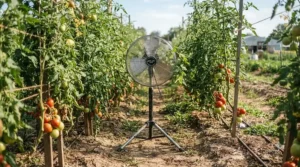
2. Vent-Axia Eclipse 150X — best British-brand value pick
Vent-Axia has been manufacturing ventilation equipment in Britain since 1936, and the Eclipse 150X reflects that no-nonsense engineering pedigree rather than flashy features. This is a 150mm (6-inch) axial extractor fan with a back-draught shutter, meaning air can only flow one way — out — which stops cold air or pests sneaking back in when the fan isn’t running. The Eclipse range of circular axial fans has been designed with a simple, unobtrusive fitting, and while that specific listing covers the smaller 100X sibling, the 150X shares the same shutter mechanism scaled up for a higher extraction rate.
What the spec sheet won’t tell you, but installer experience suggests, is that back-draught shutters like this one are worth their small extra cost precisely because greenhouses see huge day-to-night temperature swings — without a shutter, a still fan becomes a hole for cold air to pour through after sunset. This model suits growers with a permanent glass or polycarbonate structure who want a fit-and-forget extractor rather than something to fiddle with daily. Aggregated review sentiment for the Eclipse range frequently highlights the low operating noise and simple wiring, though a minority of buyers note the single-speed operation means no fine control over airflow rate.
Pros:
- ✅ Back-draught shutter blocks cold air re-entry when off
- ✅ British-manufactured with decades of ventilation experience
- ✅ Simple single-speed wiring suits straightforward installs
Cons:
- ❌ Single speed only — no way to throttle airflow down
- ❌ Needs a proper cut-out and mains spur, not just plugged in
At around £30-£45, the Eclipse 150X delivers a compelling middle ground between disposable clip fans and full smart-extraction systems.
3. Xpelair VX100T — best budget extractor with a built-in timer
If your greenhouse fan budget is closer to “one plant tray” than “one polytunnel,” the Xpelair VX100T is where most first-time buyers land. It’s a 100mm axial extractor fan with an adjustable timer running from roughly 2 to 30 minutes, which in practice means you can trigger a short burst of extraction after damping down the greenhouse floor without needing to remember to switch it off. Xpelair has decades of history in domestic extraction, and this model borrows straight from their bathroom fan range — a detail worth knowing, because it’s built for compact spaces rather than large glasshouses.
Here’s what most buyers overlook about this model: the “100mm” measurement refers to the duct size, not the blade diameter, so actual airflow volume is modest compared with a 150mm or 6-inch unit — fine for a small cold frame or a mini greenhouse, underpowered for anything larger than about 6ft x 4ft. Aggregated customer feedback is genuinely mixed on this point; some reviewers report the unit performs adequately for a small enclosed space, while others found the internal fan smaller and less forceful than the 100mm sleeve suggested, with a few noting mild rattling after extended use. That honesty matters more than a glowing headline claim would.
Pros:
- ✅ Adjustable 2-30 minute timer suits short damping-down bursts
- ✅ Genuinely affordable entry point for small setups
- ✅ Straightforward wall, window or ceiling mounting
Cons:
- ❌ Modest airflow — not suited to larger glasshouses
- ❌ Some reported rattling noise after months of use
Priced under £30, the value proposition is clear for compact greenhouses, cold frames or as a second fan supplementing a bigger circulator elsewhere in the space.
4. SUNYIMA 16W Solar Panel Fan Kit — best for off-grid, mains-free greenhouses
Not every greenhouse has a handy socket nearby, and that’s precisely the gap the SUNYIMA 16W Solar Panel Fan Kit fills. It pairs a 16W weatherproof solar panel with a DC-powered exhaust fan, meaning the whole system runs entirely off sunlight with no cabling, no RCD sockets, and no electrician required. On paper this means genuinely zero running costs, and the waterproof construction is specifically aimed at outdoor and semi-outdoor installations like allotment greenhouses, sheds and polytunnels sitting well away from the house.
Reviewers consistently note that output is directly tied to sunlight intensity, which is the honest trade-off with any solar unit: on a bright July afternoon it moves a useful volume of air, but on an overcast British winter’s day it will run slowly or not at all, right when condensation control matters most. Based on the spec comparison with mains-powered alternatives, this makes the SUNYIMA kit a strong summer-cooling solution and a weaker year-round humidity manager, so pairing it with passive vents for shoulder-season ventilation is a sensible workaround rather than a flaw unique to this unit.
Pros:
- ✅ Zero electricity costs and no cabling required
- ✅ Weatherproof build suited to standalone outdoor greenhouses
- ✅ Simple installation without an electrician
Cons:
- ❌ Airflow drops sharply on cloudy days and in winter
- ❌ Not a substitute for extraction during humid, low-light spells
In the £30-£45 range, it earns its place for anyone whose greenhouse sits at the bottom of the garden or on an allotment plot with no realistic mains access.
5. Vornado 460 Small Air Circulator — best for even air distribution, not extraction
The Vornado 460 Small Air Circulator does something genuinely different from every extractor on this list: it doesn’t remove air, it reorganises it. Vornado’s signature deep-pitched blades are engineered to project a directed airstream that, according to the brand’s own vortex-action design principle, keeps moving and mixing air across a room rather than just blowing a narrow column at whatever’s directly in front of it. In a greenhouse context, that translates to breaking up the still, humid layer that tends to sit around lower leaves and pooling at floor level.
What most buyers overlook about circulators generally is that they don’t reduce total humidity or heat at all — they simply prevent it from concentrating unevenly, which is precisely why pairing one with an extractor (rather than using it alone) delivers the biggest disease-prevention benefit. Aggregated review sentiment for the 460 consistently praises the surprisingly strong airflow from a compact unit and relatively quiet operation on lower settings, with the main recurring gripe being that the tilt head has limited adjustment range on some batches.
Pros:
- ✅ Deep-pitched blades circulate air well beyond the fan’s footprint
- ✅ Compact size suits staging benches and tight aisles
- ✅ Quiet enough for extended daytime operation
Cons:
- ❌ Doesn’t extract humid air — circulation only
- ❌ Tilt head adjustment is limited on some units
Around £45-£65, this is best bought as a companion to an extractor fan rather than a standalone ventilation solution.
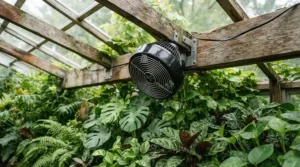
6. AC Infinity CLOUDLINE T6 — best for automated temperature and humidity control
Take everything the S6 does and add a built-in temperature and humidity controller, and you land on the AC Infinity CLOUDLINE T6. This inline duct fan uses the same EC motor and mixed-flow design as its sibling, but the controller lets you set trigger points — for instance, ramping fan speed up automatically once the greenhouse crosses a humidity threshold overnight, precisely when nobody’s around to react manually. Featuring advanced EC motor technology, PWM-controlled performance and intelligent climate automation, these systems help maintain stable temperature, humidity and airflow conditions for healthier plant growth, which is the whole point of paying the premium.
Here’s what the brochure doesn’t spell out clearly: automation only pays off if you actually calibrate the trigger points to your specific greenhouse and crop, rather than leaving factory defaults in place. Growers running late-season tomatoes or overwintering tender plants get the most value here, since the controller reacts to conditions at 3am just as reliably as at 3pm. Reviewers frequently mention that the initial setup takes patience but that, once dialled in, the hands-off reliability is the main selling point over cheaper timer-based fans.
Pros:
- ✅ Automatic response to temperature and humidity triggers
- ✅ Same efficient, quiet EC motor as the S6
- ✅ Reduces daily manual fan management to near zero
Cons:
- ❌ Highest price point on this list
- ❌ Initial calibration takes real time and attention
At £150-£190, this is squarely aimed at growers who value consistency over cost, particularly those protecting high-value or heat-sensitive crops.
7. Honeywell HTF090B TurboForce — best budget circulator for small greenhouses
Rounding out the list is the Honeywell HTF090B TurboForce, a compact, mains-powered circulator built for punchy airflow from a small footprint. Honeywell’s TurboForce line is engineered around a distinctive blade pitch designed to push air further than its physical size would suggest, and multiple fan speeds mean you can dial output up during a hot spell and back down for gentler overnight circulation. This is a genuine domestic circulator repurposed for greenhouse use, which is worth knowing since it isn’t weatherproof — best suited to a dry-ish staging area or a lean-to greenhouse rather than a damp, unheated glasshouse floor.
Based on the spec comparison with the pricier Vornado, what most buyers overlook is that multi-speed control matters more day-to-day than raw peak output, since most greenhouse circulation needs are actually on the low-to-medium setting most of the season. Aggregated reviews consistently rate the airflow-to-size ratio highly, with a common complaint being that the plastic housing feels less premium than the performance suggests.
Pros:
- ✅ Strong airflow relative to its compact size
- ✅ Multiple speed settings for seasonal flexibility
- ✅ Genuinely affordable for a circulator with real punch
Cons:
- ❌ Not weatherproof — indoor/dry areas only
- ❌ Housing feels basic compared with output quality
Typically priced in the £25-£40 range, this is the pragmatic pick for smaller greenhouses or as a second circulator supplementing a larger extraction setup.
Extractor vs Circulator Fans: What’s the Real Difference?
This is the single most confused topic in greenhouse ventilation, so let’s untangle it properly. An extractor fan, like the Xpelair VX100T or Vent-Axia Eclipse 150X, physically removes air from inside the greenhouse and pushes it outside, usually through a duct, vent, or wall-mounted housing. A circulator fan, like the Vornado 460 Small Air Circulator or Honeywell HTF090B TurboForce, moves air around within the same enclosed space without exchanging it for outside air at all.
| Factor | Extractor Fans | Circulator Fans |
|---|---|---|
| Air movement | Removes air, replaces with outside air | Recirculates existing internal air |
| Best for | Humidity removal, heat exhaust, fresh CO₂ | Even temperature, breaking up damp pockets |
| Typical price | £20-£190 | £25-£65 |
| Weatherproofing | Often required (outdoor-facing) | Rarely weatherproof |
| Works best when | Combined with intake vents | Combined with an extractor |
Reading the table, the practical takeaway is that these two categories solve different problems and, ideally, work as a team rather than a substitute for one another. An extractor without any circulation still leaves cold spots and humid pockets between plants, while a circulator without extraction just moves the same stale, moisture-laden air around in circles — improving distribution but doing nothing to actually reduce it. Growers chasing the best greenhouse extractor fan specifically should prioritise units with a back-draught shutter and adequate duct sizing for their floor area, since an undersized extractor struggles regardless of how good its motor is.
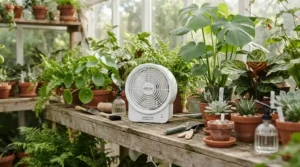
Best Greenhouse Extractor Fan Picks for Every Budget
Zooming in specifically on extraction, the seven products above split cleanly into three tiers worth calling out on their own. At the budget end, the Xpelair VX100T delivers workable extraction for small structures under £30, and its built-in timer is genuinely useful for short bursts after watering rather than running continuously. In the middle tier, the Vent-Axia Eclipse 150X brings a proper back-draught shutter and British manufacturing pedigree to a 150mm fan that suits most hobby glasshouses in the £30-£45 range without needing app pairing or a smartphone.
At the premium end, both AC Infinity CLOUDLINE models earn their higher price tags through EC motor efficiency and, in the T6’s case, genuine automation rather than just a fancier badge. The honest ROI case here: a £150 fan that reliably prevents a single ruined tray of seedlings or a season of botrytis-hit tomatoes has effectively paid for itself, whereas the same argument is harder to make if you’re only growing a few pots of basil on a windowsill greenhouse. Extraction rate, measured in m³/h or litres per second on most UK spec sheets, should roughly match your greenhouse volume being exchanged every few minutes during peak summer heat — undersizing this figure is the single most common mistake buyers make.
Best Ventilation Fan for a Small Greenhouse
Small greenhouses — think 4ft x 6ft or smaller cold frames — have a specific ventilation puzzle: they heat up disproportionately fast relative to their volume, but they also can’t accommodate large, power-hungry inline duct fans without the equipment dominating the growing space. For this scenario, the Xpelair VX100T and SUNYIMA 16W Solar Panel Fan Kit are the two standout picks from this list, precisely because both are compact enough not to eat into precious staging space while still offering genuine, if modest, extraction.
What most buyers overlook with small greenhouses specifically is that a single well-placed fan often outperforms two mismatched ones, since compact structures don’t have the volume to need multiple air paths — one clear intake (a louvre vent or slightly propped door) paired with one extractor creates a simple, effective through-flow. If your small greenhouse sits somewhere with no easy mains access, the SUNYIMA solar kit sidesteps cabling headaches entirely, though as covered earlier, its output tracks sunlight rather than need. For anyone running a compact structure indoors on a balcony or in a conservatory extension, a small circulator like the Honeywell can supplement airflow without the extraction step at all, provided humidity is otherwise manageable.
How Air Circulation Actually Protects Your Plants
It’s tempting to think of air circulation as a comfort feature, something that just makes a greenhouse feel less stuffy. In practice, moving air does measurable, specific work: it keeps leaf surfaces dry by preventing moisture from settling and sitting, it strengthens plant stems through gentle mechanical stress (a phenomenon called thigmomorphogenesis), and it evens out the microclimate so pockets of trapped heat or cold don’t stress individual plants differently from their neighbours. Reviewers and growers alike consistently note that greenhouses running a circulator alongside their vents report noticeably less leaf-surface condensation on cool mornings compared with structures relying on doors and windows alone.
The mechanism matters here more than the marketing language usually suggests. Powdery mildew and botrytis spores germinate far more readily on a leaf with a persistent film of moisture than on one that dries within an hour of dawn condensation forming — a distinction well documented in horticultural literature on powdery mildew-type fungal pathogens, whose spore germination is strongly moisture-dependent source: Wikipedia. A circulator like the Vornado 460 Small Air Circulator doesn’t dry the air, but by constantly moving it, it shortens the window during which any given leaf surface stays wet, which is exactly the window fungal spores need to establish.
Fungal Disease Prevention: Why Airflow Beats Fungicide
Every experienced grower eventually learns the uncomfortable truth that treating fungal outbreaks after the fact is far less effective than preventing the humid, stagnant conditions that cause them in the first place. Botrytis (grey mould), powdery mildew and damping-off are the three fungal problems UK greenhouse growers report most often, and all three share the same root cause: prolonged surface moisture combined with poor air exchange. A 2026 peer-reviewed study on Mediterranean greenhouse climate management found that increased natural ventilation surface, combined with passive climate management, reduced the development of naturally occurring fungal diseases in tomato, pepper and cucumber crops — direct evidence that airflow itself, not just chemical treatment, measurably suppresses disease pressure. Read the full study on ventilation and fungal disease in Mediterranean greenhouses.
What most buyers overlook when they reach straight for fungicide is that spraying without addressing airflow is treating a symptom while the underlying cause — a persistently damp, still atmosphere — remains completely unchanged, meaning the same outbreak tends to recur within weeks. Pairing an extractor fan such as the Vent-Axia Eclipse 150X with a circulator like the Honeywell HTF090B TurboForce creates the two-pronged effect that horticultural research consistently points to: humid air actually leaves the structure, and whatever moisture remains gets distributed thinly enough that it evaporates quickly rather than sitting in cold, sheltered pockets near the greenhouse floor. Combined with basic hygiene — clearing plant debris promptly and avoiding overhead watering late in the day — mechanical airflow does more disease-prevention work per pound spent than almost any other single intervention.
How to Choose the Best Greenhouse Fan: 7-Step Framework
Picking the right fan doesn’t need to be complicated if you work through it in order rather than starting with price.
- Measure your greenhouse volume first. Multiply length by width by height to get cubic metres — this single number determines whether a compact extractor or something more powerful is actually appropriate.
- Decide extraction, circulation, or both. If humidity and heat build-up are your main issue, prioritise an extractor; if uneven temperature and damp pockets are the complaint, start with a circulator.
- Check the extraction rate against your volume. Aim for the fan to be capable of exchanging the greenhouse’s full air volume every few minutes during peak summer conditions.
- Confirm your power source realistically. Mains access simplifies things considerably; without it, a solar unit like the SUNYIMA 16W Solar Panel Fan Kit becomes the only sensible route.
- Look for a back-draught shutter on extractors. This one detail, present on the Vent-Axia Eclipse 150X, prevents cold air simply flowing back in when the fan sits idle.
- Weigh automation against your available time. A controller-equipped unit like the AC Infinity CLOUDLINE T6 earns its premium mainly for growers who can’t check the greenhouse daily.
- Factor in noise if the greenhouse sits near a house or neighbour. EC-motor fans run noticeably quieter than basic AC-motor axial units at equivalent airflow.
Working through these steps in order avoids the single most common buying mistake: choosing based on price or brand recognition before establishing what the greenhouse actually needs.
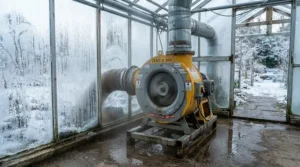
Common Mistakes When Buying a Greenhouse Fan
Even experienced gardeners fall into a handful of predictable traps when shopping for ventilation equipment, and most of them are avoidable with a bit of forethought.
Buying only one fan type. Relying solely on an extractor or solely on a circulator, rather than pairing the two, is probably the single biggest efficiency loss — as covered above, they solve different problems and complement rather than replace each other.
Ignoring duct size and static pressure. A powerful motor connected to undersized or badly routed ducting loses much of its rated airflow to resistance, which is precisely why mixed-flow designs like those in the AC Infinity CLOUDLINE range exist in the first place.
Underestimating small-greenhouse heat gain. Compact structures heat disproportionately fast relative to their volume, so a fan rated for a much larger space isn’t automatically “better” for a small one — it’s often just noisier and more expensive than necessary.
Forgetting seasonal variation. A solar-powered unit that performs beautifully in July may do almost nothing useful in November, so growers relying on year-round humidity control should factor this into their power source decision from day one.
Skipping electrical safety basics. Any mains-powered fan installed outdoors or in a damp greenhouse environment needs appropriate weatherproofing and circuit protection — a detail covered in full in the safety section below.
Practical Usage Guide: Setting Up, Running and Maintaining Your Fan
Getting a new greenhouse fan performing well from day one comes down to a handful of setup habits that most instruction leaflets gloss over. First, position extractor fans high on a gable end or roof vent wherever possible, since hot, humid air naturally rises and collects there — mounting low wastes a meaningful chunk of the fan’s effective pull. Pair every extractor with a corresponding intake, whether that’s a louvre vent, a slightly propped door, or a dedicated inlet grille on the opposite side of the structure; without a clear intake path, an extractor is simply fighting a vacuum and underperforming its rated specification.
During the first 30 days, resist the urge to run any fan continuously at full power around the clock — most units, including the AC Infinity CLOUDLINE PRO S6, are designed to modulate speed based on conditions, and constant full-throttle operation both wastes electricity and accelerates bearing wear unnecessarily. A simple maintenance schedule pays dividends: wipe down blades monthly to prevent dust and cobweb build-up that silently reduces airflow, check that back-draught shutters on units like the Vent-Axia Eclipse 150X open and close freely without sticking, and inspect any outdoor cabling for wear at least once a season, ideally before winter sets in. For solar units such as the SUNYIMA 16W Solar Panel Fan Kit, wiping the panel surface clean of pollen, dust and algae every few weeks meaningfully improves output — a detail almost never mentioned on the product packaging itself.
Real Greenhouse Scenarios: Which Fan Fits Your Setup?
The allotment beginner with a 6ft x 4ft glasshouse and no nearby power. This grower needs mains-free reliability above all else. The SUNYIMA 16W Solar Panel Fan Kit solves the access problem entirely, and pairing it with a simple propped-open door for intake gives basic but genuinely useful summer cooling without a single cable run across the plot.
The keen hobbyist running tomatoes, chillies and cucumbers in an 8ft x 6ft aluminium greenhouse with mains access. Here, a two-fan approach earns its keep: the Vent-Axia Eclipse 150X handles extraction through a roof vent, while a Honeywell HTF090B TurboForce keeps air moving between the taller crops where humid pockets tend to form around lower leaves.
The dedicated grower overwintering tender plants and running a heated propagation bench. Consistency matters most here, and manual fan management becomes a liability when conditions swing overnight. The AC Infinity CLOUDLINE T6, with its automated temperature and humidity triggers, removes the guesswork and reacts at 3am exactly as reliably as at 3pm, protecting an investment in heating and stock that a missed manual adjustment could otherwise undo.
Long-Term Cost, Electricity & Safety Considerations
Running costs vary far more between fan types than most buyers expect. EC-motor extractors like the AC Infinity CLOUDLINE PRO S6 and CLOUDLINE T6 typically draw a fraction of the power of an equivalent AC-motor unit run at reduced speed via a simple dimmer, since EC motors are engineered for efficiency across their whole speed range rather than just at full output. Over a full growing season, that difference can offset a meaningful chunk of the higher upfront purchase price, particularly for anyone running a fan for several hours daily through spring and summer.
| Consideration | Budget Fans (Xpelair, Honeywell) | Premium Fans (AC Infinity range) |
|---|---|---|
| Upfront cost | Under £40 | £120-£190 |
| Running cost per season | Low-moderate | Low (EC motor efficiency) |
| Expected lifespan | 2-5 years typical | 5+ years with proper care |
| Automation | Manual/timer only | App or trigger-based control |
The table makes the trade-off explicit: budget fans win on upfront cost but rely more on the grower’s own vigilance, while premium units shift some of that burden onto the hardware itself over a longer service life. On the safety side, any mains-powered fan installed in or near a greenhouse — an inherently damp environment — needs proper consideration of electrical risk. Electricity and water don’t mix, so electrical equipment outdoors should have RCD protection and shouldn’t be used until conditions are dry, guidance echoed across UK electrical safety resources and well worth reading in full via Electrical Safety First’s garden safety guidance before wiring any fan into an outbuilding circuit. Look for an appropriate IP rating on the fan housing itself, use weatherproof outdoor-rated cabling, and where in doubt, have a qualified electrician confirm the circuit feeding your greenhouse is properly protected.
✨ Don’t Miss These Exclusive Deals!
🔍 Take your greenhouse ventilation to the next level with these carefully selected products. Click on any highlighted item to check current pricing and availability. These fans will help you create a genuinely healthier growing space your plants (and your Sunday mornings) will thank you for!
Frequently Asked Questions
❓ Do I need a greenhouse fan if I already have roof vents?
❓ What's the best greenhouse extractor fan for a beginner?
❓ Can I use a normal household fan in my greenhouse?
❓ How many air changes per hour does a greenhouse actually need?
❓ Do solar greenhouse fans work in the UK climate?
Conclusion
There’s no single best greenhouse fan for every setup — the right choice depends on your structure’s size, your access to mains power, and honestly, how much daily attention you’re willing (or able) to give your plants. What’s consistent across every scenario, though, is that moving air does real, measurable work: it dries leaf surfaces before fungal spores can establish, it evens out the punishing heat swings a British summer throws at glass and polycarbonate alike, and it keeps plants sturdier through gentle, constant mechanical stress.
Budget buyers get genuinely usable performance from the Xpelair VX100T or Honeywell HTF090B TurboForce, mid-range growers land well with the Vent-Axia Eclipse 150X, off-grid plots are solved neatly by the SUNYIMA 16W Solar Panel Fan Kit, and anyone serious about consistency over a full season should be looking hard at the AC Infinity CLOUDLINE range. Whichever you choose, pairing an extractor with a circulator rather than relying on just one will consistently outperform either running alone — that’s less an opinion and more a straightforward reading of how airflow actually behaves inside an enclosed growing space.
Recommended for You
- Automatic Vent Opener for Greenhouse: 7 Best UK Picks (2026)
- Small Greenhouse Heater for Allotment: 7 Top UK Picks (2026)
- Electric Greenhouse Heater For Winter: 7 Proven Picks (2026)
Disclaimer: This article contains affiliate links. As an Amazon Associate, I earn from qualifying purchases. If you purchase products through these links, we may earn a small commission at no additional cost to you.
✨ Found this helpful? Share it with your friends! 💬🤗
