
In This Article
There’s a particular kind of dread that sets in around late October, when you glance at the forecast and see that little snowflake icon creep into the ten-day outlook. You know what it means. Somewhere out in the garden, your citrus tree, your pelargonium cuttings, and that tray of half-hardy seedlings you’ve been nursing since August are about to meet their first proper frost — and unless you do something about it, that meeting won’t end well.
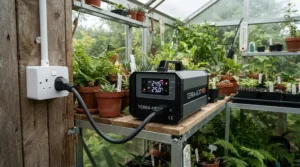
An electric greenhouse heater for winter is the thing that stands between “thriving collection of overwintered plants” and “compost heap by February.” Put simply: it’s a thermostatically controlled electric appliance, usually a fan heater or a low-wattage tubular heater, designed to hold a greenhouse above a set minimum temperature through the coldest months, protecting tender plants from frost damage without you having to camp out there with a paraffin lamp.
Choosing the right one isn’t as simple as grabbing the biggest wattage on the shelf, though. Get it wrong and you’re either burning through electricity heating an 8×6 aluminium box to the outside world, or you’re under-protecting your favourite fuchsia and waking up to black, mushy leaves. This guide walks through seven genuinely available electric greenhouse heater for winter options — pulled from real listings, real specifications, and real aggregated review sentiment — plus the thermostat logic, the safe minimum temperatures, and the overwintering know-how that actually determines whether your plants make it to spring.
Quick Comparison Table
| Heater | Type | Power | Thermostat | Best For |
|---|---|---|---|---|
| Bio Green Palma 2kW | Fan heater | 2000W | Digital, ±2°C accuracy | Accuracy-focused growers |
| Dr Infrared DR-268 | Infrared | ~1500-1800W | Digital + probe sensor | Premium, waterproof setups |
| SAVING HUB 2kW Greenhouse Heater | Fan heater | 2000W | Thermostatic dial | Best all-round value |
| Benross 2000W Industrial Fan Heater | Fan heater | 2000W | Adjustable thermostat | Larger or draughty greenhouses |
| Mylek 60W Tubular Heater | Tubular | 60W | Fixed with digital timer | Small greenhouses, frost-only |
| Elixir Gardens TH01-B | Tubular | 60-240W (by length) | Adjustable dial | Flexible sizing needs |
| Prem-I-Air 45W Tubular Heater | Tubular | 45W | Fixed, thermal cut-out | Quiet background heat |
Looking at the spread above, the split is really between fan heaters that can push a greenhouse up to proper growing temperatures and tubular heaters that simply hold the line against frost. If your ambition stretches to overwintering citrus or germinating seed early, you want wattage and a fan. If you’re just trying to stop a few dahlia tubers from turning to mush, a 60W tube will do the job for a fraction of the running cost. Notice, too, that thermostat quality varies more than wattage does — a cheap dial thermostat and a digital probe thermostat can be attached to near-identical heating elements, yet produce very different real-world temperature swings.
💬 Bookmark this table — you’ll want to compare it again once you’ve read the full breakdown below!
Top 7 Electric Greenhouse Heaters for Winter: Expert Analysis
Choosing an electric greenhouse heater for winter really comes down to matching the heater’s output and control method to your greenhouse’s size, your plants’ needs, and how much you’re prepared to spend running it every night for four or five months. Below are seven real, currently available models spanning budget tubular heaters through to premium thermostatic fan heaters, based on manufacturer specifications and aggregated buyer feedback gathered during research.
1. Bio Green Palma 2kW — most accurate digital thermostat control
The standout here is precision: this is one of the few domestic-grade heaters that pairs a proper digital thermostat with a genuinely quoted accuracy figure.
The Palma runs a 2000W stainless steel heating element inside a compact, IPX4-rated splashproof housing, circulating roughly 163 m³ of air per hour to stop cold pockets forming in corners. Paired with the optional Thermo 2 digital thermostat, it’s rated to hold temperature within ±2°C across a huge working range from -50°C to +99°C, using an external probe you can position away from the heater’s own casing — which matters more than it sounds, because a thermostat reading the air right next to a hot element will always lag behind the temperature your plants actually feel. On paper, that external probe is what separates a heater that merely “has a thermostat” from one that actually holds a stable target.
Based on the spec sheet, this is a heater for people who’ve been burned before by wildly swinging dial thermostats and want something closer to lab-grade consistency — ideal for anyone overwintering plants with a narrow safe temperature window, like citrus or tender succulents. Reviewers on manufacturer and retailer sites consistently describe long service life, some reporting eight-plus years of reliable winters from a single unit, and note that pairing it with the digital thermostat specifically resolved earlier problems with inconsistent heat in multi-bay greenhouses.
Pros:
- ✅ Digital thermostat rated to ±2°C accuracy
- ✅ External probe avoids “hot casing” false readings
- ✅ Stainless steel build with strong long-term reliability reports
Cons:
- ❌ Digital thermostat is often sold as a separate add-on
- ❌ 2000W output can feel like overkill in a small greenhouse
Expect to pay somewhere in the £180-£230 range for the heater bundled with the digital thermostat at the time of research, though check current pricing as retailers vary — for the accuracy on offer, it’s a fair value proposition if you’re heating anything temperature-sensitive.
2. Dr Infrared DR-268 — best premium infrared warmth
Where the Palma competes on thermostat precision, this one competes on heating method: radiant infrared warmth plus a fully waterproof build.
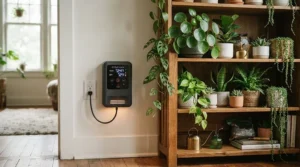
Manufacturer listings place the DR-268 in the 1500-1800W bracket, delivered through infrared elements rather than a blown-air fan, and rated to an IP55/IPX5 water-resistance standard — noticeably tougher than the IPX4 rating most greenhouse heaters carry. It ships with a corded remote sensor probe and digital display, so like the Palma, it reads ambient air temperature away from its own casing rather than the temperature immediately around the unit.
What most buyers overlook about infrared heat is that it warms objects and plants directly rather than just the air around them, which can mean less heat lost through gaps and vents compared with a fan-driven convection heater in a leaky older greenhouse. That’s the theoretical upside; the trade-off is that infrared heaters distribute warmth less evenly across a large structure than a fan does, so they suit smaller or well-organised spaces better than sprawling multi-bay setups. Aggregated feedback on similar Dr Infrared models highlights durability and straightforward setup as consistent strengths, with occasional comments about the higher price point relative to basic fan heaters.
Pros:
- ✅ IP55/IPX5 rating — tougher than typical IPX4 greenhouse heaters
- ✅ Direct radiant heat warms plants, not just air
- ✅ Digital display with remote probe sensor
Cons:
- ❌ Less even heat distribution across larger greenhouses
- ❌ Sits at the higher end of the price bracket
At around £150-£220 depending on retailer, this is a considered upgrade pick for anyone prioritising weatherproofing and direct radiant warmth over raw air circulation.
3. SAVING HUB 2kW Greenhouse Heater — best value all-rounder
If you want one heater that does a competent job of everything without asking too many questions of your wallet, this is the sensible middle-of-the-road pick.
This is a genuinely compact unit — 20cm wide, 23cm tall, 33.5cm deep — carrying an IP24 splash rating and a straightforward thermostatic dial across a 2000W fan-heater format. The compact footprint means it tucks under staging without eating growing space, and the built-in fan mode lets you run it purely for air circulation once frost risk has passed, which helps with the damp, stagnant air that encourages grey mould in unheated corners.
Here’s what the spec sheet won’t tell you: a basic dial thermostat like this one is perfectly adequate for frost protection and general background warmth, but it typically swings a couple of degrees either side of your target before the element clicks on or off, since the sensor sits inside the casing rather than out in the room. For overwintering forgiving plants — pelargoniums, half-hardy perennials, dahlia tubers — that swing genuinely doesn’t matter. For anything fussier, you’d want the external-probe accuracy of the Palma above. Reviewers commonly praise the compact size and ease of setup, while a recurring theme in feedback is that the dial markings are approximate rather than precise, which lines up with what you’d expect from this style of thermostat.
Pros:
- ✅ Genuinely compact — fits under staging easily
- ✅ IP24 splash-rated for damp greenhouse conditions
- ✅ Dual fan-only and heat modes for year-round use
Cons:
- ❌ Dial thermostat is approximate, not precise
- ❌ IP24 is lower rated than premium IPX4/IPX5 alternatives
Priced typically in the £30-£50 range, this is one of the most accessible entry points into a proper thermostatic electric greenhouse heater for winter use.
4. Benross 2000W Industrial Fan Heater — toughest industrial-grade build
For anyone who’s ever watched a flimsy plastic-cased heater rattle itself apart on an uneven greenhouse floor, this is the sturdier alternative.
Built around a 2000W element with adjustable thermostatic control, warm and cool air settings, and dual overheat protection, the Benross leans into its “industrial” branding with a more robust casing designed for repeated moving between greenhouse, garage, and workshop. The carry handle and low-noise operation are aimed squarely at gardeners who also use the same heater for drying out a shed or taking the chill off a workshop in the off-season — genuine multi-purpose value rather than a one-trick greenhouse gadget.
Based on the spec comparison with the SAVING HUB model above, the core heating performance is broadly similar — both are 2000W fan heaters with dial-style thermostats — so the real differentiator is build quality and the dual overheat cut-out, which offers a second layer of protection if the primary thermal cut-out were ever to fail. That’s a meaningful safety margin for a heater that’s likely to run unattended overnight for months on end. Aggregated review sentiment points to durability and low operating noise as the most repeated positives, with occasional notes that the thermostat dial, like most in this price bracket, isn’t laboratory-precise.
Pros:
- ✅ Dual overheat protection for unattended overnight running
- ✅ Robust casing built for repeated repositioning
- ✅ Warm/cool switch doubles as a summer air circulator
Cons:
- ❌ Similar core heat output to cheaper 2kW alternatives
- ❌ Bulkier than compact greenhouse-specific models
You’re generally looking at £35-£55 for this model, making it a close cousin in price to the SAVING HUB but arguably the safer bet if you want a heater that also earns its keep outside the growing season.
5. Mylek 60W Digital Tubular Heater — best low-wattage frost protection
If your only goal is stopping ice from forming and nothing more dramatic, this tiny tube heater is astonishingly effective for the wattage.
At just 60W drawn over a 340mm length, the Mylek unit runs on roughly 0.03-0.06 kWh depending on cycling, carries a built-in thermal cut-out at 90°C for safety, and is IP44 rated against splashes. What genuinely sets it apart from most background tubular heaters is the built-in digital timer, letting you programme it to run continuously or switch on and off across a 1-24 hour window — handy if you only need frost protection during the coldest overnight hours rather than round the clock, which can meaningfully cut running costs across a long winter.
Reviewers consistently describe this as easy to mount using the supplied brackets and note that it noticeably reduces condensation on glazing as a side benefit of steady low-level warmth, alongside its frost-protection role. The trade-off, and it’s an important one: 60W across 2m² of rated heating area is genuinely only suitable for keeping frost at bay in a small or well-insulated greenhouse — it will not raise temperatures meaningfully for germination or tropical overwintering, and pairing it with an external plug-in thermostat or frost stat, rather than relying on any built-in temperature sensing, gives you far tighter control over exactly when it fires.
Pros:
- ✅ Digital 1-24 hour timer for scheduled overnight running
- ✅ CE/UKCA certified with a 2-year warranty
- ✅ Extremely low running cost for genuine frost-only protection
Cons:
- ❌ No built-in thermostat — needs an external one for precision
- ❌ Insufficient output for anything beyond frost protection
At around £20-£30, this is one of the cheapest genuine entry points into electric frost protection, and arguably the best frost protection heater for greenhouse spaces under about 2.5 x 2 metres.
6. Elixir Gardens TH01-B Tubular Heater — best flexible-length background heat
Where the Mylek is fixed at one wattage, this range lets you scale the heater to the actual size of your greenhouse.
The TH01-B is sold across four lengths — 1ft, 2ft, 3ft and 4ft — corresponding to roughly 60W, 120W, 180W and 240W outputs, all built around the same low-energy tubular design with an adjustable thermostat dial. That scalability is genuinely useful: rather than buying one heater and hoping it’s roughly right, you can size the wattage to your actual floor area, or even run two shorter tubes at opposite ends of a larger greenhouse for more even background warmth than a single unit would give.
What most buyers overlook when shopping tubular heaters is that the adjustable thermostat on models like this one is still a manual dial rather than a digital probe system, so treat the marked temperatures as a rough guide and verify with a separate max/min thermometer, exactly as horticultural experts recommend when setting up any greenhouse heater. Aggregated feedback highlights straightforward wall or floor mounting and describes the units as reliable low-level background heaters, with the main limitation — as with all tubular heaters — being that they warm by convection rather than fan-assisted circulation, so they work best mounted low down where cold air actually pools.
Pros:
- ✅ Four length options let you match wattage to greenhouse size
- ✅ Adjustable thermostat dial for basic temperature control
- ✅ Simple wall or floor mounting
Cons:
- ❌ Manual dial thermostat, not digital-probe precision
- ❌ Convection-only heat needs careful low-level positioning
Prices generally sit in the £15-£35 range depending on length chosen, making this one of the more adaptable budget picks if your greenhouse doesn’t fit a “standard” size heater well.
7. Prem-I-Air 45W Tubular Heater — quietest budget frost guard
For anyone whose greenhouse doubles as a peaceful retreat from the house, the appeal of this heater is precisely what it doesn’t do: make any noise at all.
At 45W over a 1ft length, this is one of the lowest-output heaters in this line-up, built specifically for background heat and frost protection with a built-in thermal protection cut-out and wall-mounting bracket included. With no fan and no moving parts beyond the internal thermal switch, it runs essentially silently — a genuine advantage for anyone who overwinters plants in a greenhouse attached to or near a bedroom, or simply finds a running fan heater’s hum irritating during long winter evenings.
The honest trade-off is capacity: 45W is right at the bottom end of what’s realistically useful, appropriate mainly for very small greenhouses, cold frames, or as a supplementary heater alongside a stronger unit in one corner of a larger space. Reviewers describe it as quiet and inexpensive to run, consistent with its low wattage, while noting — reasonably — that it needs pairing with realistic expectations about what 45W can actually achieve in anything beyond the smallest structures.
Pros:
- ✅ Near-silent operation with no fan
- ✅ Includes mounting bracket and thermal cut-out
- ✅ Extremely low running cost
Cons:
- ❌ Very limited output — smallest spaces only
- ❌ No integrated thermostat for automatic control
Typically priced under £20, this is about as low-commitment as electric frost protection gets, and a sensible starting point if you’re not yet sure how much heating your greenhouse genuinely needs.
Top 7 Products at a Glance
| Heater | Price Range | Water Rating | Best For |
|---|---|---|---|
| Bio Green Palma 2kW | £180-£230 | IPX4 | Precision-focused growers |
| Dr Infrared DR-268 | £150-£220 | IP55/IPX5 | Premium waterproof setups |
| SAVING HUB 2kW Greenhouse Heater | £30-£50 | IP24 | Best all-round value |
| Benross 2000W Industrial Fan Heater | £35-£55 | IP24 | Multi-purpose durability |
| Mylek 60W Tubular Heater | £20-£30 | IP44 | Small-space frost protection |
| Elixir Gardens TH01-B | £15-£35 | Not specified | Custom-sized background heat |
| Prem-I-Air 45W Tubular Heater | Under £20 | Not specified | Quiet, minimal spaces |
The pattern across this table is fairly stark: the jump from a £20 tubular heater to a £200 digital fan heater buys you precision and water resistance, not necessarily more effective frost protection for a small space. If your greenhouse is under three square metres and your goal is simply “don’t let it freeze,” a Mylek 60W Tubular Heater or Elixir Gardens TH01-B genuinely competes with heaters costing ten times as much. Step up to a Bio Green Palma 2kW or Dr Infrared DR-268 only once your ambitions — or your plant collection’s temperature demands — outgrow simple frost avoidance.
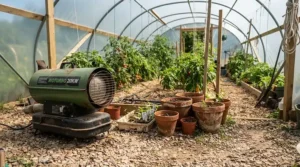
Practical Usage Guide: Setting Up Your Electric Greenhouse Heater for Winter
Getting the setup right matters as much as which heater you buy. Position matters first: mount or place your heater low down for tubular models, since cold air sinks and pools at floor level, but keep fan heaters elevated slightly on a stable shelf or bracket so warm air can circulate rather than blast directly onto nearby leaves, which can scorch foliage even from a “cool” 2000W unit.
Before the first proper cold snap, run the heater for a test evening with a separate max/min thermometer placed centrally among your plants, not next to the heater itself — this is the single most common setup mistake, because built-in thermostats read the air right beside a hot casing, which the RHS specifically flags as a source of inaccurate temperature readings compared with a properly positioned thermometer. Adjust your dial or digital setpoint over two or three nights until the thermometer confirms you’re holding your target minimum.
Maintenance across the season is minimal but not optional: keep vents free of debris so the greenhouse can still breathe on milder days (a heated but sealed greenhouse invites fungal problems faster than an unheated, ventilated one), wipe dust from fan grilles monthly, and check the power cable and plug for any moisture ingress after heavy rain. The most common first-30-days mistake is simply setting a heater and forgetting it — checking your thermometer weekly through the first month catches thermostat drift or positioning errors before they cost you plants.
Real-World Scenarios: Which Heater Suits Your Greenhouse?
Picture three fairly typical UK gardeners. First, a retiree with a compact 6×4 greenhouse overwintering a handful of pelargonium cuttings and dahlia tubers on a fixed budget — for them, a Mylek 60W Tubular Heater run on its digital timer through the coldest overnight hours delivers exactly the frost protection needed for pennies a night, no fussing with dials required.
Second, an allotment holder with an 8×6 structure who starts chilli and tomato seed in February and overwinters a small citrus tree — this is where wattage and thermostat precision both start to matter, making the Bio Green Palma 2kW with its digital probe thermostat a genuinely justified investment, since citrus needs a reliably held minimum rather than a heater that swings a few degrees either side.
Third, a family with a larger polycarbonate greenhouse doubling as a potting shed and general storage space through winter — here the Benross 2000W Industrial Fan Heater‘s dual-purpose design (greenhouse in winter, workshop drying in summer) and rugged build suit the mixed-use, occasionally knocked-about reality of a busy multi-function space far better than a delicate precision heater would.
Problem → Solution: Common Winter Greenhouse Heating Problems
Problem: cold spots despite an apparently adequate heater. Solution: switch from a tubular heater to a fan-assisted model, or reposition an existing fan heater centrally rather than in a corner — the RHS notes that fan heaters specifically improve air circulation to eliminate the cold corners that tube heaters, working by convection alone, often can’t reach.
Problem: thermostat seems inaccurate compared with a separate thermometer. Solution: this is expected behaviour for any thermostat mounted inside the heater casing, since it’s reading air warmed by its own element rather than ambient room temperature — either upgrade to a model with an external probe, like the Bio Green Palma 2kW, or wire in a separate plug-in frost stat.
Problem: condensation dripping from the roof onto plants. Solution: run your heater alongside better ventilation rather than instead of it — sealing a greenhouse tight to conserve heat, without any airflow, is a recipe for the very fungal problems a heater is meant to help prevent.
Problem: electricity bills spike sharply once the heater’s running nightly. Solution: check whether you actually need continuous heat or just overnight frost protection; a timer-equipped model like the Mylek 60W Tubular Heater, or a thermostat set closer to the genuine minimum safe temperature for your specific plants rather than a comfortable “just in case” buffer, can cut running hours dramatically.
✨ Don’t Miss These Exclusive Deals!
🔍 Take your greenhouse through winter without losing a single tender cutting — click through on any heater above to check today’s availability and pricing before the next cold snap arrives.
How to Choose the Best Thermostatic Greenhouse Heater
Picking the best thermostatic greenhouse heater for your specific setup comes down to working through a handful of criteria in order, rather than fixating on wattage alone.
- Measure your greenhouse volume first. A 6×4 needs far less wattage than an 10×8, and buying for the space you actually have avoids both under-heating and wasted spend.
- Decide your target minimum temperature. Frost-free (around 4-5°C) needs far less power than a growing temperature of 10-15°C for tender exotics.
- Prioritise thermostat type over raw wattage. A digital probe thermostat holds temperature more consistently than an internal dial, even on an identical heating element.
- Check the water-resistance rating. IPX4 is the recognised minimum for safe greenhouse use; IPX5 or higher adds margin in a genuinely damp, well-watered environment.
- Match heating method to your greenhouse’s leakiness. Fan heaters circulate air better in draughty older structures; tubular or infrared heaters can be more efficient in tighter, well-sealed ones.
- Factor in running cost, not just purchase price. A cheap 2000W heater run constantly can cost more over a winter than a pricier, well-thermostatted unit that only fires when genuinely needed.
- Consider secondary use. A multi-purpose model that also serves the shed or workshop justifies its cost across more of the year.
Thermostat Accuracy: Why It Matters More Than Wattage
It’s tempting to assume that more watts automatically means a safer greenhouse, but thermostat accuracy is arguably the more important spec, because a heater that fires reliably at the right moment beats a stronger heater that fires late or shuts off early.
Here’s the mechanism worth understanding: a thermostat sensor mounted inside the heater’s own casing is, by definition, reading air that’s already been warmed by the element next to it. That means the true ambient temperature in the greenhouse can drift several degrees below the thermostat’s setpoint before the sensor “notices” and switches the heater back on — precisely why the RHS advises using a dedicated max/min thermometer positioned away from the heater to verify what your plants are actually experiencing, rather than trusting the dial alone. Digital thermostats with an external probe, like the one available for the Bio Green Palma 2kW, solve this by physically separating the sensor from the heat source, typically tightening accuracy to within a couple of degrees of the true reading.
In practical terms: if you’re overwintering forgiving, frost-tolerant plants, a basic dial thermostat’s few degrees of swing genuinely won’t matter. If you’re keeping anything with a narrow safe temperature band — citrus, more tender exotics, early seed germination — that swing is exactly the margin that separates a healthy plant from a stressed one, and it’s worth paying for genuine thermostat accuracy over extra wattage you may never need.
Minimum Safe Temperature for Your Greenhouse Explained
What is the minimum safe temperature for a winter greenhouse? For most frost-tender plants, keeping the greenhouse from dropping below 4-5°C (39-41°F) overnight is the generally accepted safe minimum, while more tender exotics like citrus typically need a higher floor of around 7-10°C depending on species.
This isn’t one-size-fits-all, and it’s worth grouping your plants by requirement rather than heating the whole greenhouse to the needs of your fussiest specimen. Dahlia and canna tubers, alpines, pelargoniums, and most bedding plant cuttings are genuinely happy simply staying frost-free, meaning a heater doesn’t need to work particularly hard for them. Citrus, by contrast, generally wants a night minimum closer to 7-10°C depending on the variety, and more tropical specimens can need considerably more — which is exactly the sort of detail that should shape which heater and thermostat combination you choose, rather than guessing.
It’s also worth remembering just how cold UK winters genuinely get before deciding your heater “should be enough”: according to Met Office long-term averages, UK minimum temperatures regularly sit around 1°C through January, with double-digit numbers of air frost days most winters — so a heater that comfortably holds 4-5°C on an average night needs real headroom for the sharper cold snaps that inevitably arrive at some point most winters.
Best Frost Protection Heater for Greenhouse: Tubular vs Fan Heaters
When people search for the best frost protection heater for greenhouse use, they’re usually choosing between two genuinely different approaches, and the right answer depends more on your greenhouse’s size and leakiness than on brand loyalty.
Tubular heaters, like the Mylek 60W Tubular Heater, Elixir Gardens TH01-B, and Prem-I-Air 45W Tubular Heater, work by convection: a low-wattage element inside a metal tube gently warms the air immediately around it, which then rises and mixes through the greenhouse naturally. They’re cheap to buy, extraordinarily cheap to run, and near-silent — but because they rely on natural air movement rather than a fan, they can leave cold pockets in corners or under staging, particularly in larger or more complex-shaped structures.
Fan heaters, like the SAVING HUB 2kW Greenhouse Heater, Benross 2000W Industrial Fan Heater, and Bio Green Palma 2kW, actively push warm air around the space, which the RHS specifically recommends for avoiding the cold corners that convection-only heaters often miss. That even distribution comes at the cost of higher running expense and, for basic models, a fair amount of fan noise.
Benefits vs Traditional Alternatives
| Method | Running Cost | Control | Best For |
|---|---|---|---|
| Electric heaters (this guide) | Low-moderate, precise | Thermostatic, automated | Reliable unattended frost protection |
| Paraffin heaters | Moderate, fuel-dependent | Manual only | No mains electricity available |
| Horticultural fleece alone | Minimal | None | Supplementary, not standalone protection |
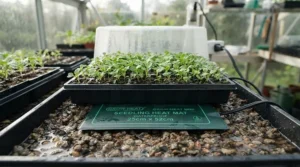
| Propagator heat mats | Low, localised | Often thermostatic | Seed germination, not whole-greenhouse heat |
The clear advantage electric heaters hold over paraffin alternatives is automation: once a thermostat is set correctly, an electric heater needs no manual refuelling or nightly checking, which matters enormously on the nights you’re away from home and a cold snap arrives unannounced. Fleece and heat mats aren’t really competitors so much as companions — layering fleece over vulnerable plants on the coldest nights, alongside a modest thermostatic heater, is often more cost-effective than running a bigger heater alone to compensate for an uninsulated structure.
Overwintering Tender Plants: A Practical Guide
Overwintering tender plants successfully is less about brute heat and more about matching your heater’s capability to what each plant genuinely needs, then managing watering and light alongside temperature.
Group plants by hardiness before the first frost arrives, rather than treating your greenhouse as one uniform zone. Frost-tolerant tender plants — pelargoniums, marguerites, and standard fuchsias — can often survive in an unheated or barely-heated greenhouse provided it stays frost-free, according to RHS guidance, while genuinely tender exotics need consistent warmth maintained through the coldest nights. Dahlia and canna tubers are typically lifted after the first blackening frost and stored in slightly moist sand or vermiculite in a cold but frost-free space, following the RHS’s established method for lifting and storing tender plants over winter, rather than left in situ expecting heat alone to protect them.
Watering discipline matters just as much as temperature: keep overwintering plants on the drier side, since cold, wet compost around roots is a far faster route to rot than a slightly chilly but dry root ball. Position your most temperature-sensitive plants closest to wherever your heater’s output is strongest and most even — generally centre-greenhouse for a fan heater — while hardier specimens can sit further out toward the glazing, where temperatures naturally swing more.
Long-Term Cost & Maintenance
Running cost, not sticker price, is usually the bigger number over a full winter, so it’s worth doing the sum before committing to any single electric greenhouse heater for winter use.
| Heater Type | Typical Wattage | Est. Cost Per Night* | Best Suited To |
|---|---|---|---|
| Low-wattage tubular (45-60W) | 45-60W | Pennies per night | Small greenhouses, frost-only |
| Mid-tubular (120-240W) | 120-240W | Low, scales with length | Larger or draughtier small structures |
| Standard fan heater (2000W, cycling) | 2000W (intermittent) | Moderate, thermostat-dependent | General-purpose winter heating |
| Premium digital thermostat fan heater | 2000W (tightly cycled) | Moderate, but tends to run less overall | Precision heating, less energy waste |
*Actual cost depends on your electricity tariff and how many hours the thermostat keeps the element firing — figures are illustrative, not fixed quotes, and you should check your own supplier’s current rate.
The comparison above tells an important story: a premium digital thermostat doesn’t just improve accuracy, it often reduces total running cost too, because tighter cycling means the element switches off sooner once the target is hit rather than overshooting and running longer than necessary. Over a five-month winter, that difference can meaningfully offset the higher upfront price of a unit like the Bio Green Palma 2kW compared with a basic dial-thermostat alternative. Maintenance costs, meanwhile, are refreshingly low across every option here — an annual check of the element, cable, and thermal cut-out is generally all that’s required, with tubular heaters in particular being close to maintenance-free thanks to their lack of moving parts.
Common Mistakes When Buying an Electric Greenhouse Heater
The single most common mistake is buying purely on wattage, assuming bigger automatically means safer, when a smaller heater with an accurate thermostat can outperform a stronger one with a sloppy dial for the specific job of holding a steady minimum temperature.
A close second is ignoring water-resistance ratings entirely — a greenhouse is a genuinely damp environment between watering, condensation, and humidity, and a heater without at least an IPX4 rating is a real electrical safety risk in that setting, not just a manufacturer’s marketing tick-box. Third, many buyers skip the separate max/min thermometer entirely, trusting the heater’s own dial completely, then wonder why plants near the door or roof still suffer cold damage despite the thermostat “saying” it’s warm enough. Finally, it’s easy to underestimate ongoing running costs when comparing purchase prices alone; a cheaper heater with a poor thermostat can genuinely cost more to run over a winter than a pricier, better-controlled alternative, simply through wasted cycling.
Safety & Regulations: Electrical Safety in the Greenhouse
Greenhouses are inherently damp, and that combination of electricity and moisture deserves proper respect rather than a casually run extension lead from the house.
Any electric greenhouse heater for winter use should be plugged into a socket protected by a Residual Current Device (RCD), which cuts power almost instantly if it detects a fault to earth — genuinely life-saving protection in a wet environment, and a device that works via the same principle as those covered in the general electrical safety guidance around RCDs. If your greenhouse doesn’t already have a dedicated, properly installed circuit, a plug-in RCD adaptor at the socket is a sensible minimum precaution rather than an optional extra.
Check the IP rating of any heater before buying — IPX4 is the widely recognised minimum for greenhouse and outbuilding use, protecting against splashing water from any direction, while IPX5 or higher gives extra margin if your greenhouse gets a heavier soaking from an overhead watering system. Route cables so they can’t trail through puddles or get pinched by doors, inspect plugs and leads for damage each autumn before the heating season starts, and if you’re running a new dedicated circuit into an outbuilding rather than using an existing socket, that’s genuinely a job for a qualified, registered electrician rather than a weekend DIY project.
FAQ
❓ What is the best electric greenhouse heater for winter?
❓ How many watts do I need to heat a greenhouse in winter?
❓ Can I leave an electric greenhouse heater on all winter?
❓ Do I need a thermostat on a greenhouse heater?
❓ Is it cheaper to heat a greenhouse with electricity or gas?
Conclusion
Getting winter greenhouse heating right isn’t about buying the biggest, most expensive unit on the shelf — it’s about matching a heater’s output and thermostat quality to what your specific plants genuinely need to survive until spring. A modest tubular heater with a timer can comfortably protect a small collection of frost-tolerant cuttings for pennies a night, while a digital thermostatic fan heater earns its higher price tag the moment you’re overwintering anything genuinely tender.
Across the seven models covered here, the common thread worth remembering is that thermostat accuracy consistently outperforms raw wattage as the factor that actually keeps plants alive through a hard frost. Pair whichever electric greenhouse heater for winter you choose with a separate max/min thermometer, sensible plant grouping by hardiness, and basic electrical safety precautions like RCD protection, and you’ll be giving your greenhouse a genuinely fair shot at getting everything through to spring in good shape.
Recommended for You
- Electric vs Paraffin Greenhouse Heater: 7 Best Picks (2026)
- The Best Greenhouse Heater UK 2026: 7 Top Picks Ranked
- 7 Cheap Greenhouse Thermometers UK 2026: Ultimate Buyer’s Guide
Disclaimer: This article contains affiliate links. As an Amazon Associate, I earn from qualifying purchases. If you purchase products through these links, we may earn a small commission at no additional cost to you.
✨ Found this helpful? Share it with your friends! 💬🤗
