
In This Article
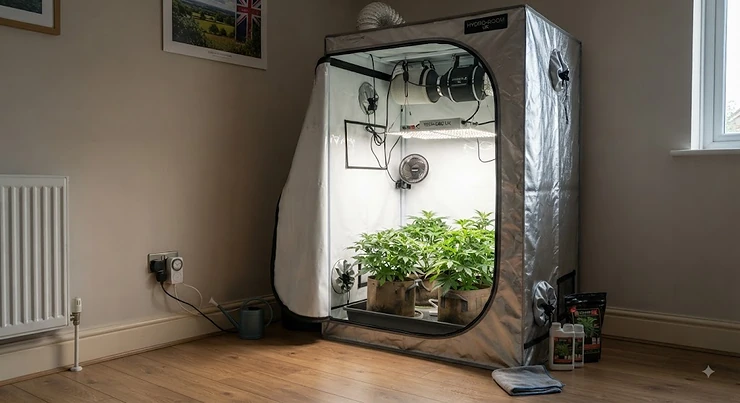
Here’s the thing nobody tells you before you start shopping for a grow tent kit: the tent is the easy bit. It’s the light, the fan and the carbon filter working together — or not — that decides whether your spare room smells like a greenhouse or turns into a swamp with sad, leggy plants in the corner. Sorting that out product by product is a rabbit hole of forum threads and mismatched CFM ratings.
That’s exactly why the best grow tent kit exists as a category in the first place: one box, matched components, no guesswork about whether your fan can actually keep up with your light’s heat output. Across this guide we’ve dug into real specifications, aggregated review sentiment and genuine spec-sheet comparisons for seven kits actually sold to UK growers — from tidy 60x60cm starter tents right through to app-controlled 4×4 systems — so you can pick one that fits your space, your budget and your patience for fiddly setup instructions.
We’ll cover budget, mid-range and premium options, walk through what the numbers on the box actually mean once the tent’s zipped shut, and flag the mistakes that trip up first-timers in week one. Prices below are given as ranges rather than exact figures, since retail prices shift constantly — always check the current price on the product page before buying.
What Is a Grow Tent Kit?
A grow tent kit is a bundled indoor growing system — a light-proof, reflective-lined tent plus a grow light, an extraction fan, ducting and usually a carbon filter — sold together as one matched package rather than as separate components you have to size and connect yourself. The idea is simple: everything inside the box is already compatible, so setup is closer to “unbox and plug in” than “research three separate purchases.”
Grow lights themselves span everything from hobby houseplant propagation to full-scale hydroponic food production, and as Wikipedia’s overview of grow lights explains, they’re simply artificial light sources tuned to the wavelengths plants use for photosynthesis rather than the ones that look pleasant to human eyes.
Quick Comparison Table
Short on time? Here’s the shape of the market before we get into specifics.
| Kit | Tent Size | Light | Best For |
|---|---|---|---|
| Mars Hydro TS600 2×2 Complete Kit | 60x60x140cm | 100W LED | Absolute beginners, tight budgets |
| VIVOSUN GIY-42 Standard Kit | 4x2ft | 100W VS2000 LED | First-time growers wanting headroom |
| Spider Farmer G4500 Complete Kit | 2x4ft | Bridgelux diode LED | Balanced mid-range performance |
| Mars Hydro TSL2000 Smart Kit | 4x2ft | 300W full-spectrum LED | Growers who want app control without premium pricing |
| AC Infinity Advance Kit 4×2 | 48″x24″x71″ | 220W IONBOARD S24 | Precision climate control, serious hobbyists |
This snapshot already tells a story: tent size and light wattage climb together with price, but the real differentiator — as we’ll get into — is whether the fan and filter were actually chosen to match the light, or just bolted on to pad out a bundle. A cheap kit with a mismatched fan can cost you more in wasted electricity and stressed plants than spending a little more up front on the Spider Farmer G4500 Complete Kit.
💬 Found a kit you like already? Scroll down to see the full breakdown before you decide.🤗
Top 7 Best Grow Tent Kits: Expert Analysis
We’ve grouped these across budget, mid-range and premium tiers, including a UK-based alternative brand, so there’s a genuinely honest option whatever you’re working with.
1. Mars Hydro TS600 2×2 Complete Kit — cheapest genuine all-in-one on the market
The Mars Hydro TS600 2×2 Complete Kit is about as close as this category gets to an impulse buy, and that’s not an insult — it’s the whole point. The kit pairs a 100W TS600 full-spectrum LED with a 60x60x140cm 1680D-canvas tent, a 4-inch inline fan rated around 205 CFM, a matching carbon filter and a 6-inch clip fan for internal air movement. On paper, that CFM figure means the extraction fan can fully cycle the air inside this small tent multiple times an hour, which is exactly what you want for odour and humidity control in a space this size.
Based on the spec comparison with rival budget bundles, the standout here is that Mars Hydro actually ships a inline fan and filter pre-matched to the tent volume, rather than an underpowered generic fan — a corner competitors in this price bracket often cut. This is the kit for someone growing one or two plants in a cupboard, loft corner or student room who wants results without a second mortgage.
Reviewers consistently report the tent’s zips and seams hold up well to repeated use, and the reflective lining noticeably brightens the lower canopy compared with flat white interiors. A recurring theme in aggregated feedback is that the kit occasionally ships across multiple parcels, so don’t panic if your fan arrives a day after your tent.
Pros:
- ✅ Genuinely matched fan-to-tent sizing for a 2×2 space
- ✅ Lowest realistic entry price for a complete kit
- ✅ Simple, beginner-friendly setup with few components
Cons:
- ❌ 100W LED limits you to one or two mature plants
- ❌ No app or smart control — manual timer needed
Expect this kit in the under-£150 bracket at the time of research. For a first-ever grow tent kit with light and fan bundled in, it’s hard to argue with the value.
2. VIVOSUN GIY-42 Standard Kit — best beginner grow tent kit for extra headroom
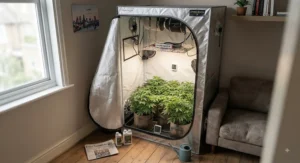
The VIVOSUN GIY-42 Standard Kit steps up the footprint to a 48″x24″x60″ tent — noticeably taller than the Mars Hydro option — paired with VIVOSUN’s own VS2000 100W LED and a 4-inch ventilation combo. That extra height matters more than people expect: it gives you room to hang the light higher during the vegetative stage and lower it as plants stretch, rather than fighting for inches in a cramped tent.
What most buyers overlook about this model is that the taller format also improves passive airflow before the fan even kicks in, because hot air has further to rise before it stagnates near the canopy. It’s a smart pick for anyone who’s outgrown a windowsill setup but isn’t ready to commit serious floor space or budget.
Aggregated review sentiment for VIVOSUN’s tent build quality is strongly positive — buyers repeatedly mention sturdy poles, well-sealed seams and minimal light leakage, alongside praise for how logically the ventilation combo assembles compared with own-brand generic kits.
Pros:
- ✅ Taller tent gives far more flexibility for plant height
- ✅ Strong, consistent build-quality feedback across reviews
- ✅ Straightforward 4-inch ventilation combo, easy to install
Cons:
- ❌ 100W LED still modest for a 4×2 footprint
- ❌ No WiFi control on this entry-level tier
Pricing typically sits in a similar range to the Mars Hydro kit, sometimes a touch higher depending on bundle inclusions — check current pricing before ordering, as VIVOSUN runs frequent bundle variations.
3. Spider Farmer G4500 Complete Kit — best balanced mid-range grow tent kit with light and fan
This is the kit we’d point most people towards if they can stretch the budget slightly. The Spider Farmer G4500 Complete Kit builds around Spider Farmer’s G-series diode board, using Bridgelux diodes at a higher density than the brand’s entry-level lights, which on paper means better light penetration through a fuller canopy without pushing individual diodes to their thermal limits.
Here’s what the spec sheet won’t tell you, but reviewers note: the real advantage of this kit isn’t raw wattage, it’s balance. The whole package — light, tent and ventilation — is engineered to work as a matched system rather than chasing the biggest possible output figure, which makes heat and noise easier to manage in a spare room or bedroom setup without constant tweaking.
That fan-to-light matching is the whole reason to pick this over a cheaper bundle — you’re not stuck manually swapping in a bigger fan six months later because the stock one couldn’t keep pace with the light’s heat.
Pros:
- ✅ Diode density improves light penetration without extra heat
- ✅ Fan and filter genuinely matched to light output
- ✅ Quieter running than many similarly priced rivals
Cons:
- ❌ Sits above true entry-level pricing
- ❌ Coverage area suits 2x4ft rooms, not larger spaces
Expect a mid-range price, roughly in the low-to-mid hundreds of pounds — a fair trade for the balance this kit delivers.
4. Mars Hydro TSL2000 Smart Kit — best grow tent kit with light and fan for app-based control
Stepping up again, the Mars Hydro TSL2000 Smart Kit brings a 300W full-spectrum LED into a 48″x24″x70″ 1680D tent, alongside a genuinely automatic 4-inch ventilation system and a 10-speed fan, all tied together through Mars Hydro’s iControl WiFi controller. The 300W figure is triple the entry-level kits above, and in practice that translates to healthier coverage across a 4×2 footprint rather than a single hot spot in the centre.
Based on the spec comparison, what separates this from a bigger dumb light is the automation layer: the iControl system can schedule light cycles and adjust fan speed based on temperature and humidity readings, taking the guesswork out of “is it too hot in there right now” — a question every first-time grower asks at 11pm at least once.
Aggregated feedback highlights the app’s learning curve as mild but real; most users report getting comfortable within a session or two, with the trade-off being genuinely useful automated climate response afterwards.
Pros:
- ✅ 300W output suits a fuller 4×2 canopy, not just one plant
- ✅ WiFi automation adjusts fan speed to real conditions
- ✅ 10-speed fan gives fine control over airflow and noise
Cons:
- ❌ App setup adds a learning curve for total beginners
- ❌ Multi-parcel shipping reported for some orders
This kit typically lands in the £350-£450 range — a meaningful step up, but you’re paying for genuine climate automation, not just a bigger light.
5. VIVOSUN Smart Kit 4×4 GrowHub — best premium grow tent kit for serious canopy coverage
For growers who’ve outgrown a 2×4 tent, the VIVOSUN Smart Kit 4×4 GrowHub scales things up properly: a 48″x48″x80″ tent, VIVOSUN’s AeroLight Wing 400W LED, and a 6-inch AeroZesh ventilation combo, all managed through the WiFi-enabled GrowHub E42A+ controller. This is a four-plant system by VIVOSUN’s own classification, and the numbers back that claim up — 400W spread across a much larger footprint gives comparable intensity per square foot to the smaller 100W kits above, just scaled to a room-sized canopy.
What most buyers overlook about scaling up a tent is that ventilation demands don’t grow in a straight line — doubling your floor space roughly doubles the air volume you need cycling, which is exactly why VIVOSUN bumped the fan from 4-inch to 6-inch rather than simply doubling the light. That’s sound engineering, not just a bigger box for a bigger price tag.
Review sentiment consistently praises the GrowHub app’s ability to coordinate lights, fans and add-on sensors from one interface, with a smaller number of users noting that the sheer number of settings can feel like overkill if you only want basic on/off scheduling.
Pros:
- ✅ 4×4 footprint suits multiple mature plants comfortably
- ✅ 6-inch ventilation properly scaled to the larger tent volume
- ✅ GrowHub app unifies light, fan and sensor control
Cons:
- ❌ Considerable step up in price versus 2×4 smart kits
- ❌ Overkill for anyone growing just one or two plants
Budget somewhere in the £550-£650 bracket for this tier — it’s a serious step towards a proper home grow room rather than a starter setup.
6. AC Infinity Advance Kit 4×2 — best for precision climate control
The AC Infinity Advance Kit 4×2 is arguably the most engineered kit on this list. It bundles the CLOUDLAB 642 tent (48″x24″x71″) with a CLOUDLINE Pro T6 inline fan run through AC Infinity’s Controller 69 Pro, and an IONBOARD S24 220W LED grow light — every component from a single ecosystem designed to talk to each other rather than being loosely bundled by a retailer.
The whole point of the bundle is removing the guesswork of matching components individually, and the CLOUDLAB tent itself is built from a heavy-duty waterproof canvas with a cross-patterned diamond mylar interior designed to bounce as much light back onto the canopy as possible. Here’s what the spec sheet won’t tell you, but reviewers note: the Controller 69 Pro’s programmable fan curves — automatically ramping extraction up as temperature or humidity rises — are the real reason growers pay a premium for this brand, not just the tent fabric.
This is squarely a kit for the grower who wants dial-in precision and is willing to pay AC Infinity’s premium for a controller ecosystem that scales as you add more devices later.
Pros:
- ✅ Controller 69 Pro automates fan speed to real climate data
- ✅ Heavy-duty 2000D canvas built for repeated long-term use
- ✅ Ecosystem expands with add-on sensors and devices later
Cons:
- ❌ Among the most expensive kits in this size class
- ❌ Overkill for anyone just testing the hobby
Typical pricing sits around £700-£800, positioning this firmly as the premium choice for growers who see this as a long-term setup, not a trial run.
7. London Grow Complete Kit with Lumatek Attis LED — best UK-brand alternative
Rounding out the list with a genuinely lesser-known but high-quality UK option: the London Grow Complete Kit bundles a Lumatek Attis 200W LED with a Ram carbon filter and matched inline fan, plus ducting and a timer, from a UK retailer rather than a US-headquartered brand. Even at the entry level, the kit ships with a proper Ram carbon filter, matching inline fan and Lumatek Attis LED as standard rather than as paid add-ons, which is a genuinely strong specification for the price bracket it competes in.
Based on the spec comparison, the Lumatek Attis line has a longer commercial pedigree in UK hydroponics retail than most of the newer Chinese-manufactured brands on this list, and Ram Filters carry a well-established reputation specifically for odour control performance — arguably the single most important spec for anyone growing in a shared or terraced house.
Reviewers and UK hydroponics forum sentiment repeatedly flag London Grow’s customer support and UK-based stock availability as a genuine advantage over importing individual parts, since replacement components and warranty claims stay within the UK rather than requiring international returns.
Pros:
- ✅ Established, well-regarded UK brands for light and filter
- ✅ Ram carbon filter has a strong odour-control reputation
- ✅ UK-based stock and support for warranty or replacement parts
Cons:
- ❌ Less brand recognition online than Mars Hydro or AC Infinity
- ❌ Fewer smart/app-control features than the premium picks
Pricing generally falls in the mid-range bracket, comparable to the Spider Farmer G4500 Complete Kit, making this a genuine alternative if you’d rather support a UK-based retailer with UK-based support.
Top 7 Kits: Full Specification Comparison
| Kit | Light Output | Fan Size | Price Range | Best For |
|---|---|---|---|---|
| Mars Hydro TS600 2×2 Complete Kit | 100W | 4-inch, 205 CFM | Under £150 | Absolute beginners |
| VIVOSUN GIY-42 Standard Kit | 100W | 4-inch combo | £150-£190 | Beginners wanting height |
| Spider Farmer G4500 Complete Kit | Bridgelux diode board | 4-inch matched | £250-£350 | Balanced mid-range |
| Mars Hydro TSL2000 Smart Kit | 300W | 4-inch, 10-speed | £350-£450 | App-based automation |
| VIVOSUN Smart Kit 4×4 GrowHub | 400W | 6-inch combo | £550-£650 | Larger canopy coverage |
| AC Infinity Advance Kit 4×2 | 220W | CLOUDLINE Pro T6 | £700-£800 | Precision climate control |
| London Grow Complete Kit | Lumatek Attis 200W | Ram-matched inline | £250-£320 | UK brand, best support |
Laid out side by side, the pattern is obvious: fan size scales with tent volume far more consistently than light wattage does, which tells you ventilation engineering is where the real quality gap sits between budget and premium kits. If you’re choosing between the Mars Hydro TSL2000 Smart Kit and the AC Infinity Advance Kit 4×2, the extra £300-£400 is buying you controller sophistication and build-grade canvas, not fundamentally more grow space.
LED Wattage Guide: How Much Light Do You Actually Need
Wattage numbers on grow light packaging are one of the most misunderstood specs in this whole category, so let’s untangle it properly.
- Match wattage to floor area, not ambition. As a rough rule, budget 30-50W of quality LED per square foot of canopy for healthy vegetative growth — a 2x2ft tent is comfortably served by 100W, while a 4x4ft space wants closer to 400W.
- Efficacy matters more than raw wattage. A 200W light with high-efficiency diodes can outperform a cheaper 300W unit, because efficacy measures how many usable photons reach the plant per watt consumed, not just how much electricity the fixture draws.
- Diode quality drives long-term running cost. Premium diode boards like those in the Spider Farmer G4500 Complete Kit waste less energy as heat, which lowers both your electricity bill and the load on your extraction fan.
- Dimmable lights future-proof your setup. Being able to run a light at reduced power during seedling stages, then ramp up for flowering, is more useful long-term than a fixed-output unit.
- Full spectrum beats single-colour for most home growers. Unless you’re running a highly specific commercial protocol, full-spectrum white LEDs — as used across every kit on this list — give the most forgiving results for mixed growth stages.
- Height above canopy changes effective intensity. The same light delivers dramatically different PPFD readings at 12 inches versus 24 inches from the canopy, so factor tent height into your wattage decision, not just floor area.
- Don’t chase commercial-grade numbers for a hobby space. A 4×4 hobby tent rarely needs the same PPFD a commercial grow room targets — matching a kit like the VIVOSUN Smart Kit 4×4 GrowHub to genuine home use avoids overspending on unnecessary intensity.
Carbon Filter & Fan Setup: Getting Ventilation Right
If there’s one section of this guide worth reading twice, it’s this one — ventilation mistakes are the single most common reason first-time grow tent kits underperform.
The core principle is negative pressure: your extraction fan should pull slightly more air out of the tent than passive vents let in, so air is actively drawn through the carbon filter rather than leaking out through seams and zips unfiltered. Get this backwards and you’ll smell every stage of the grow through your house, no matter how good the filter itself is.
Sizing the fan to the filter — and both to the tent — is where budget kits sometimes cut corners, bundling an underpowered fan that can’t push enough air through the filter’s carbon media to actually scrub odour effectively. Kits like the AC Infinity Advance Kit 4×2 and Spider Farmer G4500 Complete Kit earn their higher price partly because the fan-to-filter-to-tent ratio has actually been calculated, not guessed at.
A practical rule of thumb many UK growers use: aim to fully exchange the tent’s air volume roughly once every one to three minutes, adjusting fan speed down if that pace creates excessive negative pressure that flexes the tent walls inward. Ducting length and bends also matter more than people expect — every 90-degree bend in flexible ducting reduces effective airflow noticeably, so keeping the run from fan to filter as short and straight as possible protects the CFM rating you’re actually paying for.
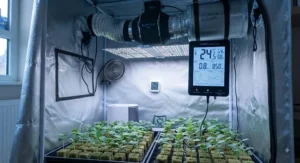
All-In-One Kit Components Explained
“Complete” or “all-in-one” on a listing title can mean wildly different things depending on the brand, so here’s what should actually be inside a genuine all-in-one kit components bundle before you buy.
The non-negotiables: a light-proof tent with reflective interior lining, a grow light with its own power supply, an inline extraction fan, ducting to vent that fan, and — for anything beyond a tiny cupboard grow — a carbon filter to scrub odour before air leaves the tent.
The genuinely useful extras: a speed controller for the fan (rather than fixed full-speed operation), a timer or app for the light cycle, hanging rope ratchets so you can raise the light as plants grow, and a small oscillating clip fan for internal air circulation — every kit reviewed above includes at least the first three.
What to watch for on cheaper listings: some budget bundles list a “carbon filter” that’s really just an activated-charcoal pad with no proper housing, which does far less to control odour than a genuine cylindrical carbon filter matched to the ducting size. Reading the actual component list — not just the marketing bullet points — before buying saves a frustrating discovery three weeks into your first grow.
Practical Usage Guide: Setting Up Your Kit in the First 30 Days
Getting a new kit from box to running smoothly is mostly about sequencing, not difficulty.
Day one — structure first, electronics last. Build the tent frame and canvas fully before touching any wiring; trying to route cables through a half-assembled frame is the most common source of first-day frustration. Check every zip and Velcro seam for light leaks with the room lights off before moving on.
Day two-three — ventilation before lighting. Mount the fan and filter, run the ducting with as few bends as possible, and confirm negative pressure by watching the tent walls flex gently inward when the fan runs. Only then hang the light, leaving enough rope slack to raise it as seedlings grow.
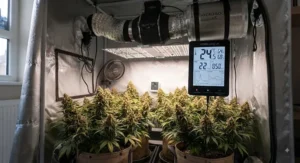
Week one — dial in your climate. Run the system empty for 24-48 hours and monitor temperature and humidity with a cheap digital thermo-hygrometer; adjust fan speed until you’re consistently in a healthy range before introducing plants. This single step catches most equipment mismatches before they cost you a grow cycle.
First 30 days — common mistakes to avoid. Don’t hang the light too close too soon; don’t run the fan at maximum speed constantly if it’s stripping too much humidity; and don’t skip a proper trellis or support if you’re growing anything that gets top-heavy. Log your temperature and humidity readings daily for the first month — it sounds tedious, but it’s the fastest way to spot a developing problem before it shows up on the leaves.
Real-World Scenarios: Which Kit Suits Your Space
The student in a shared house. Limited space, thin walls, and a genuine need for discretion on odour. A 2×2 setup like the Mars Hydro TS600 2×2 Complete Kit fits in a wardrobe-sized footprint, and pairing it with disciplined negative-pressure setup (see the ventilation section above) keeps smell contained even in close quarters.
The hobbyist converting a spare room. More floor space, less urgency around noise, and a desire to actually scale output. The Spider Farmer G4500 Complete Kit or Mars Hydro TSL2000 Smart Kit suit this profile well — enough light for a genuinely productive canopy without the premium cost of AC Infinity’s ecosystem.
The established grower building a proper room. Available floor space, a genuine long-term commitment, and a preference for app-based monitoring they can check from the sofa. Here the VIVOSUN Smart Kit 4×4 GrowHub or AC Infinity Advance Kit 4×2 justify their higher price tags through automation that removes daily manual checking from the routine.
Problem → Solution: Common Grow Tent Kit Issues
Problem: persistent odour despite a carbon filter. Solution: check for negative pressure first — if air is escaping through unsealed seams rather than passing through the filter, no filter quality fixes that. Reseal cable ports and confirm the fan is genuinely pulling more air out than passive vents let in.
Problem: humidity swinging wildly. Solution: this is almost always a fan-speed mismatch rather than a broken component — try dropping fan speed on kits like the VIVOSUN Smart Kit 4×4 GrowHub that offer variable control, since running full-speed constantly over-dries the tent between cycles.
Problem: leggy, stretched growth. Solution: usually means the light’s too far from the canopy or underpowered for the footprint — revisit the LED Wattage Guide above and consider whether your kit’s wattage genuinely matches your tent’s floor area.
Problem: condensation on the tent’s inner walls. Solution: typically a sign extraction isn’t keeping pace with humidity output, particularly common with budget kits’ smaller fans — increasing fan speed or shortening ducting runs usually resolves it within a day.
Problem: kit components arrive in separate deliveries. Solution: this is genuinely common with several brands on this list, including Mars Hydro — check your order confirmation email for multiple tracking numbers before assuming anything’s missing.
Complete Grow Tent Kit vs Buying Components Separately
It’s a fair question: why not just buy a tent, light, fan and filter individually and save money matching your own combination?
| Factor | Complete Grow Tent Kit | Buying Components Separately |
|---|---|---|
| Compatibility risk | Pre-matched by manufacturer | You calculate fan-to-light-to-tent sizing yourself |
| Upfront cost | Often lower via bundle pricing | Can be cheaper if you shop sales carefully |
| Setup time | Faster — fewer sizing decisions | Slower — more research required |
| Best For | Beginners, time-poor buyers | Experienced growers with specific preferences |
The analysis here is straightforward: a complete grow tent kit removes the single biggest risk for a first-time buyer, which is mismatching fan CFM to tent volume and light heat output. Experienced growers who already know their preferred diode brand or fan noise tolerance can sometimes save money buying separately, but for anyone on their first setup, the bundled sizing logic in kits like the VIVOSUN GIY-42 Standard Kit is worth the modest premium over piecing it together yourself.
💬 One click could save you hours of component research — compare current kit pricing now!🤗
Grow Tent Kit for Beginners vs Experienced Growers
A genuinely beginner grow tent kit and an advanced grower’s setup differ in more than just size — the priorities shift entirely.
What beginners should prioritise: simplicity over automation, forgiving tent dimensions that allow for mistakes in light height, and a fan with a wide speed range so you can correct ventilation errors without buying new hardware. The Mars Hydro TS600 2×2 Complete Kit and VIVOSUN GIY-42 Standard Kit both fit this brief — few enough components that troubleshooting a problem doesn’t require ruling out five variables at once.
What experienced growers should prioritise: precision climate control, scalable canopy coverage, and an ecosystem that accepts add-on sensors or controllers as needs grow. The AC Infinity Advance Kit 4×2 and VIVOSUN Smart Kit 4×4 GrowHub are built around exactly that kind of expandability, at a price point that reflects it.
Where people go wrong most often is buying premium automation before they’ve learned what a healthy climate actually looks like by eye — there’s real value in running a manual kit for one full cycle first, so app-based automation later feels like a genuine upgrade rather than a crutch you never learn to do without.
Common Mistakes When Buying a Grow Tent Kit
Even careful buyers repeat a handful of predictable errors, so here’s honest commentary on where budget goes to waste.
Buying too large a tent for the available light is the most frequent mistake — a 4×4 tent lit by a 100W fixture leaves most of the canopy under-lit, which no amount of good ventilation compensates for. Equally common is the reverse: pairing a powerful light with a fan too small to manage the resulting heat, which is exactly the trap budget bundles with mismatched components set for unsuspecting buyers.
Ignoring noise tolerance is another one — a fan rated for maximum airflow at full speed can be genuinely disruptive in a bedroom setup, so checking whether a kit offers variable speed control, as several kits above do, matters more than raw CFM figures for anyone growing somewhere they also sleep.
Finally, underestimating ongoing running costs catches people out. A higher-wattage light isn’t just a bigger upfront spend — it’s a recurring electricity cost worth factoring against your available budget before committing to a premium kit like the AC Infinity Advance Kit 4×2 over a more modest alternative.
Grow Tent Kit Reviews: What Real Buyers Say
Rather than repeat individual product reviews already covered above, here’s the honest pattern across aggregated feedback for this whole category.
Build-quality complaints cluster overwhelmingly around zip and seam durability on the cheapest unbranded listings — a theme notably absent from reviews of the seven branded kits featured in this guide, which is exactly why we stuck to established manufacturers rather than anonymous marketplace bundles. Ventilation satisfaction correlates strongly with whether the fan includes speed control; kits with fixed-speed fans generate noticeably more noise complaints than variable-speed equivalents like those in the Mars Hydro TSL2000 Smart Kit.
A recurring positive theme across nearly every brand reviewed is how much difference proper negative-pressure setup makes to odour control satisfaction — buyers who follow manufacturer ventilation guidance report far fewer complaints than those who don’t, reinforcing that setup technique matters as much as component quality. If you can’t verify individual review authenticity on a listing, treating aggregated sentiment across multiple retailers — rather than a handful of five-star reviews on one page — gives a far more honest picture of real-world performance.
Safety, Regulations & Electrical Compliance Guide
Running a light, fan and often a heater or humidifier from a single spare-room socket raises genuine electrical safety considerations worth taking seriously.
Extension leads are one of the most commonly damaged pieces of kit in any home setup — plugs, sockets and cabling all take repeated wear — so the HSE’s guide to electrical safety is worth a genuine read before running multiple grow tent components from one lead. Never daisy-chain extension leads together, and always check the combined wattage of your light, fan and any heater stays comfortably under your lead’s rated capacity.
Look for UK-compliant BS 1363 plugs on every component — all the kits featured in this guide ship with UK-specification plugs as standard, but always verify this on the listing before buying from a smaller or newer brand. If you’re ever unsure whether a specific electrical product has been flagged for a safety issue, the government’s product recalls and alerts page is the authoritative source to check.
On the environmental side, humidity control isn’t just about plant health — persistently damp conditions in a poorly ventilated tent can encourage mould, which is a genuine household concern beyond the grow itself. As the RHS growing guide explains, humidity is essentially the amount of water vapour held in the surrounding air, and it directly governs how fast plants lose moisture through their leaves and, in turn, how hard their roots have to work to replace it — a useful principle whether you’re growing houseplants on a windowsill or vegetables in a tent.
FAQ
❓ What size grow tent kit do I need for two plants?
❓ Is a carbon filter always necessary in a grow tent kit?
❓ How much does it cost to run a grow tent kit's LED light?
❓ Can a beginner grow tent kit be upgraded later?
❓ Do grow tent kit reviews on Amazon reflect real long-term performance?
Conclusion
If there’s one thing worth taking away from this guide, it’s that the best grow tent kit for you isn’t necessarily the one with the biggest wattage number on the box — it’s the one where the tent, light, fan and filter were actually sized to work together for your specific space. For a first attempt on a tight budget, the Mars Hydro TS600 2×2 Complete Kit removes almost all the guesswork. For most people upgrading from a first attempt, the Spider Farmer G4500 Complete Kit hits the sweet spot of genuine component balance without premium pricing. And for anyone building a proper long-term setup who wants app-based precision, the AC Infinity Advance Kit 4×2 or VIVOSUN Smart Kit 4×4 GrowHub justify their higher price tags through real engineering, not just marketing.
Whichever tier you land in, the ventilation principles and setup sequencing covered throughout this guide apply regardless of brand — get negative pressure right, match your fan to your tent, and give yourself that first full week to dial in your climate before worrying about anything else.
✨ Don’t Miss These Exclusive Deals!
🔍 Take your indoor growing to the next level with these carefully selected kits. Click on any highlighted product to check current pricing and availability. These setups will help you create a genuinely productive grow space, whatever your experience level!
Recommended for You
- Best Medium Grow Tent UK 2026: 7 Top Picks That Actually Deliver
- Best 60×60 Grow Tent UK 2026: 7 Top Picks
- Grow Tent for Beginners: 7 Real Picks
Disclaimer: This article contains affiliate links. As an Amazon Associate, I earn from qualifying purchases. If you purchase products through these links, we may earn a small commission at no additional cost to you.
✨ Found this helpful? Share it with your friends! 💬🤗
