
In This Article
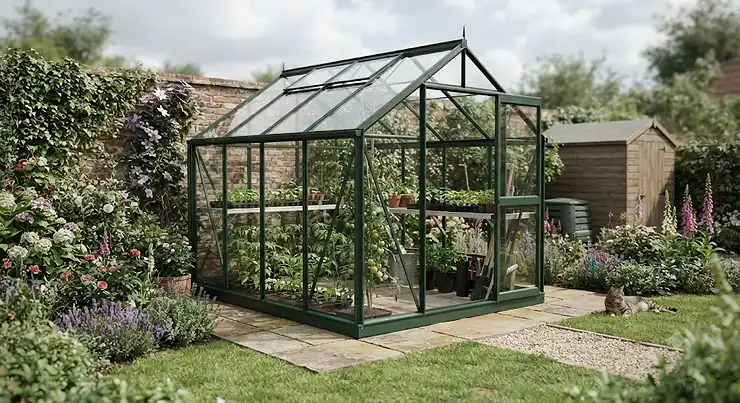
If your tomatoes have been sulking on a windowsill for the last three summers, a 6×8 greenhouse is probably the upgrade your garden has been begging for. It is the size that keeps coming up again and again in allotment forums and garden centre car parks, and there is a good reason for that: it is roomy enough for a proper growing bed and a potting bench, yet compact enough to slot into a fairly average British back garden without eating the whole lawn. A 6×8 greenhouse is a freestanding growing structure measuring roughly 1.85m by 2.5m, built from aluminium, resin, or timber, and glazed with glass or polycarbonate to trap warmth and light for plants.
That extra two feet over a 6×6 model buys you a proper run of staging down one side and space to walk comfortably down the other, according to RHS greenhouse guidance, which is why so many first-time buyers land here rather than sizing up or down. This guide digs into seven genuinely available UK models, from budget aluminium-and-polycarbonate kits through to premium British-built structures, and weighs up what the spec sheets don’t tell you. We have researched real customer feedback, cross-checked warranties, and worked out where each design earns its keep and where it falls short, so you are not left guessing after the delivery van has gone. Along the way we will also cover the practical stuff nobody puts in the product description: what base you actually need, how to lay out shelving in a space this size, and whether your allotment committee will even let you put one up. By the end, you should know exactly which 6×8 greenhouse suits your garden, your budget, and your growing ambitions.
Quick Comparison Table
Here is the shortlist at a glance before we go deeper into each one.
| Product | Frame | Glazing | Best For |
|---|---|---|---|
| Outsunny 6×8 Polycarbonate Greenhouse with Base | Aluminium | Single-wall polycarbonate | Tight budgets and first greenhouses |
| Palram Canopia Harmony 6×8 Silver | Aluminium | Single-wall polycarbonate | Beginners wanting a known brand |
| Waltons 6×8 Polycarbonate Greenhouse | Aluminium | Single-wall polycarbonate | Straightforward apex-style value |
| Palram Canopia Mythos 6×8 Silver | Aluminium | Twin-wall polycarbonate | Better insulation on a modest budget |
| Vitavia Venus 5000 6×8 | Anodised aluminium | Horticultural glass | All-round durability and light |
| Halls Cotswold Burford 6×8 | Heavy-duty aluminium | Glass or polycarbonate | Easy access and British build quality |
| Rhino Premium 6×8 | Reinforced aluminium | Toughened glass | Long-term investment and harsh sites |
Looking at the spread above, the jump from single-wall to twin-wall polycarbonate on the Palram Canopia Mythos 6×8 Silver is where insulation genuinely starts to improve, while the Halls Cotswold Burford 6×8 and Rhino Premium 6×8 justify their higher position with heavier-gauge aluminium and longer warranties. Budget buyers shouldn’t assume cheaper always means worse value; the Outsunny 6×8 Polycarbonate Greenhouse with Base and Waltons 6×8 Polycarbonate Greenhouse both cover the fundamentals well for anyone testing the water with their first greenhouse.
💬 Found a model that jumps out already? Check today’s availability before prices shift again!😊
Top 7 6×8 Greenhouses: Expert Analysis
Every model below has been chosen because it is a real, currently available structure, not a fictional composite. We have leaned on manufacturer specifications and aggregated review sentiment from retailer and marketplace listings rather than inventing customer quotes, and we have flagged where feedback is mixed rather than smoothing it over.
1. Outsunny 6×8 Polycarbonate Greenhouse with Base — best budget walk-in with a raised bed option
The standout here is the galvanised base, which some Outsunny 6×8 listings pair with a raised planting bed built into the design, giving new growers a head start without buying separate staging. The frame is powder-coated aluminium, resistant to rust in a way that matters more than it sounds once a British winter has had a go at it, and the panels are polycarbonate rather than glass, so a mis-thrown football is an inconvenience rather than a trip to A&E. A hinged door and an adjustable window that locks into five positions give you basic but workable ventilation control, which matters hugely on the first genuinely hot day of a British summer when a sealed greenhouse can hit uncomfortable temperatures within the hour. Based on the spec comparison with other entry-level kits, this model sits firmly at the budget end but doesn’t skimp on the base and gutter system that cheaper no-name imports often drop first. Reviewers consistently note that assembly takes a full day for two people and that panel alignment needs patience, though the finished structure is described as sturdy once properly anchored. It suits anyone who wants a low financial commitment while they find out whether greenhouse growing is really for them.
Pros:
- ✅ Includes a galvanised base as standard, not an optional extra
- ✅ Polycarbonate panels remove the glass-breakage worry entirely
- ✅ Adjustable window offers genuine multi-position ventilation
Cons:
- ❌ Single-wall polycarbonate offers limited heat retention overnight
- ❌ Assembly instructions are reported as fiddly for first-timers
At the time of research this model typically sits under £350, making it one of the more accessible entries on this list; always check current price and stock before ordering, since garden ranges shift seasonally.
2. Palram Canopia Harmony 6×8 Silver — best entry-level polycarbonate for first-time growers
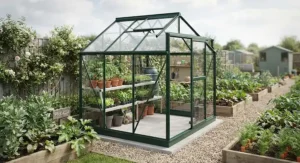
What most buyers overlook about the Palram Canopia Harmony 6×8 Silver is the sliding glazing system, which does away with the fiddly spring clips that plague cheaper polycarbonate greenhouses and are a leading cause of panels popping out in gusty weather. The crystal-clear single-wall polycarbonate lets through close to full light transmission while still blocking harmful UV, and the ridge height of around 2.09m means most adults can stand up straight inside without ducking under the apex, a detail that sounds trivial until you are the one stooping to reach a hanging basket. The rust-resistant aluminium frame sits on a galvanised steel base, and Palram backs the structure with a five-year warranty. Reviewers consistently report that the greenhouse is easy enough for two people to assemble in a weekend, though a handful of buyers have noted that panels arriving slightly out of true can make alignment tricky on the first attempt. On balance, this is a sound choice for anyone wanting a recognisable, widely-stocked brand without stretching to twin-wall glazing.
Pros:
- ✅ Slide-in glazing avoids fiddly clips seen on rival budget models
- ✅ Full-height ridge gives genuine standing room throughout
- ✅ Five-year manufacturer warranty backs a well-known brand
Cons:
- ❌ Single-wall polycarbonate means less heat retention than twin-wall rivals
- ❌ Some reported issues with panel-cutting tolerances on delivery
Prices generally fall in the £250-£350 range depending on retailer and season, so it’s worth comparing a few sellers before committing, and never assume a listed figure is fixed.
3. Waltons 6×8 Polycarbonate Greenhouse — best value classic apex design
The Waltons 6×8 Polycarbonate Greenhouse goes for a no-nonsense classic apex shape, and the standout feature is simply how unfussy the whole package is: aluminium frame, shatterproof polycarbonate panels, and a design Waltons pitches as suitable for both complete beginners and gardeners who have done this before. Polycarbonate’s insulating advantage over glass comes from trapped air rather than a single solid pane, so on paper this greenhouse should hold heat a touch better than an equivalent glass model of the same size, which matters for extending your growing season into autumn. Waltons backs its polycarbonate range with a five-year manufacturer guarantee on the frame. Aggregated customer sentiment on similar Waltons polycarbonate models is mixed rather than uniformly glowing: some buyers praise fast delivery and a sturdy finished structure that shrugs off wind and stray footballs, while others have flagged flimsier spring-clip glazing systems on certain product lines and gaps around the sliding door letting in draughts. What most buyers overlook is that getting the base perfectly level before assembly resolves a large share of the door-alignment complaints seen in reviews.
Pros:
- ✅ Classic apex shape maximises usable headroom and floor space
- ✅ Polycarbonate glazing is shatterproof and child-safe
- ✅ Five-year guarantee on the aluminium frame
Cons:
- ❌ Some reported gaps around the sliding door letting draughts in
- ❌ Panel clips need careful fitting to avoid popping in high wind
Expect a price somewhere in the £300-£450 range at most retailers, with occasional seasonal discounts worth watching for.
4. Palram Canopia Mythos 6×8 Silver — best twin-wall insulation upgrade
Step up from the Harmony range and the Palram Canopia Mythos 6×8 Silver swaps single-wall for 4mm twin-wall polycarbonate, and that single change is the real story here. Twin-wall panels trap a layer of air between two skins of plastic, roughly doubling the heat retention of a single-layer panel according to Palram’s own technical literature, which in practice means fewer cold snaps setting your seedlings back in April and May. The frame remains rust-resistant brushed aluminium on a galvanised steel base, with a lockable door and magnetic catch, plus an adjustable roof vent for ventilation control. Based on the spec comparison with the Harmony, you are paying more for warmth retention rather than extra floor space, since both share the same 6×8 footprint. Reviewers on comparable Mythos sizes note the twin-wall panels are noticeably light for their thickness but can catch the wind like sails during installation, so calm-day assembly is worth planning for. Retail listings put this model at roughly £400 at UK stockists such as B&Q, positioning it as a genuine mid-range step rather than a luxury purchase.
Pros:
- ✅ Twin-wall polycarbonate roughly doubles heat retention over single-wall
- ✅ Lockable door with magnetic catch adds basic security
- ✅ Galvanised steel base included as standard
Cons:
- ❌ Panels can act like sails in wind during assembly
- ❌ Diffused twin-wall glazing reduces clarity compared with clear panels
At the time of research this model tends to sit in the £350-£450 range, so it’s worth checking current price before deciding between this and the standard Harmony.
5. Vitavia Venus 5000 6×8 — best anodised aluminium all-rounder
The Vitavia Venus 5000 6×8 trades polycarbonate for glass as standard, and the headline feature is the anodised aluminium frame, a finish that resists tarnishing without the powder-coat maintenance some rival frames eventually need. Standard glazing is 3mm horticultural glass, which the manufacturer states offers around 90% light transmission, noticeably clearer than diffused polycarbonate, though buyers can upgrade to toughened glass or polycarbonate panels if young children or pets are likely to be near the structure. What most buyers overlook about horticultural glass is that it is thinner and less impact-resistant than toughened alternatives, so siting matters: away from trampolines and football-mad children is sensible. Vitavia backs the frame with what the manufacturer describes as a lengthy guarantee, and the sliding door plus adjustable roof vent give reasonable airflow control for a mid-range model. Aggregated reviewer sentiment on the wider Vitavia range is positive on build quality and finish, with occasional comments that assembly is a genuine two-day, two-person weekend project rather than a quick afternoon job. This is a strong choice for gardeners who want the clarity of glass without stretching to a premium-tier structure.
Pros:
- ✅ Anodised aluminium frame resists tarnishing long-term
- ✅ Horticultural glass gives noticeably clearer light than polycarbonate
- ✅ Upgrade path to toughened glass or polycarbonate if needed
Cons:
- ❌ Standard horticultural glass is less impact-resistant than toughened options
- ❌ Assembly is reported as a full weekend project for two people
Mid-size Vitavia models in this bracket typically sit in the £700-£900 range once accessories are added, reflecting the step up from resin-framed budget kits; always confirm current pricing directly with the retailer.
6. Halls Cotswold Burford 6×8 — best British-built access and glazing choice
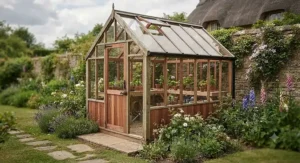
Built in Gloucestershire by one of the UK’s longest-established greenhouse manufacturers, the Halls Cotswold Burford 6×8 stands out for its patented Zero Threshold sliding door system, which removes the raised door lip that trips up wheelbarrows, wheelchairs, and distracted gardeners carrying full watering cans. The frame is described by the manufacturer as high-profile, heavy-duty aluminium, noticeably thicker in person than budget rivals, paired with a strong ridge bar and an integral metal base that speeds up installation compared with building onto a separate foundation. Buyers choose from three glazing options: 3mm horticultural glass, 3mm long-pane toughened glass, or 6mm twin-wall polycarbonate, which means this single model can be specified as a clear-view classic or a tougher, child-safe alternative depending on your household. Halls backs the frame with a substantial 12-year guarantee. Aggregated review sentiment praises the sturdy feel and wide integral gutters, though at least one detailed review flagged that the frame flexed in a severe storm before additional cross-bracing was fitted, a useful reminder that anchoring and bracing matter regardless of build quality. On balance, this is a strong pick for anyone prioritising easy access and a long frame guarantee.
Pros:
- ✅ Zero Threshold door removes trip hazards for wheelbarrows and mobility aids
- ✅ Choice of three glazing types to suit family safety needs
- ✅ 12-year frame guarantee, among the longest at this tier
Cons:
- ❌ One documented case of frame flex in severe storms without extra bracing
- ❌ Heavier components require two people for a comfortable build
Expect a price in the £700-£1,000 range depending on glazing choice, with toughened glass and polycarbonate options typically costing more than standard horticultural glass.
7. Rhino Premium 6×8 — best premium build quality and warranty
If budget stretches far enough, the Rhino Premium 6×8 is built around a genuinely different proposition: the manufacturer states its frame uses 60% more aluminium than typical competitor structures, with added T-section bracing at every strut of the eaves and ridge, aimed squarely at gardens exposed to real British weather rather than a sheltered suburban corner. Standard specification includes two double roof vents with automatic openers, two five-blade louvre side vents, integral gutters and downpipes, hanging basket rails, and a low-threshold doorway wide enough for a wheelbarrow. Glazing is 4mm toughened safety glass as standard, described as 33% thicker than typical greenhouse glass, held with rubber glazing beads rather than clips for a more weatherproof seal. Here’s what to weigh: automatic vent openers mean the greenhouse regulates its own temperature even when you’re at work, which meaningfully reduces the risk of scorched seedlings on an unexpectedly hot midweek day. Rhino backs the frame with a 25-year guarantee, the longest on this list by a wide margin, and the brand markets itself as Britain’s best-loved greenhouse manufacturer. The trade-off is straightforward: this is the most expensive model here, and the extra ventilation hardware means more moving parts to maintain over the years.
Pros:
- ✅ 60% more aluminium in the frame than typical rival structures
- ✅ Automatic roof vent openers regulate heat without manual checking
- ✅ Class-leading 25-year manufacturer guarantee
Cons:
- ❌ Significantly higher upfront cost than every other model on this list
- ❌ More vents and moving parts mean more long-term maintenance
Pricing typically sits well above £1,000, often in the £1,300-£1,700 range depending on colour and accessories, positioning it as a long-term investment rather than an impulse buy; check the manufacturer directly for current figures.
Practical Usage Guide: Setting Up Your 6×8 Greenhouse
Getting a 6×8 greenhouse right starts before the first panel goes in. Lay the base square first: measure both diagonals and adjust until they match exactly, because even a couple of centimetres of skew will make every door and vent fight you for the life of the structure. Whichever of the seven models you choose, anchor it properly on day one rather than treating that as an optional extra for later; ground anchors, concrete-set bolts, or a weighted paving base all work, but an unsecured 6×8 aluminium greenhouse is dangerously light in strong gusts. In the first 30 days, the most common mistake is leaving panels only partially fitted overnight, which can let water track behind the glazing and either warp polycarbonate or crack a stressed glass pane by morning; complete each wall section fully before stopping for the day. Once built, bed in a simple maintenance schedule: check door runners and vent hinges monthly for grit build-up, particularly on sliding-door models, and clear gutters each autumn before falling leaves clog the downpipes and send water pooling against the base frame. An optimisation trick few sellers mention is fitting an automatic vent opener even on a manual-vent model; a basic wax-cylinder opener costs relatively little and prevents the single most common greenhouse disaster, which is cooking your seedlings on the one hot day you happened to be at work. Finally, resist the urge to fully glaze and plant on the same weekend. Let the structure settle and the door run smoothly for a few days before loading up staging and pots, so you catch any adjustment issues while the greenhouse is still empty and easy to access.
Real-World Scenarios: Which 6×8 Greenhouse Suits You?
Picture three fairly typical buyers. First, a retired couple with a modest suburban garden who want to raise bedding plants each spring and overwinter a few tender pots; their budget sits around £300-£400, they are not fussed about glass clarity, and they value ease of assembly over ultimate durability, which points squarely at the Palram Canopia Harmony 6×8 Silver or the Outsunny 6×8 Polycarbonate Greenhouse with Base. Second, a family on a windy edge-of-town plot with two young children and a football that finds every window in a two-mile radius; here, safety and wind resistance matter more than glazing clarity, making the twin-wall Palram Canopia Mythos 6×8 Silver or the polycarbonate-glazed option on the Halls Cotswold Burford 6×8 sensible choices, since both remove the shattered-glass risk while still offering reasonable insulation. Third, a serious allotment grower who is on their plot several times a week, wants to grow cordon tomatoes and overwinter chillies, and has watched a cheaper greenhouse get battered by two winters already; for this buyer, the reinforced frame and automatic ventilation of the Rhino Premium 6×8, or the Zero Threshold access and glazing flexibility of the Halls Cotswold Burford 6×8, represent money well spent rather than an extravagance, because the cost of a second greenhouse after a storm write-off dwarfs the price difference up front.
How to Choose the Best 6×8 Greenhouse
Working through these criteria in order will narrow seven options down to one fairly quickly.
- Decide on glazing first. Glass gives the clearest light and looks smarter, but a stray football turns it into a hazard; polycarbonate sacrifices a little clarity for genuine impact resistance, which matters if children or pets share the garden.
- Check the frame gauge, not just the material. Every model here uses aluminium, but wall thickness varies hugely between a budget kit and something like the Rhino Premium 6×8, and that difference shows up during the first proper storm.
- Match warranty length to how long you plan to stay put. A five-year guarantee on the Palram Canopia Harmony 6×8 Silver is fine for a starter garden; a 12- or 25-year guarantee on the Halls Cotswold Burford 6×8 or Rhino Premium 6×8 makes more sense for a forever home.
- Think about door access before you fall in love with a design. Sliding doors save swing space in tight gardens, while the Zero Threshold system on the Halls Cotswold Burford 6×8 genuinely helps with wheelbarrows and mobility aids.
- Count your vents. A single manual roof vent is workable for casual growing; multiple vents plus louvres, as on the Rhino Premium 6×8, become important once you are growing heat-sensitive crops in a hot summer.
- Confirm the base is included or budget separately. Some kits, like the Outsunny 6×8 Polycarbonate Greenhouse with Base, include a foundation; others expect you to build or buy one.
- Read aggregated reviews for assembly complaints specifically. Recurring mentions of misaligned panels or draughty doors, as seen with some Waltons 6×8 Polycarbonate Greenhouse feedback, often trace back to base levelling rather than the product itself, but it is worth knowing before you commit a weekend to the build.
6×8 Polycarbonate Greenhouse vs 6×8 Aluminium Greenhouse
This comparison causes more confusion than it should, mostly because the two terms describe different parts of the same structure rather than competing whole designs. Every model on this list, from the Outsunny 6×8 Polycarbonate Greenhouse with Base to the Rhino Premium 6×8, actually has an aluminium frame; the real choice is about glazing, and specifically whether that frame is fitted with polycarbonate panels or glass. A 6×8 polycarbonate greenhouse, such as the Palram Canopia Harmony 6×8 Silver or Palram Canopia Mythos 6×8 Silver, wins on safety and insulation: the material won’t shatter into sharp shards, and twin-wall variants trap air for noticeably better heat retention on cold nights. Where it loses out is light clarity, since polycarbonate diffuses light rather than transmitting it perfectly clear, which can slightly slow growth for light-hungry crops compared with glass. A 6×8 aluminium-framed glass greenhouse, like the Vitavia Venus 5000 6×8, delivers close to full light transmission and a classic look many gardeners simply prefer, but standard horticultural glass is more fragile and a genuine consideration around children or windy, exposed sites. The practical answer for most buyers is not to pick a side but to match the glazing to the household: families with young children or pets, or anyone on a windy site, lean polycarbonate; gardeners chasing maximum light for demanding crops, in a sheltered spot away from footballs, lean glass, or a toughened-glass model like the Rhino Premium 6×8 that splits the difference.
Common Mistakes When Buying a 6×8 Greenhouse
The single biggest mistake buyers make is measuring only the greenhouse footprint and forgetting the door swing and roof vent clearance, which can leave a 6×8 model uncomfortably close to a fence or shed once fully open. A close second is skipping the base budget entirely; a model like the Outsunny 6×8 Polycarbonate Greenhouse with Base bundles this in, but several rivals on this list expect a separate concrete pad, paving slabs, or a dedicated base kit, and forgetting to price that in is how a £350 greenhouse quietly becomes a £500 project. Buyers also frequently underestimate ventilation needs, assuming the single manual vent that ships with entry-level models like the Palram Canopia Harmony 6×8 Silver will be enough, only to find their plants scorching on the first genuinely hot week of summer; adding a second vent or an automatic opener early is far cheaper than replacing cooked seedlings. Another recurring error is ignoring wind exposure when choosing between single-wall and twin-wall polycarbonate, or standard and toughened glass; a coastal or hilltop plot punishes a lightweight budget frame far more than a sheltered urban garden does. Finally, plenty of first-time buyers assemble the whole structure before checking local planning rules or, for allotment holders, checking their site’s structure policy, which can mean an awkward conversation with a neighbour or committee after the concrete has already gone off.
Greenhouse Base Kit 6×8: What You Need to Know
Not every 6×8 greenhouse arrives with a foundation, and getting this wrong undoes even the best-built frame. A dedicated greenhouse base kit 6×8 typically consists of galvanised steel or aluminium perimeter rails that bolt together into a rectangle matching the greenhouse footprint, which then gets levelled, squared, and anchored into the ground or onto paving before the frame goes up. Models like the Outsunny 6×8 Polycarbonate Greenhouse with Base and the Halls Cotswold Burford 6×8 include an integral base as part of the kit, saving buyers the cost and hassle of sourcing one separately, while others, including some Waltons 6×8 Polycarbonate Greenhouse listings and the Vitavia Venus 5000 6×8, may need a base purchased or built to spec. On paper this means budget comparisons between models can be misleading unless you check whether a base is genuinely included. If you are buying a base kit separately, three things matter more than the marketing photos: it must sit dead level in both directions, it must be anchored rather than simply resting on soil, and it should be checked against the exact external dimensions of your chosen greenhouse model rather than assumed to be universal. Concrete slab foundations offer the most permanent, storm-resistant option, while a purpose-made base kit on firm, compacted soil is the practical middle ground most allotment growers choose.
Greenhouse Shelving Layout for a 6×8 Space
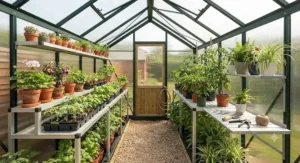
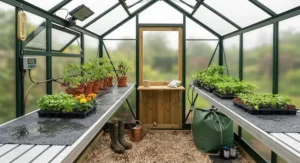
A 6×8 footprint sounds generous until staging, pots, and a watering can start eating into it, so layout planning pays off. The most space-efficient approach for most of the seven models here is to run a single row of staging down one long side, leaving the full width of the opposite side clear for walking, wheelbarrow access, and taller crops like cordon tomatoes grown directly in the border soil or growbags. Two-tier staging, similar to the resin shelving accessories Palram sells for its Harmony and Mythos ranges, roughly doubles usable growing surface for seed trays and pots without needing extra floor space, which matters hugely in a structure this size. For gardeners who want growing space on both sides, narrower single-tier staging along each wall with a central path works, though it noticeably reduces manoeuvring room and is better suited to a 6×8 used mainly for propagation rather than mature plant growth. Position taller plants and hanging baskets toward the back or ridge, where headroom is greatest, and keep the area immediately inside the door clear for tools, watering cans, and the wheelbarrow you will inevitably need to bring in at some point. Finally, leave a narrow gap between staging and the polycarbonate or glass wall itself; airflow behind pots reduces the risk of condensation-driven mould building up against cold glazing overnight.
Is a 6×8 the Right Size for Your Allotment Plot?
A 6×8 greenhouse is one of the most common sizes seen on UK allotments, but “common” doesn’t automatically mean “permitted,” so this is worth checking before ordering. Standard UK allotment plots are traditionally measured in rods, with a full plot around 250 square metres and a half plot around 125 square metres, according to Runnymede Borough Council’s allotment guidance. Most site committees cap all structures combined at somewhere between 20% and 25% of total plot area, which means a 6×8 footprint, at roughly 4.6 square metres, is comfortably within limits on a standard 125-square-metre half plot, but could be a tight squeeze or even breach the rules on smaller quarter-size or reduced plots common in oversubscribed urban areas. Before ordering any of the seven models covered here, check your specific site’s tenancy agreement rather than assuming, since rules vary noticeably between local authorities and self-managed sites. It is also worth positioning the greenhouse away from the plot boundary and any shared paths, both to satisfy committee rules and to reduce the temptation for casual theft, a genuine concern on open allotment sites without on-site security. For growers on a genuinely small plot, a 6×6 or 6×4 version of models like the Palram Canopia Harmony range may be the more sensible fit, freeing up growing beds elsewhere on the plot.
Long-Term Cost & Maintenance
The sticker price is only the first instalment. Polycarbonate models such as the Outsunny 6×8 Polycarbonate Greenhouse with Base and both Palram Canopia options need almost no ongoing spend beyond an occasional soft-brush clean to keep light transmission up, since the panels won’t need repainting or resealing. Glass models like the Vitavia Venus 5000 6×8 carry a small ongoing risk of replacement panes after storm damage or an errant football, and horticultural glass replacements, while not expensive individually, can add up if breakages become a repeated issue on an exposed site. Frame maintenance is minimal across the board thanks to aluminium’s natural corrosion resistance, though anodised and powder-coated finishes, as used on the Vitavia Venus 5000 6×8 and Halls Cotswold Burford 6×8, tend to hold their appearance longer than bare mill-finish aluminium. Looking at total cost of ownership over a decade, the higher upfront price of the Rhino Premium 6×8 or Halls Cotswold Burford 6×8 starts to look more reasonable once you factor in a 25-year and 12-year warranty respectively against the very real possibility of a budget frame needing full replacement after a decade of British winters. Automatic vent openers, whether factory-fitted on the Rhino Premium 6×8 or retrofitted to a budget model, typically need a wax cylinder replacement every few years, a minor running cost that pays for itself many times over in prevented heat damage.
Features That Actually Matter (And Those That Don’t)
Cutting through the marketing copy, a few features genuinely change your day-to-day experience, and a few are mostly noise. Twin-wall glazing, as fitted on the Palram Canopia Mythos 6×8 Silver, matters because the insulation difference is measurable and extends your effective growing season at both ends of the year. A wide, low-threshold door, the standout on the Halls Cotswold Burford 6×8, matters because you will use that door dozens of times a week, and a design you have to fight with becomes a genuine daily irritation. Multiple, ideally automatic, roof vents matter enormously once summer arrives, as the difference between one manual vent and the fully automated system on the Rhino Premium 6×8 is the difference between checking your plants anxiously on a hot Tuesday afternoon and simply not needing to. What matters rather less, despite how prominently it’s marketed, is exact frame colour; silver, green, or black aluminium perform identically once installed and come down to garden aesthetics rather than growing performance. Integral gutters are a nice-to-have rather than essential on most standard UK gardens with reasonable drainage, though they become genuinely useful for anyone planning to collect rainwater via a butt. Hanging basket rails, included as standard on the Rhino Premium 6×8, are a pleasant bonus rather than a deciding factor for most buyers, since basket hooks can usually be retrofitted to any frame.
Safety, Regulations & Planning Permission Guide
Most standard 6×8 greenhouses in England, Wales, and Scotland fall under permitted development and do not need planning permission, provided they meet a handful of conditions, according to Planning Portal’s official outbuildings guidance. In practice this means the structure must sit behind the front wall of the house, stay under 2.5 metres in height if within 2 metres of a boundary, and not push total garden coverage from all outbuildings combined past 50%. Every model on this list, at roughly 2m to 2.1m at the ridge, comfortably clears the height limits for a typical rear-garden installation. The main exceptions worth checking before you buy are listed buildings, which need separate consent, and conservation areas or Areas of Outstanding Natural Beauty, where local authorities can restrict permitted development rights entirely. Beyond planning rules, basic safety matters too: always anchor the structure regardless of how heavy it looks, since even the reinforced Rhino Premium 6×8 can be lifted or tipped by severe gusts if not properly secured to a base or ground anchors. Glass models should be sited with some thought for children’s play areas, and polycarbonate remains the safer default anywhere young families or boisterous pets share the garden. Following BBC Gardeners’ World siting advice, positioning your greenhouse away from overhanging trees also reduces both shading and the ongoing hassle of algae building up on glazing.
What is the Best 6×8 Greenhouse? Real-World Performance
On paper, specification sheets make every 6×8 greenhouse sound broadly similar, but real-world performance diverges quickly once weather gets involved. In a mild, sheltered suburban garden, the difference between the Palram Canopia Harmony 6×8 Silver and the Rhino Premium 6×8 may barely register day to day, both keeping frost off seedlings and extending the growing season by several weeks at either end of the year. On an exposed hillside allotment or a coastal plot, however, that gap widens dramatically: lighter budget frames and single-wall glazing genuinely struggle in sustained wind, while the reinforced bracing on the Rhino Premium 6×8 and the heavy-duty frame of the Halls Cotswold Burford 6×8 are built specifically to shrug off conditions that would flex or lift a lighter structure. Ventilation performance is the other area where spec sheets undersell real experience; a single manual vent, adequate on a mild spring day, becomes a genuine limitation during a July heatwave, when temperatures inside an unventilated polycarbonate greenhouse can climb uncomfortably fast within an hour of direct sun. Twin-wall models like the Palram Canopia Mythos 6×8 Silver perform noticeably better than single-wall equivalents on cold nights in early spring and late autumn, meaningfully reducing the risk of a late frost catching out tender seedlings. The honest takeaway is that budget models perform perfectly well for casual, seasonal growing in typical UK gardens, while the premium end of this list earns its price specifically when your site, climate, or growing ambitions push beyond the ordinary.
FAQ
❓ What is the best 6x8 greenhouse for beginners?
❓ Is polycarbonate or glass better for a 6x8 greenhouse?
❓ Do I need planning permission for a 6x8 greenhouse in the UK?
❓ What base does a 6x8 greenhouse need?
❓ How much shelving fits inside a 6x8 greenhouse?
Conclusion
Choosing the best 6×8 greenhouse really comes down to matching the structure to your garden’s conditions and your own growing ambitions rather than chasing the longest spec sheet. If you are testing the waters with your first season of home growing, the Outsunny 6×8 Polycarbonate Greenhouse with Base or Palram Canopia Harmony 6×8 Silver deliver everything a casual grower needs without overcommitting financially. Families wanting a safer, better-insulated middle ground should look closely at the Palram Canopia Mythos 6×8 Silver, while anyone wanting the clarity of glass alongside solid all-round durability will find the Vitavia Venus 5000 6×8 hard to beat. For gardeners on exposed sites, or those simply unwilling to compromise on build quality and access, the Halls Cotswold Burford 6×8 and Rhino Premium 6×8 represent genuine long-term investments backed by warranties that outlast most other garden purchases entirely. Whichever model you choose from this list, remember that the base, the ventilation plan, and honest siting decisions will do as much for your growing success as the greenhouse itself. Take the time to get those fundamentals right, and any of these seven structures should reward you with years of extended seasons, healthier seedlings, and considerably less windowsill clutter.
✨ Ready to bring one of these home? Compare current prices and reviews before stock changes! 🌱🛠️
Recommended for You
- Best Lean To Greenhouse UK 2026: 7 Top Picks Reviewed
- 4 Tier Mini Greenhouse: 7 Best Picks for UK Gardens in 2026
- Best Mini Greenhouse UK 2026: 7 Tiered & Wind-Resistant Picks
Disclaimer: This article contains affiliate links. As an Amazon Associate, I earn from qualifying purchases. If you purchase products through these links, we may earn a small commission at no additional cost to you.
✨ Found this helpful? Share it with your friends! 💬🤗
