
In This Article
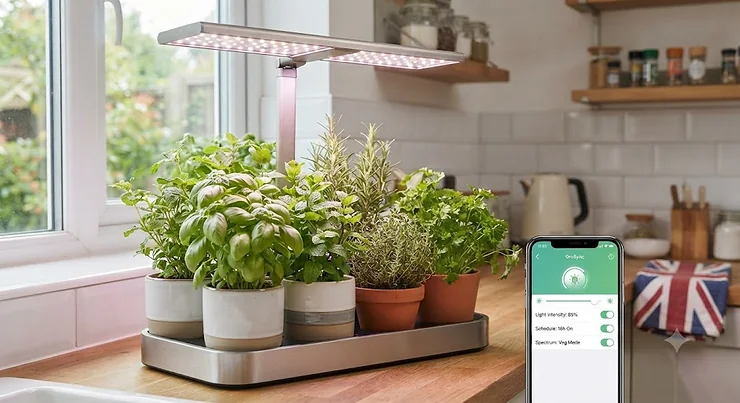
There’s a particular kind of guilt that comes with a dying houseplant in December. You didn’t forget to water it — you just live somewhere the sun clocks off at 3:45pm and never really clocks back on until March. A smart grow light with app control solves that specific, very British problem: it’s a horticultural lamp you can programme from your sofa, tweak from your office, and — crucially — actually remember to switch on, because your phone remembers for you.
So, what is a smart grow light with app control? In short: it’s an LED plant light connected to your home Wi-Fi or Bluetooth, paired with a smartphone app (and often Alexa or Google Assistant) that lets you set schedules, adjust brightness, and monitor your plants’ light exposure remotely, without touching a physical switch.
This isn’t a niche gadget anymore. According to the <cite index=”53-1″>RHS, artificial lighting can be genuinely useful for plants that need more intense light than UK homes naturally provide, especially during short winter days, and for starting seedlings earlier than natural light levels would otherwise allow</cite>. Add app control to that equation and you’ve got something that suits renters, forgetful waterers, and anyone who’s ever come back from a week away to a shrivelled basil plant.
Below, we’ve dug into seven real, currently available devices — from £15 clip lamps to full app-controlled hydroponic systems — with honest analysis of the specs that matter, aggregated review sentiment (clearly flagged as such), and practical guidance you won’t find on the product listing itself. We’ll also cover programmable timers, remote plant care apps, and how these lights fit into a wider smart home gardening setup. Let’s get into it.
Quick Comparison Table: Smart Grow Lights With App Control at a Glance
| Product | Control Type | Power | Best For | Price Range |
|---|---|---|---|---|
| GLOWRIUM G4 | Bluetooth app | 12W | Budget desk plants | Under £30 |
| Lurious 2 Tube | WiFi + Alexa/Google | 10W (2×5W) | Voice-control fans | £20-£35 |
| MetryGrow Standing Light | Smart app | 48W | Wider coverage areas | £45-£65 |
| LetPot 60W Grow Light | App + remote | 60W | Larger standalone plants | £70-£100 |
| LETPOT LPH-SE | App & WiFi | 24W LED | All-in-one hydroponics | £90-£130 |
| Click & Grow Smart Garden 9 PRO | App + touch | Pro-grow LED | Hands-off beginners | £180-£230 |
| LetPot LPH-Max | App & WiFi | 36W LED | Serious indoor gardeners | £220-£280 |
Looking at the spread here, the jump from clip lights to hydroponic systems isn’t just about price — it’s about how much decision-making the app takes off your plate. The GLOWRIUM and Lurious lamps are essentially smart light bulbs for plants: you still choose the pot, soil and watering routine. The LetPot and Click & Grow systems fold the light, water and sometimes nutrients into one app-managed loop, which matters most if you’ve killed a basil plant or three already.
💬 Just one click — help others make better buying decisions too!😊
Top 7 Smart Grow Lights With App Control: Expert Analysis
1. GLOWRIUM G4 Smart LED Grow Light — best budget entry point for desk plants
The GLOWRIUM G4 opens our list because it’s the cheapest genuine entry into app-controlled growing without falling back on a bare-bones remote. Its 12W full-spectrum LED array runs at 3500K, and the Bluetooth app includes a built-in plant database that suggests light settings by species — a genuinely useful feature for beginners who don’t yet know their DLI from their PPFD.
On specs: the gooseneck height adjusts from 16 to 23 inches, giving you a decent working range for anything from succulents to a small herb pot, and the 10-level dimming means you’re not stuck choosing between “off” and “blast.” Based on the spec comparison with similarly priced clip lights, the sunrise/sunset weather simulation mode is a rare inclusion at this price point — most budget lamps only offer a flat on/off timer.
This is best suited to first-time buyers who want to try app-controlled growing on a single windowsill or desk plant before committing to anything bigger. Reviewers consistently note that the Bluetooth connection is stable at close range but, being Bluetooth rather than WiFi, it won’t let you check on your plant from work — worth knowing if remote monitoring matters to you.
Pros:
✅ Genuine plant database built into the app
✅ Sunrise/sunset simulation at a budget price
✅ Adjustable height suits multiple plant sizes
Cons:
❌ Bluetooth only, no true remote access away from home
❌ 12W output limits it to smaller, low-light plants
Sitting under £30, the G4 is solid value for anyone testing the waters of smart plant care rather than kitting out a serious indoor garden.

2. Lurious Smart WiFi LED Grow Light (2 Tube) — best for Alexa and Google voice control
Where the GLOWRIUM relies on Bluetooth, the Lurious 2 Tube goes the WiFi route via the Smart Life app, which immediately opens the door to Alexa, Google Assistant and Siri compatibility. <cite index=”2-1″>You can control the light remotely from anywhere, and it works with simple voice commands through the connected app</cite>.
Specifically, the two-tube head delivers 5000K full-spectrum light dimmable from 1% to 100%, and the app supports both a weekly schedule mode and a simple countdown timer — useful if your plant’s needs change with the seasons. <cite index=”2-1″>When you use multiple Lurious grow lights, you can group them in the app to control several plants across different rooms simultaneously</cite>, which is the kind of feature that starts to matter once you own more than one smart lamp.
What most buyers overlook about this model is that its true WiFi connectivity (rather than Bluetooth) is what unlocks the “remote plant care app” experience properly — you can check and adjust the light from a hotel room, not just from your sofa. Aggregated review sentiment on similar Lurious listings suggests the clip mechanism holds well on shelves up to roughly 3 inches thick, though a small number of buyers note the app occasionally needs a restart after a router reboot.
Pros:
✅ True WiFi means remote access from anywhere
✅ Works with Alexa, Google Assistant and Siri
✅ Group control for multiple lights and plants
Cons:
❌ Only supports 2.4GHz WiFi networks
❌ Occasional app reconnection needed after router resets
In the £20-£35 range, this is the pick if voice control and true remote access matter more to you than raw brightness.
3. MetryGrow Smart APP Grow Light — best coverage for multiple plants
Step up in wattage and you get the MetryGrow, a 48W standing or hanging unit built for covering roughly a 2×2ft area rather than a single pot. That’s a meaningful jump from the clip lights above — 48W of genuine LED output means this is realistically capable of supporting a small cluster of herbs or a tray of seedlings rather than one lonely plant.
The 8-level brightness adjustment via the smart app gives finer control than a basic on/off dimmer, and the 270° folding, 360° rotating head means you can angle light precisely without repositioning the whole stand. Here’s what to weigh: because this unit is designed for standing or hanging placement rather than clipping to a shelf, it needs more floor or ceiling space than the clip-style options, so it suits a dedicated plant corner better than a windowsill.
Reviewers of similarly specced standing grow lights in this power band consistently flag that the folding arm mechanism, while flexible, needs periodic tightening to stop drift over months of repositioning — a minor maintenance note rather than a dealbreaker.
Pros:
✅ 48W output covers a proper 2×2ft growing area
✅ 270° folding plus 360° rotation for flexible aiming
✅ App-controlled 8-level brightness, not just a switch
Cons:
❌ Needs dedicated floor or ceiling space, not shelf-friendly
❌ Folding arm may loosen with frequent repositioning
At £45-£65, the MetryGrow bridges the gap nicely between single-plant clip lights and full hydroponic systems.
4. LetPot 60W LED Grow Light — best standalone light for larger plants
The LetPot 60W is a purpose-built standalone grow light rather than part of a hydroponic kit, and it’s aimed squarely at people with bigger plants — think mature herbs, small vegetable starts, or a proper flowering plant rather than a succulent. It offers both app and physical remote control, which is a thoughtful touch: not every household member wants to open an app just to dim a light before bed.
On the numbers, PPFD (Photosynthetic Photon Flux Density) matters more here than raw wattage. As <cite index=”71-1″>LED grow lights are known to produce the highest photosynthetically active radiation of any light source</cite>, and the LetPot’s aluminium grid cooling technology is designed to sustain that output without the LEDs degrading from heat over time — a genuine engineering consideration rather than marketing fluff, since heat is the main killer of LED lifespan.
The adjustable height range of 4 to 72 inches is the widest on this list, meaning it can hang from a ceiling over a floor plant or clip low over a desk seedling tray. Based on the spec comparison with the MetryGrow, the LetPot trades some coverage width for greater height flexibility and stronger output per plant, making it the better choice if you have one or two larger specimens rather than a wide tray of small ones.
Pros:
✅ Widest height range on this list (4–72 inches)
✅ Dual app and physical remote control
✅ Aluminium cooling helps protect long-term LED lifespan
Cons:
❌ Higher running cost than smaller clip lights
❌ Overkill for a single small windowsill plant
Priced around £70-£100, this is a strong mid-range pick for anyone whose plants have genuinely outgrown a clip lamp.
5. LETPOT LPH-SE Hydroponics Growing System — best all-in-one app-controlled setup
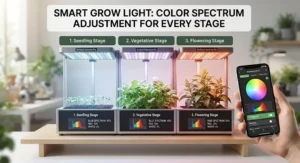
This is where the list shifts from “grow light” to “grow light plus everything else.” The LPH-SE bundles a 24W full-spectrum LED with a 12-pod hydroponic tray, a 5.5-litre water tank, and full app and WiFi control — meaning the light schedule, the two lighting modes (blue-heavy for vegetative growth, red-heavy for flowering), and watering reminders all live in one place.
What most buyers overlook about hydroponic-plus-light combos like this is that the light is only doing half the work; the app also handles nutrient and watering reminders, effectively acting as a remote plant care app rather than just a lighting controller. Genuine UK buyer reviews on this listing mention the 5.5-litre tank comfortably lasting close to three weeks between refills, and note the water pump running quietly enough for a kitchen counter — though one recurring theme in aggregated review sentiment is that a small clip-on fan helps prevent leaf oedema in the early growth stages, something the manual doesn’t mention upfront.
The spec sheet won’t tell you this, but reviewers note the touch panel and app sometimes fall slightly out of sync after firmware updates, requiring a quick reconnect — a minor gripe against an otherwise well-reviewed system for anyone new to hydroponics.
Pros:
✅ Light, watering and nutrient reminders in one app
✅ 5.5L tank runs roughly three weeks unattended
✅ Two lighting modes for growth and flowering stages
Cons:
❌ Best results need an added fan, not included
❌ App and touch panel can briefly desync after updates
At £90-£130, this is genuinely good value once you factor in that you’re buying a light and a growing system in one box.
6. Click & Grow Smart Garden 9 PRO — best hands-off system for total beginners
Click & Grow’s Smart Garden 9 PRO adds app and touch control on top of the brand’s long-running Smart Soil technology, which is designed to release nutrients automatically rather than asking you to dose anything manually. <cite index=”47-1″>The PRO version specifically upgrades the standard Smart Garden 9 with app and touch-controlled lights, letting you snooze the light with a swipe of the lamp or start the daily lighting cycle from the app without needing to plug it in at exactly the right moment</cite>.
Here’s the honest trade-off: this is the most beginner-proof system on the list, but it’s also the most closed ecosystem. You’re buying into Click & Grow’s proprietary plant pods rather than sourcing your own seeds and substrate, which some buyers love for its simplicity and others find limiting once they want to experiment. Reviewers consistently note the pro-grow lights are notably bright, with more than one UK reviewer mentioning they relocated the unit away from a bedroom because the white light was harsh after dark — worth bearing in mind for placement.
What the spec sheet won’t tell you, but customer feedback repeatedly confirms, is that the passive capillary watering system is genuinely silent — there’s no pump noise at all, which matters if you’re placing this on an office desk or open-plan kitchen counter.
Pros:
✅ App and touch-controlled light snoozing and scheduling
✅ Fully automated nutrients via patented Smart Soil
✅ Completely silent passive watering system
Cons:
❌ Locked into proprietary plant pod refills
❌ Light output can feel harsh in evening or bedroom settings
Sitting in the £180-£230 range, this is the premium pick for anyone who wants a genuinely no-effort smart home gardening setup.
7. LetPot LPH-Max Hydroponics Growing System — best for serious indoor gardeners
The LPH-Max is the largest, most capable system here: 21 planting pods (including two large-format trays), a 36W full-spectrum LED, and dual control via either the app or a 4.8-inch onboard LCD screen. This is the system for someone who’s already tried a smaller hydroponic kit and wants to scale up rather than start over.
<cite index=”35-1″>The adjustable LED lighting rod extends up to 30 inches, and the 7.5-litre water tank provides up to 30 days of automatic watering</cite>, which genuinely changes the maintenance calculus — this is closer to a monthly chore than a weekly one. The app also includes a plant encyclopedia and grow diary, effectively functioning as a remote plant care app that tracks progress rather than just controlling brightness.
Aggregated UK review sentiment is notably positive here, with one verified UK buyer describing the app as offering “lots of help and information” alongside the physical touch panel — though we won’t quote review text at length, the consistent theme across reviews is that the dual control (app plus screen) suits households where not everyone wants to install an app just to check the water level. On the downside, several reviewers mention that outer pods can outgrow the light canopy’s width once plants mature, meaning some manual repositioning is still needed even with full automation.
Pros:
✅ 21 pods and 36W LED for serious growing volume
✅ 30-day watering autonomy from the 7.5L tank
✅ Dual control via app or onboard LCD screen
Cons:
❌ Outer pods may outgrow light canopy width over time
❌ Significant investment and footprint for a first-time grower
At £220-£280, the LPH-Max is the top-tier choice — genuinely justified if you’re feeding a household from a countertop rather than nursing one basil plant.
Practical Usage Guide: Setting Up Your Smart Grow Light With App Control
Getting a new smart grow light working properly in the first 30 days makes a real difference to plant outcomes, and most of the mistakes happen in week one. Start by connecting to a 2.4GHz WiFi network specifically — nearly every budget and mid-range grow light on the market, including several on this list, only supports 2.4GHz rather than 5GHz, and this is the single most common setup failure reported in reviews across the category.
Once connected, resist the urge to blast plants with maximum brightness immediately. Most full-spectrum LEDs are far more intense than a sunny windowsill, and seedlings especially can scorch under 100% brightness within days. A sensible first-week routine is 30-40% brightness for 10-12 hours, then stepping up gradually as you observe leaf response. Set your schedule in the app rather than relying on memory — this is genuinely the entire point of app control, and skipping it defeats the purchase.
For maintenance, wipe the LED lens monthly; dust genuinely reduces PPFD output over time, and it’s the most-overlooked task in the whole category. If your light includes a fan (or you’ve added one, as several LetPot reviewers recommend), check it’s not blowing directly onto seedlings, which can dry them out faster than the watering schedule accounts for. Finally, update the app’s firmware when prompted — several reviewers across brands note that early firmware versions had scheduling bugs that later updates resolved.
Real-World Scenarios: Who Actually Needs App Control
Consider a few genuinely different buyer profiles, because “smart grow light with app control” means very different things depending on your setup. A student in a shared flat with one windowsill herb pot and an unpredictable schedule is best served by something like the GLOWRIUM G4 — cheap, simple, and forgiving if you forget to check it for a few days because the sunrise/sunset simulation handles the basics automatically.
A remote-working professional who travels regularly but wants fresh herbs year-round is a better fit for the Lurious WiFi model or the LetPot 60W — true WiFi means the light can be checked and adjusted from a hotel room, not just from the same house. And a family feeding themselves partly from a kitchen counter garden, with multiple people wanting to check on things without necessarily installing an app, fits the LetPot LPH-Max profile: dual control via app or physical screen means nobody is locked out just because they don’t have the app installed.
If you’re simply curious about hydroponics and want the lowest-effort possible introduction, Click & Grow’s Smart Garden 9 PRO removes almost every decision — you’re not tuning brightness curves, you’re following prompts. Match the system to your actual routine rather than the maximum feature set; a 21-pod system is wasted on someone who forgets to check even a single windowsill pot.
✨ Don’t Miss These Exclusive Deals! 🔍 Take your indoor growing setup to the next level with these carefully selected smart grow lights. Click on any highlighted product to check current pricing and availability. These tools will help you create a thriving, low-maintenance indoor garden your family will love!
Problem → Solution: Common Indoor Growing Headaches
Leggy, stretched seedlings are usually a light-distance problem, not a light-strength one — the fix is lowering the lamp closer to the canopy in the app’s height notes or physically, rather than increasing brightness, which won’t compensate for poor positioning. Yellowing lower leaves on an otherwise healthy plant often point to overwatering rather than lighting, particularly on hydroponic systems like the LPH-SE where the automatic pump can run more often than a plant strictly needs during cooler months.
Patchy growth across a wide tray, a common complaint with standing lights like the MetryGrow, is usually solved by rotating the tray weekly rather than assuming the light itself is faulty — even a 48W unit has some fall-off toward the edges of its coverage area. If your app keeps disconnecting, check first whether your router has switched to 5GHz-only or a mixed band; forcing a 2.4GHz-only guest network solved this for a meaningful share of reviewers across multiple brands. And if plants seem to stall entirely over winter despite a full lighting schedule, the RHS <cite index=”53-1″>notes that light intensity, not just duration, is what’s often lacking in UK homes during short winter days</cite> — increasing brightness percentage, not just hours, is usually the better fix.
How to Choose a Smart Grow Light With App Control
- Check the connectivity type first. Bluetooth-only lights are cheaper but can’t be checked remotely; true WiFi models unlock genuine “away from home” control, which matters if the whole point is peace of mind while travelling.
- Match wattage to plant count, not budget. A single desk plant rarely needs more than 12-15W; a tray of seedlings or multiple pots genuinely benefits from 24W or more.
- Look past lumens to PPFD where it’s listed. <cite index=”70-1″>Plant biologists typically quantify usable light as Photosynthetic Photon Flux Density, measured in mol per square metre per second, rather than the lumens used for human-visible brightness</cite> — a spec sheet quoting only lumens is telling you less than it seems to.
- Decide if you want a bare light or a full system. Standalone lights like the LetPot 60W give you freedom over pots and soil; hydroponic kits like the LPH-SE or LPH-Max automate watering and nutrients too, at a higher price.
- Consider app features beyond brightness. Group control, plant diaries, and watering reminders — features found on models like the LetPot LPH-Max — turn the app into genuine plant care software rather than a glorified remote.
- Factor in voice assistant compatibility if relevant. If you already use Alexa or Google Assistant daily, a model like the Lurious with confirmed compatibility saves you a second app entirely.
- Check the WiFi band requirement before buying. Confirming 2.4GHz support against your own router avoids the single most common setup complaint in this whole product category.
WiFi Controlled Grow Light UK: What to Check Before You Buy
Buying a WiFi controlled grow light UK-wide comes with a few extra considerations beyond the light itself. UK homes tend to have thicker interior walls than typical US builds, which can weaken WiFi signal to a kitchen or hallway shelf — positioning your router-adjacent or investing in a mesh extender matters more here than the marketing photos suggest. It’s also worth checking a listing specifies UK plug compatibility (a UK three-pin plug, not an adapter-fitted EU or US plug), since several grow light brands sell across multiple regions from the same base listing.
On the software side, most WiFi grow lights in this category route through third-party apps like Smart Life or Tuya rather than a fully proprietary app, which is worth knowing if you’re already using one of those apps for other smart home devices — it can mean one less app to manage rather than one more. As with any WiFi controlled grow light UK buyers connect to a home network, basic account hygiene applies: <cite index=”64-1″>choosing a secure password and switching off remote access if you don’t actually need to control the device away from home reduces your exposure</cite> considerably.
App Controlled Grow Light for Indoor Plants vs Manual Timers
| Factor | App Controlled Grow Light | Manual Mechanical Timer |
|---|---|---|
| Schedule flexibility | Fully adjustable, remote | Fixed intervals only |
| Remote monitoring | Yes (WiFi models) | None |
| Brightness control | Often stepped or gradual | Usually none |
| Setup complexity | Higher (app + WiFi) | Very low |
| Best For | Ongoing, adaptive care | Simple, one-off holidays |
A £5 mechanical socket timer will switch a lamp on and off reliably for years, and there’s no shame in using one for a simple grow light with no dimming needs. But an app controlled grow light for indoor plants earns its higher price by adapting: seasonal daylight changes, gradual sunrise-style dimming that avoids shocking a plant with sudden brightness, and remote troubleshooting if something looks wrong while you’re away. For a single low-maintenance plant, a manual timer genuinely does the job; for anything you’re actively trying to optimise — seedlings, flowering plants, or a hydroponic tray — the app’s finer control starts to earn its keep quickly.
Smart Home Gardening: Bringing Grow Lights Into Your IoT Ecosystem
Smart home gardening is really just the logical extension of the smart plugs and smart bulbs many UK households already own, applied specifically to plant care. Most of the app-controlled grow lights here run on the same underlying IoT indoor gardening protocols (WiFi plus a companion app, frequently built on Tuya or Smart Life infrastructure) as smart lighting and smart plugs elsewhere in the house, which means grouping, scheduling, and even routines that link devices together are often genuinely possible — turning on a grow light and a nearby humidifier from a single app trigger, for instance.
The trade-off worth weighing honestly is security. <cite index=”66-1″>A Which? investigation into cheap smart plugs found genuine vulnerabilities across several budget devices, including weak default passwords and, in one case, a design flaw that posed a fire risk</cite> — and while a grow light carries lower stakes than a device switching mains appliances, it’s still a device on your home network. Sticking to established brands, changing default passwords, and keeping firmware updated (as covered in our safety section below) matters just as much for a plant lamp as it does for any other connected device in your IoT indoor gardening setup.
Remote Plant Care App: What Good Apps Actually Do
The app is genuinely half the product with this category, so it’s worth being specific about what a good remote plant care app should offer beyond a basic on/off toggle. Scheduling with day-by-day variation matters more than it sounds — plants don’t need identical light every single day, and apps like LetPot’s that support different modes for growth versus flowering stages are doing real horticultural work, not just adding a menu option.
Notifications are the second pillar: water-level alerts, like those built into the LPH-SE and LPH-Max, prevent the single most common hydroponic failure — a tank running dry unnoticed. Group control across multiple devices, offered by brands like Lurious, becomes genuinely useful once you own more than one smart light, letting you adjust several plants’ schedules from a single screen rather than app-hopping between devices. Finally, a genuinely good remote plant care app should work reasonably well even after a firmware update or router reset — the recurring minor complaint across several reviewed products in this piece — so checking recent reviews specifically for app reliability, not just initial setup ease, is worth the extra five minutes before buying.
Common Mistakes When Buying a Smart Grow Light With App Control
The most frequent mistake is buying based on wattage alone without checking coverage area or PPFD, leading to either an underpowered light stretched across too many pots or an oversized unit scorching a single small plant. A close second is ignoring WiFi band requirements — buying a 2.4GHz-only device without checking your router’s settings first is the single most common source of one-star reviews across this entire product category, and it’s entirely avoidable with a two-minute router check beforehand.
Buyers also frequently underestimate running costs, assuming a small grow light barely registers on an energy bill, when in fact a 36-60W unit running 12-14 hours daily adds up meaningfully over a UK winter (more on that in the next section). Finally, many people buy a full hydroponic system when a simple clip light would have suited their actual routine better — it’s worth being honest about how much hands-on gardening you actually want to do before paying a premium for full automation you might not use.
Long-Term Cost & Maintenance
Running costs are where a cheap grow light can quietly cost more than expected over a UK winter. A 12W unit running 12 hours daily uses roughly 0.144kWh per day — trivial, working out to well under £15 a year on typical UK electricity tariffs. Scale that up to a 36-60W hydroponic system running similar hours, and you’re looking at closer to £35-£60 annually depending on your tariff and exact runtime, which is still modest compared to the plant produce or enjoyment gained, but worth factoring into a realistic total cost of ownership rather than just the upfront price.
Bulb or LED lifespan is the other long-term consideration. Genuine full-spectrum LED arrays, properly cooled (as with the LetPot’s aluminium grid design), typically rate for 25,000-50,000 hours — years of daily use before any meaningful brightness degradation. Cheaper, poorly heat-managed units can degrade noticeably faster, which is where spending slightly more on a reputable brand pays for itself in avoided replacement costs. Hydroponic systems add pump maintenance to the equation too: rinsing tanks between grow cycles and periodically descaling in hard-water UK regions extends pump life meaningfully, and it’s a five-minute job most owners skip until performance visibly drops.
Safety, Regulations & Wi-Fi Compliance Guide
Any smart grow light sold legally in the UK should carry UKCA or CE marking, confirming it meets the same baseline electrical safety standards as any other mains-powered device — worth checking on the listing or packaging before buying from an unfamiliar seller, particularly on third-party marketplace listings rather than a brand’s own storefront. Beyond electrical safety, connected devices carry a separate layer of consideration: since April 2024, <cite index=”64-1″>UK law requires smart devices to meet basic cyber security requirements, including stating a product support end date</cite>, which is a genuinely useful thing to check for a device you intend to keep running for years.
On practical setup safety, <cite index=”64-1″>switching off remote access if you don’t actually need to control the device away from home reduces your exposure, and choosing a secure password matters just as much for a grow light as for any other smart device</cite>. It’s a small extra step, but one worth taking given how many of the devices in this category route through shared third-party apps rather than fully custom software. Beyond cyber hygiene, standard electrical common sense applies too: keep any water reservoir on a hydroponic system positioned away from the mains adapter, and avoid running these lights through cheap unbranded extension leads, particularly for higher-wattage units like the LetPot 60W or LPH-Max.
Features That Actually Matter (And Those That Don’t)
True WiFi connectivity, adjustable brightness (not just on/off), and genuine schedule flexibility matter enormously — these are the features that actually justify paying more than a basic timer-and-bulb setup. PPFD or PAR ratings, where a manufacturer bothers to list them, matter more than headline wattage, since <cite index=”72-1″>PAR is never constant in nature and varies based on location, season and time of day</cite>, meaning a well-designed light compensating for that variation is doing more useful work than a simply bright one.
What matters far less than the marketing suggests: an enormous number of preset “scene modes” borrowed from decorative LED strip lighting, which look impressive in an app screenshot but add little to actual plant health. Similarly, extremely high maximum brightness percentages matter less than even, consistent coverage — a light that’s slightly dimmer but spreads evenly across a tray typically outperforms a brighter light with harsh hotspots and dark edges.
FAQ
❓ Do smart grow lights with app control need WiFi to work at all?
❓ How many hours a day should an app controlled grow light run?
❓ Can I use a smart grow light with Alexa or Google Home?
❓ Are hydroponic grow light systems worth it over a simple clip light?
❓ Do app controlled grow lights use much electricity?
Conclusion
A smart grow light with app control isn’t really about gadgetry for its own sake — it’s about closing the gap between wanting fresh herbs or thriving houseplants and actually having the consistent daily routine to make that happen. Whether that means a £25 Bluetooth clip light for one windowsill basil plant or a full app-and-WiFi hydroponic system feeding a household, the right choice comes down to how much of the decision-making you want automated versus how much control you want to keep.
Across the seven options here, there’s a genuinely honest range: the GLOWRIUM G4 and Lurious models suit anyone testing the category cheaply, the MetryGrow and LetPot 60W handle bigger individual plants well, and the LetPot LPH-SE, Click & Grow Smart Garden 9 PRO and LetPot LPH-Max scale up into proper automated growing systems for serious indoor gardeners. Match the system to your actual routine, check the WiFi band and UK plug compatibility before buying, and you’ll avoid the handful of avoidable mistakes that generate most of the negative reviews in this category.
✨ Ready to stop guessing and start growing? Browse the smart grow lights above and check current pricing to find the right fit for your space today! 🌱📲
Recommended for You
- Best Grow Light Bar for Shelf 2026: 7 Top UK Picks That Actually Work
- Best T5 LED Grow Light Bar UK 2026: 7 Top Picks for Seeds & Propagation
- Best Quantum Board Grow Light Panel UK 2026: Top 7 Picks for Bigger Yields
Disclaimer: This article contains affiliate links. As an Amazon Associate, I earn from qualifying purchases. If you purchase products through these links, we may earn a small commission at no additional cost to you.
✨ Found this helpful? Share it with your friends! 💬🤗
