
In This Article
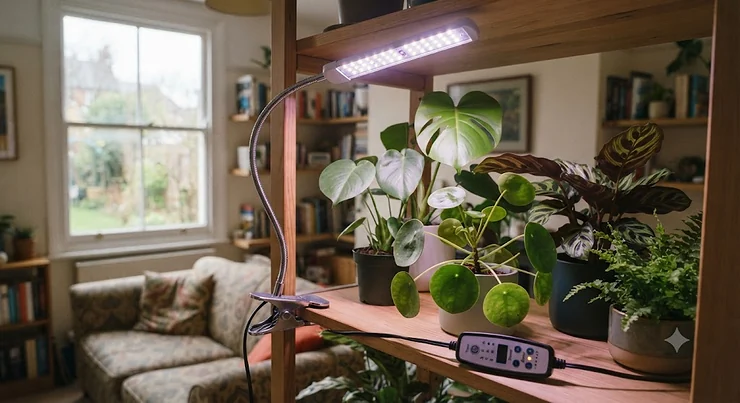
Somewhere between “I’ll just pop it on the windowsill” and “why has my basil gone the colour of old parchment” lies a small, humbling truth: most of us are terrible judges of how much light a room actually gets. British winters don’t help. By late October, a north-facing kitchen can drop to a fraction of the light a plant needs, and no amount of positive thinking will fix that. This is where a grow light with timer and dimmer earns its keep — it takes over the two jobs you’re most likely to forget or fumble: switching the light on and off at sensible hours, and giving your plant the right intensity rather than a relentless, one-setting blast.
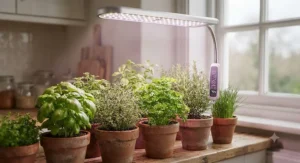
A grow light with timer and dimmer is a plant lamp, usually LED, that combines an automated on/off schedule with adjustable brightness in one fixture. Instead of remembering to flick a switch every morning and evening, or squinting at whether your seedlings are cooking under too much light, the timer handles the clock and the dimmer handles the intensity — together doing what a patient, attentive gardener would do by hand.
The market has exploded with options, from £20 clip-on lamps for a windowsill herb pot to serious tent-ready fixtures with daisy-chained dimmers. Some now sync with Alexa and Google Home, letting you dim a shelf of succulents by voice while your hands are full of compost. Whichever end of that spectrum suits you, the fundamentals are the same, and getting them right saves both your plants and your electricity bill. According to the RHS, artificial lighting is worth adding specifically where UK homes fall short on natural daylight — during short winter days, in windowless rooms, or when starting seedlings early for a head start come spring, as detailed in the RHS guide to artificial lighting for indoor plants.
This guide walks through seven real, currently available grow lights with timer and dimmer functions, breaks down what actually matters in the spec sheet, and gives you a practical framework for choosing between them — whether you’re nursing a single fussy fiddle-leaf fig or running a windowsill full of chilli seedlings.
Quick Comparison Table
| Product | Best For | Timer Options | Dimming | Price Range |
|---|---|---|---|---|
| Wolezek 4-Head LED Grow Light | Budget windowsill herbs | 4/8/12h auto-cycle | 10 levels | Under £30 |
| Garpsen 65″ Gooseneck Grow Light | Tall plants, floor use | 6/12/16h | 5 levels | £30-£45 range |
| SENTAIMAO 4-Head Grow Light | Remote-control convenience | Built-in timer | 10 levels | £25-£40 range |
| OFFCUP 4-Piece Grow Light Set | Multi-shelf propagation | Auto on/off 3/9/12h | 10 levels | £35-£55 range |
| Barrina T10 Pro Standing Light | Large floor plants | Foot-switch timer | Stepless | Mid-£60s range |
| Lurious Smart WiFi Grow Light | Alexa/Google voice control | App schedule + timer | App-controlled | £30-£45 range |
| VIPARSPECTRA Pro Series P1000 | Serious multi-plant grows | Compatible with external timers | Analogue dimmer knob | £90-£120 range |
Looking at the spread above, the Wolezek earns its place as the entry point simply because ten dimming levels at under £30 is rare value, while the VIPARSPECTRA sits at the other end for anyone treating a grow tent or several trays as a proper hobby rather than a windowsill afterthought. The middle ground — Garpsen, SENTAIMAO, OFFCUP and Barrina — is where most UK buyers will actually land, because they balance genuine auto on/off timer reliability with a dimmer range wide enough to serve seedlings and mature plants from the same fixture.
💬 Found a light that matches your space already? Check today’s availability before prices shift!😊
Top 7 Grow Lights With Timer and Dimmer: Expert Analysis
1. Wolezek 4-Head LED Grow Light — best budget pick for windowsill herbs
The standout here is simplicity married to genuine control: four flexible gooseneck arms, each independently aimable, paired with a proper built-in timer rather than the “you’ll need a separate plug timer” workaround that plagues cheaper lamps. The fixture mixes 3000K warm white, 5000K cool white and 660nm red LEDs into a full spectrum, drawing around 25-30W in real-world use — modest enough that running it 12 hours a day costs pennies rather than pounds. Its 10 dimming levels are the real party trick at this price point; most budget clip-ons offer three brightness steps at best, so being able to fine-tune from a gentle seedling glow up to a proper midday-strength beam is unusual generosity for under £30.
Based on the spec comparison with similar clip-on lamps, this model’s four-head, three-switch-mode design (letting you run one, two or all four heads) is what most buyers overlook when they first compare wattage figures — it means you’re not locked into lighting the whole tray if you’ve only got two pots that need help. Reviewers consistently report that the light spread tops out around 40cm wide per head, so it suits a cluster of small pots on a shelf or windowsill rather than a wide seed tray. It’s best suited to beginners with herbs, succulents, or a handful of seedlings who want something they can set up in five minutes and largely forget about.
Aggregated customer sentiment on Amazon UK, where the lamp holds an Amazon’s Choice badge with well over a thousand ratings, points to strong satisfaction with the flexible arms and the timer memory function, though a recurring theme in reviews is that the light doesn’t reach further than a small cluster of pots — so buyers with a longer windowsill often end up wanting two units rather than one.
Pros:
- ✅ Four independent gooseneck arms for flexible positioning
- ✅ Genuinely useful 10-level dimmer, rare at this price
- ✅ Very low running cost at roughly 25-30W
Cons:
- ❌ Light spread limited to around 40cm per head
- ❌ Timer offers fixed 4/8/12-hour cycles, no custom start time
At around £26.99 typical retail (check current price, as it fluctuates with periodic discounts), this is difficult to beat as a first grow light — the value verdict is straightforward: if your ambitions are a few pots on a shelf, this is probably all you need.
2. Garpsen 65″ Gooseneck Grow Light — best for tall or floor-standing plants
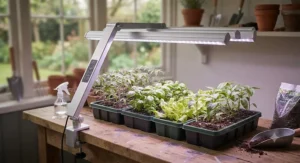
What immediately sets this apart from the desktop clip-ons is reach: a height-adjustable stand running from roughly 16.5 to 24.5 inches (with the 65″ gooseneck variant extending considerably further for larger specimens), meaning it can hover over anything from a low seed tray to a proper floor-standing fiddle-leaf fig without you jury-rigging a stack of books underneath. The 360-degree gooseneck and three colour modes give a level of positioning freedom that clip-on lamps, bolted to a single spot, simply can’t match.
Here’s what the spec sheet won’t tell you, but the design implies: because the light hangs from an adjustable pole rather than clamping to a shelf edge, it copes far better with plants that grow upward and outward over a season, since you’re not stuck re-clamping every few weeks as the plant outgrows its original position. The 6/12/16-hour auto timer options track fairly closely with the RHS recommendation that seedlings often need up to sixteen hours, while established houseplants generally do fine on shorter daily doses — a distinction that matters more than most buyers realise when a lamp only offers a single fixed cycle.
Reviewers frequently mention the stability of the base, which matters more than it sounds — a top-heavy grow light is a genuinely common complaint category for standing lamps, and Garpsen’s weighted foot appears to have been specifically engineered against tipping when the gooseneck is extended at an angle. Some review threads do note that assembly instructions are thin, so a few minutes with a video tutorial saves frustration on day one.
Pros:
- ✅ Height-adjustable stand suits tall or floor plants
- ✅ 360° gooseneck for precise light direction
- ✅ Three timer settings covering seedling to mature-plant needs
Cons:
- ❌ Assembly instructions are sparse out of the box
- ❌ Larger footprint than desktop models, needs floor space
Typically retailing in the £30-£45 range, this is solid value for anyone whose plant has simply outgrown a clip-on lamp and needs something built for height rather than width.
3. SENTAIMAO 4-Head Grow Light — best for remote-controlled convenience
The stand-out feature is the included remote control, a small but genuinely useful addition when your grow light lives somewhere slightly awkward to reach — behind a sofa-side plant stand, say, or mounted above a shelf you’d rather not climb on daily. Eighty full-spectrum LEDs are split across four heads, giving ten dimming levels and a built-in timer, putting it roughly on par with the Wolezek on paper but with the added convenience of adjusting brightness from the sofa rather than reaching up to the fixture itself.
What most buyers overlook about this model is that remote control isn’t just a gimmick for laziness — it genuinely extends the practical lifespan of the “correct” dimming setting, because you’re more likely to actually adjust brightness as your seedlings mature into sturdier plants if doing so takes two seconds rather than requiring you to physically access the unit. Based on the spec comparison with similarly priced four-head lamps, the LED count and dimming range are comparable to competitors, so the remote is genuinely the differentiator here rather than a marketing add-on bolted onto middling hardware.
Aggregated review sentiment suggests the remote’s signal range is reliable at typical room distances, though a minority of buyers note the remote’s buttons are small and can be fiddly for anyone with limited dexterity. Reviewers also flag that, like most lamps in this bracket, it lacks any daisy-chaining option, so multiple units each need their own remote and socket.
Pros:
- ✅ Remote control for hands-free brightness and timer adjustment
- ✅ 80 full-spectrum LEDs across four adjustable heads
- ✅ 10 dimming levels for precise light matching
Cons:
- ❌ Remote buttons are small and can be fiddly
- ❌ No daisy-chaining between multiple units
Priced typically in the £25-£40 range, this suits anyone who wants a grow light they genuinely will bother adjusting, rather than one they set once and never touch again.
4. OFFCUP 4-Piece Grow Light Set — best for multi-shelf propagation
Four separate 5000K full-spectrum panels, 540 LEDs total, each with its own genuine auto on/off timer set to 3, 9 or 12 hours — this is the model built specifically for people propagating across several shelves or trays rather than tending one pot. The auto on/off function, distinct from a simple countdown timer, means the unit remembers its schedule daily rather than requiring you to restart a countdown every time you plug it back in, which matters enormously if you’ve ever come home from a weekend away to seedlings that sat in darkness for two days because a basic timer had simply run out.
Based on the spec comparison, ten dimming levels per panel plus three lighting modes (a nod to the fact seedlings, vegetative growth and flowering-stage plants all want subtly different spectrums and intensities) puts this ahead of single-fixture competitors for anyone running a proper multi-tray propagation setup, such as starting tomatoes, chillies or salad leaves from seed before the UK growing season properly begins. What the spec sheet doesn’t spell out clearly is that four independent units, rather than one large panel, actually gives you more flexibility to stagger different plants at different growth stages under different settings simultaneously — a genuine advantage over single fixed-panel lights for anyone serious about succession sowing.
Reviewer sentiment is broadly positive on light coverage and the auto-memory timer function specifically, with several buyers noting it as the differentiator that pushed them to choose OFFCUP over single-panel alternatives; a recurring criticism is that four separate power adaptors and cables can create desk or shelf clutter unless you plan cable routing in advance.
Pros:
- ✅ True auto on/off memory timer, not just a countdown
- ✅ Four independent panels for multi-shelf setups
- ✅ 10-level dimming with 3 lighting modes per panel
Cons:
- ❌ Four separate cables can create clutter
- ❌ Higher total wattage than single-panel alternatives
Typically found in the £35-£55 range for the set, this is genuinely one of the better options if “automatic grow light for plants” is your priority and you’re managing more than a single tray.
5. Barrina T10 Pro Standing Grow Light — best for large floor-standing plants
The headline feature is scale: a vertical standing fixture running from roughly 115cm up to 165cm in height, with 169 LEDs delivering wide coverage designed specifically for tall or floor-standing specimens like a mature monstera, a lemon tree, or a fiddle-leaf fig that’s finally outgrown every desktop lamp you’ve thrown at it. The foot-switch timer is a genuinely practical touch too — no fumbling for a small button on a fixture mounted well above head height.
Here’s what most buyers overlook when comparing this against smaller clip-ons purely on wattage: coverage area matters as much as raw brightness for large plants, and a 42W fixture spread evenly across a wide vertical bar arrangement, positioned correctly, can outperform a higher-wattage but narrowly focused desk lamp for a plant with substantial leaf spread. Based on the spec comparison, the stepless (continuously variable, rather than stepped) dimming is a genuine upgrade over the fixed-level dimmers on the cheaper lamps in this list, letting you fine-tune brightness precisely rather than jumping between preset increments.
Reviewers frequently cite the height range as the reason they chose this model over cheaper alternatives, specifically for large houseplants that had previously been struggling in a dim corner; a recurring complaint is that the stand, while sturdy, takes up a genuine amount of floor space, so it’s not a fit for a small flat without a dedicated spot for it.
Pros:
- ✅ Height range up to 165cm suits large, mature plants
- ✅ Foot-switch timer, easy to reach at floor level
- ✅ Stepless dimming for precise brightness control
Cons:
- ❌ Significant floor footprint required
- ❌ Higher price point than desktop alternatives
Typically priced in the mid-£60s range, the value case here rests entirely on whether you actually have a large plant that needs it — for that specific job, few alternatives compete.
6. Lurious Smart WiFi LED Grow Light — best for Alexa and Google-compatible hands-free control
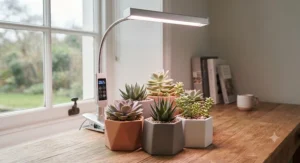
The defining feature is voice and app control: this clip-on, dual-tube fixture connects via the Smart Life app and works with Alexa, Google Assistant and Siri, meaning brightness, schedule and on/off state can all be adjusted without touching the lamp itself. For anyone whose hands are perpetually covered in compost or holding a watering can, being able to say “turn the plant light on” is a small but genuine quality-of-life upgrade over reaching for a physical switch.
Based on the spec comparison with non-smart clip-on lamps, the underlying hardware — full-spectrum LEDs, adjustable dimming, a 360-degree gooseneck — is broadly comparable to the Wolezek or SENTAIMAO. What most buyers overlook, though, is that the real value of smart grow light Alexa compatible models isn’t the novelty of voice commands but the scheduling flexibility: rather than being locked into fixed 4/8/12-hour presets, an app lets you set any custom start and end time, and some models let you build entirely different schedules for different days of the week, which suits anyone whose routine shifts between weekdays and weekends. This is a genuinely useful upgrade for hands-free plant lighting in households already using Alexa or Google Home for other smart devices, since it slots into an existing routine rather than requiring a dedicated new habit.
Aggregated review sentiment is positive on the app’s scheduling flexibility, though several reviewers note that first-time WiFi pairing can be fiddly, and that voice assistant smart devices occasionally lose connection after a router reboot, requiring the light to be re-added in the app. This is a common theme across smart home devices generally rather than something unique to this brand.
Pros:
- ✅ Full Alexa, Google Assistant and Siri compatibility
- ✅ Fully custom app-based scheduling, not just fixed presets
- ✅ Genuine hands-free control for busy households
Cons:
- ❌ Initial WiFi pairing can be fiddly
- ❌ Occasional reconnection needed after router changes
Typically priced in the £30-£45 range, this is the pick if voice control and smart home integration matter to you as much as the light itself — for a straightforward standalone lamp, one of the non-smart options above will do the same job for less.
7. VIPARSPECTRA Pro Series P1000 — best for serious multi-plant or tent growing
This is the outlier on the list in scale and intent: a genuine hobbyist-grade LED fixture with a 75cm x 75cm coverage area, an analogue dimmer knob for full-range brightness control, and daisy-chaining capability that lets several linked units share a single dimmer setting. It’s built for people running more than a handful of pots — a grow tent, a converted spare room, or several trays under one roof — rather than a windowsill herb garden.
Based on the spec comparison with hanging panel lights in this price bracket, the passive cooling design (a large aluminium heat sink rather than fans) is a genuine advantage: it means silent operation and one less moving part to eventually fail, at the cost of slightly less aggressive cooling than an actively-fanned unit under continuous heavy use. What the spec sheet won’t tell you, but the daisy-chain dimmer implies, is that this model is really designed around expansion — buy one now, add a second or third later, and dim them all in sync rather than managing each fixture’s brightness separately. Reviewers consistently note this as the reason for choosing VIPARSPECTRA over single, larger panels when scaling up a grow room over time.
Aggregated customer sentiment highlights the even light distribution across the coverage area, reducing hotspots that plague cheaper square panels, though it’s worth noting the unit doesn’t include a built-in timer of its own — for automated on/off scheduling, it needs pairing with a separate mechanical or smart plug timer, an extra step (and small extra cost) that budget buyers should factor in before assuming it matches this article’s “timer and dimmer” brief out of the box.
Pros:
- ✅ 75 x 75cm coverage suits multi-plant or tent setups
- ✅ Daisy-chain dimming across multiple linked units
- ✅ Silent, fully passive cooling
Cons:
- ❌ No built-in timer, requires a separate plug timer
- ❌ Overkill and higher cost for single-plant growers
Typically retailing in the £90-£120 range, the value case is strong specifically for anyone planning to scale beyond one or two plants — for a single houseplant, it’s genuinely more fixture than you need.
Setting Up Your Grow Light With Timer and Dimmer: A Practical Usage Guide
Getting a new grow light right in the first week matters more than most buyers expect, because early mistakes — hanging it too close, running it too long, or skipping the dimmer entirely — are the ones that actually stunt or scorch a plant. Start by positioning the light 20-30cm above small pots or clip-on setups, and 30-40cm for larger panel or standing lights, adjusting based on how the leaves respond over the following week rather than fixing the distance permanently on day one.
For the first 48 hours, set the dimmer to around 40-50% rather than full brightness, particularly for seedlings or plants recently moved from a shadier spot — sudden intense light can stress leaves that haven’t adjusted. Set the auto on/off timer to run 12-14 hours for most houseplants, or up to 16 hours if you’re specifically starting seeds, which broadly matches the RHS’s own guidance on artificial lighting for indoor growing. A common first-30-days mistake is treating the timer as “set and forget” without checking in — foliage colour is a genuinely useful diagnostic here, and pale, washed-out leaves or unusually leggy, stretched growth are both signs that the current combination of distance, timer length and dimmer setting needs adjusting.
If your lamp plugs into a shared extension lead alongside other devices, it’s worth checking the total load rather than assuming a grow light’s modest wattage is automatically safe to add — the Electrical Safety First charity specifically advises against overloading a single socket or lead, since even low-wattage devices add up when several share one connection, as outlined in their guidance on overloading sockets. For maintenance, a monthly wipe of the LED lens with a dry cloth keeps output consistent, since dust genuinely does reduce effective light intensity over months of continuous use.
✨ Ready to give your plants a head start this season?
🔍 Compare current listings for the grow light that best matches your setup, and check today’s price before you commit.
Real-World Scenarios: Which Grow Light Suits You?
Picture three fairly typical UK indoor growers, each with a different problem, and the mismatch between their situation and the wrong lamp becomes obvious fast. First, a university student in a shared house, keeping a small collection of succulents and a spider plant on a north-facing bedroom windowsill, with a tight budget and zero interest in fiddly setup. For this profile, the Wolezek 4-Head is close to ideal — cheap, quick to clip on, and its timer memory means it survives a chaotic student schedule without daily attention.
Second, a home-working professional with a large, mature fiddle-leaf fig that’s outgrown every desktop solution, living in an open-plan flat where floor space is at a premium but ceiling height isn’t a constraint. Here, the Barrina T10 Pro’s height-adjustable standing design earns its higher price, because coverage for a tall plant simply can’t be replicated by a small clip-on lamp regardless of how many you buy. Third, a retired gardener converting a spare room into a proper propagation station for starting vegetables from seed each spring, already comfortable with Alexa routines from other smart devices around the house. For this grower, either the OFFCUP multi-panel set (for sheer tray capacity) or the Lurious smart model (for scheduling flexibility tied into an existing smart home routine) makes more sense than a single fixed-timer lamp.
The common thread across all three is that the “best” grow light with timer and dimmer isn’t a single universal answer — it’s whichever model’s coverage, height range and control method actually matches the plant, the room, and how much daily attention the grower realistically wants to give it.
Problem → Solution: Fixing Common Grow Light Frustrations
Leggy, stretched seedlings reaching sideways toward a window are almost always a light-distance problem rather than a watering one — move the fixture closer, within the 20-30cm range for small setups, and increase the dimmer setting a step or two. Pale or bleached leaf patches, by contrast, usually mean the opposite: the light’s too close or too bright for that plant’s needs, so raising the fixture or dropping the dimmer down a level or two over a few days should restore normal colour.
A timer that keeps resetting to default hours after a power cut is a genuinely common frustration with budget lamps lacking true memory function — if this happens repeatedly, models like the OFFCUP with explicit “auto on/off memory” timers are built specifically to avoid it, whereas simple countdown-style timers need manually restarting each time. If a lamp seems dimmer than expected straight out of the box, check first whether the dimmer itself has been left on a low setting from the factory or a previous test — an easy thing to overlook and a common cause of “this doesn’t seem bright enough” first impressions.
For anyone finding a WiFi-connected smart grow light repeatedly dropping offline, the fix is almost always router-related rather than the lamp’s fault: most budget smart grow lights, including the Lurious model covered above, only support 2.4GHz WiFi rather than 5GHz, so ensuring your phone connects the lamp specifically to the 2.4GHz band during setup resolves the majority of dropout complaints reported in reviews.
What Is a Grow Light With Timer and Dimmer?
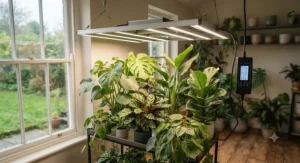
A grow light with timer and dimmer is an LED plant lamp that automatically switches on and off according to a preset daily schedule, while also letting you manually or digitally adjust its brightness to suit a plant’s growth stage. The timer replicates a consistent day-length cycle without you needing to remember it, and the dimmer lets you match intensity to what a seedling, a mature houseplant, or a flowering specimen actually needs, rather than running everything at one fixed brightness.
The underlying science is well established: plants respond to the relative length of light and dark periods, a phenomenon botanists call photoperiodism, which governs processes from flowering timing to dormancy, as documented in detail on Wikipedia’s overview of photoperiodism. A reliable timer is effectively a tool for controlling that photoperiod precisely, which matters more than most casual buyers assume — an inconsistent lighting schedule can confuse a plant’s internal clock just as much as too little light overall.
How to Choose a Grow Light With Timer and Dimmer
- Match coverage to your plant count. A single clip-on head suits one or two pots; multi-panel sets or standing lights are worth the extra cost only once you’re managing several plants or a wide tray.
- Check the timer type, not just the hours on offer. Fixed 4/8/12-hour presets are fine for most houseplants, but true auto on/off memory timers survive power cuts and irregular schedules far better.
- Look at the dimming range, not just “has a dimmer.” Ten-level dimmers give genuinely useful fine control; three-level or stepped dimmers force compromises between too dim and too bright.
- Consider smart features only if you’ll actually use them. Alexa or app control adds convenience and scheduling flexibility, but adds a small ongoing dependency on WiFi and an app account that non-smart models avoid entirely.
- Factor in height and reach for your specific plant. A lamp that can’t extend or hang far enough above a tall plant will underperform regardless of its wattage or LED count.
- Check for daisy-chaining if you plan to scale up. Anyone likely to add a second or third light later benefits from models built to link and share a single control point.
- Weigh running cost against wattage, not just purchase price. A cheaper lamp with genuinely lower wattage can cost less over a year than a pricier one left running at high brightness unnecessarily.
Grow Light With Auto On/Off Timer: Why the Memory Function Matters
Not all timers are built the same, and this is where a genuinely common source of buyer frustration lives. A basic countdown timer switches a light on for a set number of hours from the moment it’s plugged in or switched on manually — useful, but it means the schedule resets every time there’s a power cut, or every time you unplug the lamp to move it. An auto on/off timer with genuine memory, by contrast, retains its daily schedule even through interruptions, switching back into its normal 12-hour or 16-hour rhythm automatically once power returns.
This distinction matters more in the UK than in climates with fewer power interruptions, simply because winter storms and the odd tripped circuit are a fact of life here. For anyone prioritising an automatic grow light for plants that they genuinely won’t check daily — a spare room propagation station, a holiday home, or simply a busy household — models like the OFFCUP set, built specifically around this memory function, are worth the modest premium over lamps offering only basic countdown timers.
Automatic Grow Light for Plants vs Manual Lighting and Plug Timers
| Factor | Built-In Auto Timer | Manual Switching | Separate Plug Timer |
|---|---|---|---|
| Consistency | Very high | Low, depends on memory | Moderate to high |
| Cost | Included in lamp price | None | £5-£15 extra |
| Survives power cuts | Yes, if memory function present | No | Varies by model |
| Best For | Hands-off, consistent daily cycle | Occasional, flexible use | Upgrading a non-timer lamp |
A built-in automatic grow light for plants clearly wins on consistency and convenience, and the RHS’s own advice on artificial lighting notes that avoiding “running systems longer than necessary” is part of getting good results — something an automated schedule handles far more reliably than a human remembering to flick a switch twice a day. That said, manual switching still has a place for anyone actively experimenting with different light durations across a season, since a fixed timer can feel restrictive if you’re deliberately varying the schedule as your plant matures. For anyone who already owns a grow light without any timer function, such as the VIPARSPECTRA Pro Series featured above, adding a separate plug timer is a genuinely sensible middle ground rather than replacing the whole fixture.
Smart Grow Light Alexa Compatible: Hands-Free Plant Lighting Explained
For households already running Alexa or Google Home for other smart devices, extending that same voice control to plant lighting is a small but genuinely convenient step rather than a novelty purchase. A smart grow light Alexa compatible model connects via WiFi to a manufacturer’s app — typically Smart Life or Tuya-based systems for budget models — which then links to Alexa or Google Assistant through a “skill” or integration, letting you say something like “turn on the plant light” instead of reaching for a switch.
The genuine value of these voice assistant smart devices for plant care isn’t the voice command itself so much as the scheduling flexibility behind it: rather than a lamp’s fixed factory presets, an app lets you build a fully custom schedule, adjust brightness remotely if you’re away for a few days, and in some cases receive a phone notification if the light fails to switch on as expected. This matters for hands-free plant lighting specifically because it removes the daily friction of remembering — genuinely one of the more common ways houseplants suffer, not through lack of care but through inconsistent attention during busy weeks. The trade-off is a dependency on a stable home WiFi connection and, for most budget models, 2.4GHz-only compatibility, so it’s worth checking your router settings before assuming setup will be instant.
Plant Care for Beginners: Getting Light Right From Day One
For anyone newer to indoor growing, light is consistently the variable most likely to be misjudged, more so than watering, which tends to get all the beginner attention. The RHS’s own beginner-focused advice stresses that different houseplants need genuinely different light intensities — full sun, bright indirect light, or shade — and that matching a plant to its actual light needs, rather than assuming “more light is always better,” is fundamental to keeping it alive long-term.
A grow light with timer and dimmer is arguably the most forgiving tool a beginner can buy, precisely because it removes two of the most common early mistakes: forgetting to switch a light on or off consistently, and running everything at maximum brightness regardless of what the plant actually needs. Starting with a lower dimmer setting, watching how new growth responds over a week or two, and adjusting gradually rather than guessing at full brightness from day one is the single most useful habit a beginner grower can build. For plant care for beginners specifically, budget clip-on models with simple fixed timers — the Wolezek being a good example — remove enough complexity to build confidence before graduating to larger, more configurable setups.
Common Mistakes When Buying a Grow Light With Timer and Dimmer
The most frequent misstep is buying based on LED count alone, without checking actual wattage or coverage area — a lamp advertising “80 LEDs” can still be a modest, low-power fixture if each individual LED is weak, so cross-referencing wattage and stated coverage matters more than the headline LED number. A second common mistake is assuming every lamp with “timer” in its name has genuine auto on/off memory, when many budget models are simple countdown timers that reset after any power interruption.
Buyers also frequently underestimate running costs by focusing purely on purchase price, forgetting that a lamp run for 14-16 hours daily across a UK winter adds up meaningfully on an electricity bill, even at LED efficiency levels. Finally, a mistake specific to smart models: assuming Alexa compatibility guarantees seamless setup, when in practice most budget smart grow lights require a specific app, a 2.4GHz WiFi connection, and a separate skill activation in the Alexa app — worth checking the exact setup steps before purchase if smart features are the deciding factor.
Long-Term Cost and Maintenance
Running costs scale directly with wattage and daily hours, so a 25-30W lamp like the Wolezek, run for 12 hours daily, costs only a few pence a day at typical UK electricity rates — genuinely negligible over a year. A larger fixture like the VIPARSPECTRA, drawing considerably more power and often run across multiple linked units, adds up faster, though still modestly compared to most household appliances.
Maintenance itself is minimal for LED grow lights compared with older fluorescent tube setups: no bulb replacements are typically needed for years, and the main upkeep is periodic dust removal from the lens and checking gooseneck or hinge joints haven’t loosened with repeated repositioning. When a unit eventually reaches the end of its life, it shouldn’t go in general household waste — under UK regulations, electrical items including lighting equipment fall under the Waste Electrical and Electronic Equipment rules, and should be taken to a proper recycling point rather than binned, as set out in the UK government’s WEEE regulations guidance. Most local recycling centres and larger electronics retailers now offer straightforward drop-off points for exactly this kind of small electrical item.
Safety, Regulations and Compliance for UK Growers
Any grow light sold for the UK market should carry a UKCA or CE mark, confirming it meets baseline electrical safety standards, and it’s worth checking for this marking on the packaging or product listing before buying from a lesser-known brand. Because most grow lights run for long, continuous stretches — often 12-16 hours daily — it’s worth giving the fixture and its cabling more attention than a device used briefly each day, checking periodically for warm plugs, discoloured sockets, or any fraying along the cable length.
If your grow light setup involves multiple units plugged into a single extension lead, checking the lead’s rated capacity against the combined wattage of everything connected is a sensible habit rather than an overreaction, since overloading a socket or lead is a genuine and avoidable fire risk highlighted repeatedly by UK safety bodies. Anyone running lights in a room with young children or pets should also keep cables tidied away from reach, and avoid leaving any fixture running unattended overnight unless it’s specifically designed and rated for continuous use.
Frequently Asked Questions
❓ How many hours should a grow light with timer and dimmer run each day?
❓ Can I use a grow light with timer and dimmer for seedlings and mature plants together?
❓ Do smart grow light Alexa compatible models need a hub?
❓ Is an automatic grow light for plants worth it over a manual switch?
❓ How close should a grow light with timer and dimmer be to my plants?
Conclusion
A grow light with timer and dimmer solves a genuinely common problem for UK indoor growers: inconsistent light, whether from short winter days, an awkwardly positioned room, or simply a busy schedule that makes manual switching unreliable. Whether that means a £26 clip-on lamp for a windowsill herb collection, a floor-standing fixture for a plant that’s outgrown every desk, or a smart, Alexa-compatible model that fits into an existing voice-controlled household, the right choice comes down to matching coverage, timer reliability and dimming range to your actual plants rather than chasing the highest spec sheet.
Across the seven models compared here, the common thread is that genuine auto on/off memory and a wide, usable dimming range matter more to long-term plant health than headline LED counts or flashy smart features. Get the basics right — correct distance, a sensible daily schedule, and a dimmer setting matched to growth stage — and even a modest budget lamp will keep plants considerably healthier through a British winter than natural light alone ever could.
✨ Still deciding between models? A quick look at current availability and pricing might make the choice easier.💬
Recommended for You
- Smart Grow Light With App Control: 7 Top UK Picks 2026
- Best Grow Light Bar for Shelf 2026: 7 Top UK Picks That Actually Work
- Best T5 LED Grow Light Bar UK 2026: 7 Top Picks for Seeds & Propagation
Disclaimer: This article contains affiliate links. As an Amazon Associate, I earn from qualifying purchases. If you purchase products through these links, we may earn a small commission at no additional cost to you.
✨ Found this helpful? Share it with your friends! 💬🤗
