
In This Article
If you’ve been growing indoors for any length of time, you’ll know the lighting game has changed rather dramatically over the past few years. The old blurple LED panels are gathering dust in sheds across the country, and the quantum board grow light panel has firmly taken centre stage — and for very good reason. These large, flat boards packed with hundreds of tiny, highly efficient diodes deliver a quality of light that simply wasn’t accessible to home growers five years ago, all while keeping your electricity bill from reaching truly terrifying heights.
A quantum board grow light panel, at its core, is a large circuit board densely populated with small-footprint LED diodes — typically Samsung LM301B or LM301H chips — spread across a wide surface area. Unlike older COB (chip-on-board) designs or HPS bulbs that blast intense light from a single point, a quantum board distributes light evenly across the canopy, meaning every plant in your grow space receives a more uniform dose of PAR (photosynthetically active radiation). The result? Less burning on top, better light penetration to lower nodes, and — critically for those of us paying UK electricity rates — significantly less wasted energy as heat. For a deeper grounding in how plants use light at different wavelengths, the Wikipedia overview of grow lights is a useful starting point.
For UK indoor growers, the appeal goes beyond yield. With energy costs still elevated across Britain, the efficiency advantage of a quantum board grow light panel translates directly into pounds saved on your electricity bill every month. A well-chosen board drawing 200–450W can outperform a 600W HPS in terms of both yield quality and running cost — a trade-off that stacks up rather nicely over a full growing season.
In this guide, we’ve researched the best options currently available on Amazon.co.uk, covering everything from budget-friendly starter boards to professional-grade rigs capable of lighting a full 120×120cm tent. Whether you’re growing herbs on a windowsill extension, tomatoes in a spare bedroom, or running a serious indoor garden setup, there’s a quantum board grow light panel on this list that suits your space, your plants, and your budget.
Quick Comparison: Top 7 Quantum Board Grow Light Panels on Amazon.co.uk
| Product | Power Draw | Diode Technology | Ideal Coverage | Best For | Price Range (GBP) |
|---|---|---|---|---|---|
| Spider Farmer SF4000 | 450W | Samsung LM301B | 120×120cm (flower) | Serious hobbyists | £300–£380 |
| Mars Hydro TS3000 | 430W | White LED Array | 150×150cm (veg) | Large grow tents | £250–£320 |
| AC Infinity IONBOARD S44 | ~200W | Samsung LM301B | 120×120cm | Tech-savvy growers | £180–£240 |
| VIPARSPECTRA P2000 | 200W | Samsung LM301B | 90×120cm | Mid-range upgrade | £150–£200 |
| Mars Hydro TS1000 | 150W | White LED | 80×80cm (flower) | Beginners, compact grows | £80–£110 |
| AC Infinity IONBOARD S33 | ~150W | Samsung LM301H | 90×90cm | Smart ecosystem users | £120–£160 |
| Elite Quantum LED EQ1000 | 105W | Samsung LM301B | 60×60cm (flower) | Budget-conscious starters | £70–£100 |
From the table above, there’s a clear split between the heavy-hitters (the SF4000 and TS3000 sitting at the top for large coverage) and the more accessible options that suit the typical British grow setup — which, let’s be honest, is more likely to be a 60×60cm or 80×80cm tent tucked into a spare room than a commercial warehouse. Budget growers would do well to look at the Elite EQ1000 or the TS1000, while those wanting smart controls and premium build quality should look seriously at the AC Infinity range.
💬 Just one click — help others make better buying decisions too! 😊
✨ Don’t Miss These Exclusive Deals!
🔍 Take your indoor garden to the next level with these carefully selected quantum board grow light panels. Click on any highlighted item to check current pricing and availability on Amazon.co.uk. These picks will help you find exactly what you need!
Top 7 Quantum Board Grow Light Panels: Expert Analysis
1. Spider Farmer SF4000 — The Benchmark for Serious UK Growers
The SF4000 has spent several years earning its reputation as one of the most trusted quantum board grow light panels available on Amazon.co.uk, and it’s not hard to see why. Drawing around 450W from the wall, it uses Samsung LM301B diodes arranged across a full-sized board with a MeanWell driver — the latter being something worth paying attention to. A driver is essentially the brain of your light, and MeanWell is the industry standard for reliability; cheaper lights cut costs here, and growers pay the price months later when the driver fails.
In practical terms, the SF4000 covers a 120×120cm canopy during flowering and 150×150cm during veg — that’s a standard UK grow tent, perfectly sized. The 2.7 µmol/J efficiency rating means you’re converting electricity to usable plant light at an excellent rate: compare this to a 600W HPS running at roughly 1.7 µmol/J and the maths rather speaks for itself. UK electricity is expensive; efficiency isn’t a luxury feature.
This light is best suited to the UK grower who has graduated past the beginner stage and wants a single-panel solution for a 120×120cm tent. It’s not a light for someone who’s never set up a grow before — the upfront cost is meaningful — but for those running tomatoes, peppers, or more exotic botanicals through a full cycle, the yield improvement over HPS or blurple LEDs tends to justify the investment within a season or two.
UK customer feedback on Amazon.co.uk is broadly positive, with reviewers noting the even canopy coverage and the noticeably reduced heat output compared to HPS equivalents.
✅ Reliable MeanWell driver
✅ Even PPFD distribution across full 120×120cm
✅ Quiet, fanless operation — important in a shared home
❌ Higher upfront cost than budget alternatives
❌ Heavier than some comparable panels
Price range: £300–£380. At this price point, it’s a genuine investment — one that makes sound sense for anyone committed to indoor growing long-term.
2. Mars Hydro TS3000 — Big Coverage for a Bigger Grow
The Mars Hydro TS3000 takes a different approach to some of the other panels on this list. Rather than focusing purely on raw diode efficiency, it combines a high-output white LED array with a patented reflective hood — a design choice that distributes light more broadly across the canopy and reduces the intensity drop-off at the edges of your tent. For anyone running a 150×150cm space or even a 4×4ft setup, this matters more than you might think.
Drawing approximately 430W, the TS3000 is positioned as a replacement for a 600W HPS, and most experienced growers would agree that’s a fair claim. The Meanwell driver (yes, it’s fitted here too) runs reliably, and the dimming function lets you dial back intensity during seedling stages without swapping lights. Auto-sensing voltage compatibility (85–265V) means there are no issues using it on UK 230V mains — no adapter required, no worries about importing a US-spec model.
Where the TS3000 earns particular praise is in value-per-watt for larger spaces. If you’re operating a tent that’s 150×150cm or larger, the edge-to-edge coverage of this panel is genuinely impressive. For a smaller 100×100cm tent, you’d be somewhat over-lit during flowering — and while plants generally don’t object to more light (up to a point), you’d be paying for watts you don’t fully need.
UK buyers on Amazon.co.uk note it arrived with a UK plug and that customer support from the Mars Hydro UK team has been responsive.
✅ Wide, even coverage for larger spaces
✅ Patented reflective hood improves edge uniformity
✅ MeanWell driver for long-term reliability
❌ Physically large — measure your tent’s headroom first
❌ Less energy-efficient per µmol/J than top Samsung-diode boards
Price range: £250–£320. Solid value for those needing genuine 150×150cm veg coverage.
3. AC Infinity IONBOARD S44 — The Smart Grower’s Choice
AC Infinity has built a loyal following among UK indoor growers, largely because their products play well together. The IONBOARD S44 is a strong example of this philosophy: a full-spectrum quantum board grow light panel using Samsung LM301B diodes, with an IP-65 rating, a unibody aluminium build, and — crucially — a daisy-chain port that connects to the brand’s UIS smart controllers.
What does that mean in practice? If you’re already running an AC Infinity fan in your tent (a very common choice among UK hobbyists), you can link your lights and fans under one controller, set automated grow cycles, monitor conditions via the smartphone app, and simulate sunrise and sunset schedules. For anyone who travels or just wants to reduce the manual effort of running a grow, this ecosystem integration is genuinely useful rather than a gimmick.
The S44 covers a 120×120cm tent during flowering at approximately 200W — that’s noticeably more efficient than running a 450W panel at the same footprint, though the PPFD ceiling is somewhat lower. For fruiting plants or high-demand crops through the late bloom stage, some growers pair two S44s for added intensity. For herbs, leafy greens, and most veg cycles, a single S44 is more than adequate.
UK reviews highlight the build quality and the silent passive cooling — no fans, no hum, no noise to upset the neighbours.
✅ Seamless integration with AC Infinity smart controllers
✅ IP-65 rating handles humid grow tent environments well
✅ Silent operation — excellent for home growing in a flat or terraced house
❌ Higher cost relative to raw wattage
❌ Dimming only in 20% increments without a smart controller
Price range: £180–£240. Worth the premium if you’re invested in the AC Infinity ecosystem.
4. VIPARSPECTRA P2000 — A Dependable Mid-Range Upgrade
The VIPARSPECTRA P2000 occupies a sensible middle ground in the market: it uses Samsung LM301B diodes, draws around 200W from the wall, and covers a 90×120cm footprint during flowering. It’s not trying to be the highest-efficiency panel on the market, and it doesn’t pretend to be. What it does offer is reliable, consistent performance at a price that doesn’t require a great deal of soul-searching before clicking “add to basket.”
The diode layout is designed to produce a reasonably uniform PAR map, and the full-spectrum output (3000K warm white, 5000K cool white, 660nm red, and 760nm IR) covers all growth stages from seedling to late flower. The dimmer knob gives 0–100% adjustment, and the daisy-chain function means you can run multiple units from a single power connection — handy for growers splitting a 120×240cm tent across two P2000s.
In terms of UK relevance: the P2000 ships from Amazon’s UK fulfilment centres, accepts 230V mains without modification, and arrives with a standard UK plug. It’s a solid first step up from entry-level blurple LEDs, and many UK growers use it as a stepping stone before investing in a higher-spec board.
Customer feedback on Amazon.co.uk consistently praises its value for money and ease of setup.
✅ Samsung LM301B diodes at a genuinely accessible price
✅ 0–100% dimming control
✅ Daisy-chain capability for expanding coverage
❌ Efficiency slightly below top-tier competitors
❌ Build quality is functional rather than premium
Price range: £150–£200. A smart upgrade choice for growers on a budget who still want Samsung diodes.
5. Mars Hydro TS1000 — The Best Budget Starter Board
The Mars Hydro TS1000 is the entry point that has introduced a huge number of UK beginners to quantum board technology, and its enduring popularity on Amazon.co.uk is well-deserved. Drawing approximately 150W and covering an 80×80cm footprint during flowering, it’s the right size for a 60×60cm or 80×80cm tent — exactly the kind of compact setup that fits in a spare room, a loft, or a dedicated cupboard in a typical British home.
What sets the TS1000 apart from cheap no-name LED panels at a similar price is the auto-sensing power supply (works seamlessly on UK 230V) and the full-spectrum output that genuinely supports all growth stages. The dimmer function lets beginners run the light at lower intensity during early seedling stages, reducing the risk of stress before ramping up for flowering.
It won’t replace a 400W HPS in a professional setting, and it was never designed to. But for someone growing chillies, tomatoes, herbs, or simply getting to grips with LED technology before investing in a larger setup, the TS1000 is an excellent, low-risk starting point. The running cost — around 150W at full power — means you’re adding very little to your electricity bill each month.
UK buyers frequently note it arrived quickly from Amazon’s UK warehouse, and the build is more solid than the price might suggest.
✅ Very accessible price — minimal financial risk for beginners
✅ 80×80cm coverage suits typical UK compact grow setups
✅ Auto-sensing voltage — works straight out of the box on UK mains
❌ Not powerful enough for flowering stage in a 100×100cm tent
❌ Lower diode efficiency than Samsung LM301B competitors
Price range: £80–£110. The most logical starting point for any UK first-time grower.
6. AC Infinity IONBOARD S33 — Premium Compact Performance
The AC Infinity IONBOARD S33 is the smaller sibling to the S44, designed specifically for 90×90cm grow tents — a popular size in the UK market because it fits neatly into most spare rooms without dominating the space. It uses Samsung LM301H diodes (a step up from the LM301B in terms of output per diode), sits within a unibody aluminium chassis rated to IP-65, and carries the same smart ecosystem connectivity as the rest of the IONBOARD range.
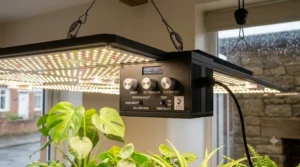
Running at approximately 150W, this board is notably efficient for its coverage area. The passive cooling design means zero fan noise — a meaningful advantage in a house or flat where you’d rather not advertise the fact that you have a grow on. The 0–100% dimming is smooth when paired with a UIS controller, or manual via the front knob.
For the UK grower running a 90×90cm tent and wanting best-in-class components without going all the way up to a 450W panel, the S33 is arguably the most elegant solution available on Amazon.co.uk. It’s also well-suited to experienced growers who want a secondary veg tent running quietly alongside a larger flowering space.
✅ Samsung LM301H diodes — excellent efficiency and output
✅ Smart controller integration for automated schedules
✅ Compact build, perfectly matched to 90×90cm UK tents
❌ Premium price for the wattage
❌ Smart features require separate UIS controller purchase to unlock fully
Price range: £120–£160. Best-in-class for the 90×90cm tent category.
7. Elite Quantum LED EQ1000 — The Budget Board That Doesn’t Embarrass Itself
The Elite Quantum LED EQ1000 is a UK-stocked quantum board grow light panel that deserves more credit than it typically receives. Drawing around 105W and using Samsung LM301B diodes, it covers a 60×60cm flowering footprint — the smallest on this list, but one that aligns perfectly with the most common beginner tent size sold in the UK.
Sold on Amazon.co.uk and stocked in UK warehouses, the EQ1000 ships quickly (often Prime-eligible) and arrives with a UK plug. The passive cooling design (no fan) keeps it quiet, the dimmer knob gives reasonable control, and the daisy-chain function lets you connect two units if you want to step up to an 80×80cm or 100×100cm tent later without buying an entirely new panel.
Is it as efficient as the Samsung-diode premium options above? Not quite — but at this price point, the gap is forgivable. For anyone growing herbs, microgreens, or small numbers of plants in a 60×60cm tent, the EQ1000 produces perfectly respectable results. It’s particularly well-suited to UK growers in flats where space is genuinely limited, or those simply dipping a toe into indoor growing before committing to a more serious setup.
UK buyers on Amazon.co.uk report solid performance for the money, with several noting it handled the British climate without issues — importantly, the passive cooling design means no moving parts to fail in a damp grow tent environment.
✅ Budget-friendly entry point with Samsung LM301B diodes
✅ Perfect size for 60×60cm UK tent setups
✅ Daisy-chain ready for future expansion
❌ Not suitable for flowering a 100×100cm tent on its own
❌ Build quality reflects the price — functional, not premium
Price range: £70–£100. The most accessible quantum board grow light panel on Amazon.co.uk.
How to Set Up Your Quantum Board Grow Light Panel: A UK Grower’s Practical Guide
Getting the most from a quantum board grow light panel isn’t complicated, but there are a handful of practical steps that make a meaningful difference — particularly in the British climate, where humidity in grow tents can be more challenging than temperature.
Week 1: Positioning and height. Start your board higher than you think necessary. For seedlings, 60–80cm above the canopy is appropriate at 50–60% power. British growers often rush this stage and cause light stress before plants have developed adequate root systems. The Royal Horticultural Society’s guidance on indoor plant growing conditions is worth a read for anyone new to controlled-environment horticulture. A bit of patience here pays dividends later.
Weeks 2–4 (Vegetative stage): Gradual intensity increase. Lower the board progressively as plants grow, and increase dimmer settings in small increments. A good rule of thumb: if the top leaves are cupping upward, you’re too close or too bright. Back off and give it 48 hours.
Flowering stage: Distance and spectrum. Most quantum boards perform best at 40–50cm above canopy during peak flowering. In a compact UK tent where headroom is often limited (many 120×120×200cm tents don’t leave masses of space between a 450W board and a mature plant canopy), consider training techniques such as LST (low-stress training) or SCROG nets to keep your canopy flat and well within the optimal light zone.
UK humidity management. This is where British growers face their biggest challenge. Our damp climate means grow tents can run high in humidity, particularly in autumn and winter — and a warm LED board creates convection currents that can pull ambient moisture into your space. Invest in a decent inline fan and a hygrometer, and keep flowering humidity below 50% to avoid mould.
Maintenance. Unlike HPS bulbs, quantum boards require almost no maintenance — no bulb replacements, no reflector cleaning. A gentle wipe of the aluminium heatsink with a dry cloth every few months is all that’s typically needed. The fanless design on most boards means there are no moving parts to seize up in a damp environment.
Which Quantum Board Panel Suits Which UK Grower? Real-World Scenarios
The urban flat grower in Bristol. Living in a one-bedroom flat, growing herbs and tomatoes in a 60×60cm tent in the corner of a spare room. Space is tight, electricity bills are visible, and noise matters (shared walls with neighbours). Best match: the Elite EQ1000 or Mars Hydro TS1000. Both run silently, draw under 150W, and produce perfectly respectable harvests in a compact space.
The suburban household in Manchester. A semi-detached with a spare bedroom and a 120×120cm tent. Growing through a full veg-to-flower cycle. Wants reliability and a decent yield without paying through the nose. Best match: the Spider Farmer SF4000 or Mars Hydro TS3000. Both cover a 120×120cm tent competently, and the upfront cost is justified over multiple cycles.
The tech-enthusiast grower in Edinburgh. Already running AC Infinity fans and controllers. Values the ability to monitor conditions remotely and automate lighting schedules — particularly useful during Scottish winters where heating and lighting requirements shift significantly. Best match: the AC Infinity IONBOARD S44 or S33. The smart ecosystem integration is genuinely valuable rather than a marketing exercise, and the passive cooling handles the damp Scottish climate without issue.
Quantum Board vs Traditional LED: What the Spec Sheet Won’t Tell You
It’s tempting to look at a quantum board panel and a traditional blurple LED drawing the same wattage and assume they’re broadly equivalent. They are not, and the difference isn’t subtle.
| Feature | Quantum Board | Traditional Blurple LED |
|---|---|---|
| Diode type | High-efficiency SMD (Samsung LM301B/H) | Lower-efficiency 3W or 5W chips |
| Light spectrum | Full white spectrum + red/IR | Blue + red only (narrow) |
| Heat output | Low (passive cooling viable) | High (fans required) |
| Canopy penetration | Deep, even spread | Hot spots, uneven |
| Typical efficiency | 2.5–2.9 µmol/J | 1.0–1.7 µmol/J |
| Best for | All stages, all plants | Limited use cases |
| UK electricity cost impact | Low | Higher for equivalent output |
The efficiency gap is the number that matters most for UK growers. At current UK electricity rates — which remain significantly higher than the US average — running a 600W blurple LED versus a 450W quantum board to achieve comparable PPFD means paying roughly 25% more on your electricity bill over a full cycle. Over a year of growing, that’s a meaningful sum.
Beyond efficiency, the full-spectrum white light from a quantum board is simply easier on the eyes — you can actually assess your plants’ colour and health under the light, rather than trying to distinguish shades of green under a purple-pink glow that makes everything look vaguely alarming.
From the comparison above, it’s clear that quantum board technology wins on every metric that matters for a typical UK indoor grower — from electricity efficiency to canopy coverage uniformity. The traditional blurple LED has no meaningful advantage in 2026, and continuing to run one is essentially choosing to pay more for worse results. If you’re still on blurple, the TS1000 or EQ1000 represent very low-cost entry points to making the switch.
✨ Don’t Miss These Exclusive Deals!
🔍 Ready to upgrade your indoor grow? Click any highlighted product to check current pricing and availability on Amazon.co.uk — all the options above are stocked in the UK for fast Prime delivery.
How to Choose a Quantum Board Grow Light Panel in the UK: 5 Key Criteria
Choosing the right panel comes down to a clearer set of priorities than most marketing copy would have you believe. Here’s the framework that matters:
1. Match wattage to your tent size. The standard rule of thumb is 40–50W of true (wall-draw) power per 30×30cm of canopy during flowering. A 60×60cm tent needs around 100W; a 120×120cm tent needs 400–500W. Don’t be tempted to over-spec on a small tent — you’ll waste money and create unnecessary heat.
2. Check the diode specification, not just the wattage. Samsung LM301B and LM301H chips are the current benchmark. Panels claiming very high wattage with generic diodes often underperform on actual PPFD despite impressive numbers on the box.
3. Verify the driver quality. MeanWell and Inventronics are the two names worth seeing on the spec sheet. A budget driver on an otherwise decent board is a weak link that will eventually let you down.
4. Confirm UK compatibility before buying. Most panels sold on Amazon.co.uk accept 85–265V input (covering UK 230V), but always verify. Check that a UK plug is included or a UK-compatible cable is specified — some panels ship with a two-pin EU plug, which requires an adapter.
5. Consider your future plans. A daisy-chain function means you can add a second board later without rewiring. Smart controller compatibility (particularly in the AC Infinity range) means you can build an automated setup progressively rather than all at once.
Common Mistakes UK Buyers Make When Choosing a Grow Light Panel
Buying on wattage claims alone. A panel marketed as “1000W equivalent” that draws 100W from the wall is a 100W light. The “equivalent” figure refers loosely to the HPS wattage it might replace in output — it is not the power consumption. Always look for the actual wattage draw, not the marketing figure.
Ignoring driver quality. A high-quality driver can extend the life of a panel from 3 years to 10 years or more. The driver regulates electrical current to the diodes; a poor one that runs hot or poorly regulated will degrade your diodes faster and represents a false economy.
Overlooking UK voltage compatibility. A small number of panels sold via Amazon Marketplace are genuinely US-spec (120V only). Running these on UK 230V will damage them immediately. Always confirm 230V compatibility and check that the seller is UK-based or shipping from a UK fulfilment centre.
Positioning the board too close to young seedlings. This is the most common beginner error. Quantum boards are considerably more powerful per unit area than many growers expect, particularly those switching from blurple. Start high, start dimmed, and work down gradually.
Underestimating heat even with LEDs. Quantum boards run significantly cooler than HPS, but they still generate heat — particularly at higher wattages. A 450W board in a poorly ventilated tent will still raise temperatures to levels that stress plants. Factor in adequate extraction and circulation alongside your lighting purchase.
Long-Term Cost & Value: What a Quantum Board Grow Light Panel Really Costs UK Growers
The upfront cost of a quantum board grow light panel is only part of the financial picture. Let’s consider the total cost of ownership across a typical two-year period for a UK grower running a 120×120cm tent:
Electricity: At UK electricity rates (currently averaging around 24p per kWh for most households — see Ofgem’s latest price cap updates for the most current figures), a 450W quantum board running an 18-hour veg photoperiod costs approximately £1.94 per day, dropping to around £1.30/day on a 12-hour flowering schedule. Over a full 16-week cycle, that’s around £150–£180 in electricity. An equivalent HPS setup drawing 600W would cost approximately £200–£230 for the same cycle.
Bulb replacement: HPS bulbs degrade noticeably after 10,000–15,000 hours and should ideally be replaced each season. A quality 600W HPS lamp costs £40–£80. Quantum boards carry a rated lifespan of 50,000–100,000 hours — effectively never needing replacement within any realistic growing career.
Heat management: Because quantum boards run cooler than HPS, you can often run a smaller extraction fan or reduce fan speed — saving additional electricity. In winter, however, some UK growers find they miss the residual heat from an HPS in an unheated space; a small oil-filled radiator on a timer resolves this at far less cost than running an oversized HPS for its heat output.
Warranty: The mid-to-premium options on this list carry 3–5 year warranties. Budget panels may offer shorter coverage, but all products sold on Amazon.co.uk are subject to the Consumer Rights Act 2015, which provides a 2-year minimum statutory protection regardless of manufacturer warranty — a meaningful advantage for UK buyers compared to purchasing from overseas retailers.
FAQ: Quantum Board Grow Light Panels — UK Buyers’ Most Common Questions
❓ Are quantum board grow light panels legal to use in the UK?
❓ Do I need a special UK plug with a quantum board grow light from Amazon.co.uk?
❓ What size quantum board panel do I need for a 120×120cm grow tent?
❓ How does a quantum board grow light panel affect my UK electricity bill?
❓ Can I use a quantum board panel in a damp UK grow tent environment?
Conclusion
The quantum board grow light panel has become the defining technology of modern UK indoor growing — and for a grower paying British electricity rates, the efficiency advantage over HPS and older LED designs isn’t a marginal improvement, it’s a genuine monthly saving that compounds over every cycle.
Our top recommendation for most UK growers is the Spider Farmer SF4000 for anyone running a 120×120cm tent and serious about yields, or the Mars Hydro TS1000 for those starting out in a 60–80cm setup. The AC Infinity IONBOARD range earns a special mention for anyone who values smart home integration and silent operation — particularly relevant in UK flats and terraced houses where noise and discretion matter.
Whatever your grow space, your crop, or your budget, the key is to match the board to the tent, verify UK compatibility, and invest appropriately in driver quality. A well-chosen quantum board grow light panel, properly maintained, will outlast several generations of HPS equipment and deliver noticeably better results from the first cycle.
Check current pricing and availability on Amazon.co.uk — stock levels on the more popular models do fluctuate, and UK delivery speeds vary by seller.
✨ Don’t Miss These Exclusive Deals!
🔍 Click any highlighted product above to check today’s price and availability on Amazon.co.uk. All picks are verified available for UK delivery — many with Prime next-day dispatch.
Recommended for You
- Best LED Panel Grow Light for Grow Tent UK 2026 (Top 7 Picks)
- Clip On Grow Light for Indoor Plants: 7 Best UK Picks (2026)
- Best Small Grow Light for Desk UK 2026: 7 Expert Picks
Disclaimer: This article contains affiliate links. As an Amazon Associate, I earn from qualifying purchases. If you purchase products through these links, we may earn a small commission at no additional cost to you.
✨ Found this helpful? Share it with your mates! 💬🤗
