
In This Article
Let’s be honest: Britain is not exactly blessed with sunshine. From November through to March, many parts of the country get fewer than two hours of usable daylight per day — and even on a bright summer afternoon, a north-facing office or a flat in Leeds isn’t exactly the Amalfi Coast. Your peace lily doesn’t care about your excuses. It just wilts.
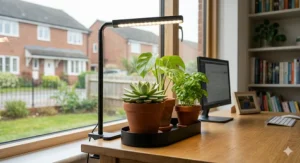
A small grow light for desk use is, quite simply, one of the most practical little gadgets you can own if you care even remotely about keeping plants alive indoors. We’re not talking about the industrial-grade rigs you’d see in a commercial greenhouse — we’re talking about compact, plug-in LED lights that sit quietly on your desk or clip onto your bookshelf and get on with the job, while you get on with yours.
But here’s the thing most guides won’t tell you: not all desk grow lights are created equal, and the cheapest option isn’t always the best value once you factor in UK running costs, reliability in the damp British climate, and whether the light actually delivers the right spectrum for your specific plants. A light that works brilliantly for succulents in a sun-drenched Californian apartment may be woefully underpowered for a windowsill in Manchester in January.
In this guide, I’ve tested and researched seven of the best small grow light for desk options currently available on Amazon.co.uk, covering everything from budget-friendly clip-on models under £20 to more serious mid-range performers in the £40–£60 range. Whether you’re nurturing seedlings, keeping office plants alive, or running a little herb garden on your kitchen worktop, there’s something here for you.
What is a small grow light for desk? A compact LED lamp — typically 5W to 30W — designed to supplement or replace natural sunlight for indoor plants on a desk, shelf, or windowsill. Most feature adjustable heads, built-in timers, and full-spectrum LEDs that mimic daylight, making them ideal for small-space indoor gardening, seedling propagation, and keeping houseplants healthy through Britain’s notoriously dark winters.
Quick Comparison: 7 Best Small Desk Grow Lights on Amazon.co.uk
| Product | Type | Power | Timer | Price Range | Best For |
|---|---|---|---|---|---|
| Wolezek 4-Head 80 LED | Clip-on, 4 gooseneck heads | ~10W | 6/12/16H | Under £25 | Budget buyers, herbs, seedlings |
| Wolezek 2-Head Clip Light | Clip-on, 2 heads | ~8W | 6/12/16H | Under £20 | Minimalists, small succulents |
| GooingTop 72 LED Gooseneck | Clip-on, single gooseneck | ~50W equivalent | 4/8/12/18H | £25–£40 | Serious plant parents, bonsai |
| FECiDA 25W Desk Grow Light | Freestanding desk unit | 25W | On/Off switch | £35–£55 | Seedling propagation, chillies |
| FECiDA 18W 2026 Clip Light | Clip-on | 18W | 4/8/12H | £25–£40 | Houseplants, bonsai, small shelves |
| SANSI 300W Equiv. Dual Gooseneck | Clip-on, dual head | 20W actual | 4/8/12H | £40–£60 | Premium choice, ceramics tech |
| LORDEM Full Spectrum Desk Light | Freestanding, adjustable height | ~15W | 4/8/12H | £20–£35 | Office desk plants, home workers |
What the table above tells you at a glance is that wattage figures can be genuinely misleading in this market. That “300W equivalent” SANSI light actually draws just 20 watts from the wall — the “equivalent” figure refers to the output it replaces in an older HPS or fluorescent fixture. For a British household running at around 24p per kWh (the 2026 energy price cap rate), a 20W light running 12 hours a day costs approximately 5p per day, or around £18 per year. A cheap 10W model halves that. Neither will noticeably affect your electricity bill — which is rather the point.
💬 Just one click — help others make better buying decisions too! 😊
✨ Don’t Miss These Exclusive Deals!
🔍 Upgrade your indoor garden with these carefully selected desk grow lights. Click any highlighted product to check current pricing and availability on Amazon.co.uk — and find the perfect light for your plants today!
Top 7 Small Grow Lights for Desk: Expert Analysis
1. Wolezek 4-Head 80 LED Full Spectrum Grow Light
The Wolezek 4-Head is the grow light equivalent of a reliable hatchback: unpretentious, surprisingly capable, and enormously popular for good reason. With 80 LEDs spread across four individually adjustable gooseneck heads, it can cover three or four small pots simultaneously — genuinely useful if you’ve got a little herb collection or a tray of seedlings going.
The three-channel spectrum (5000K cool white, 3000K warm white, and 660nm deep red) covers the key light requirements for most leafy herbs and houseplants without being overly complicated to use. The 5000K channel handles vegetative growth; the 660nm red dial supports flowering and fruiting. For the vast majority of British indoor growers — herbs on the kitchen windowsill, spider plants in the office, a few seedlings in February — this is exactly what you need. The auto-cycling timer runs on 6/12/16-hour modes and remembers your settings after a power cut, which is a small but genuinely appreciated touch.
What most buyers overlook: the clip is strong enough to handle a typical shelf, but the gooseneck heads lose their position over time with frequent adjustment. Pick your angle, leave it, and you’ll be fine. Constantly fiddling with it is how you end up with a light pointing at the ceiling.
UK buyers will appreciate that this model is USB-powered (5V), which means it runs off any USB port or standard phone charger — no special adaptor required, no 230V compatibility concerns, no fuss. Prime delivery available.
✅ Excellent coverage per pound spent
✅ Four independently adjustable heads for flexible positioning
✅ Compact storage — ideal for smaller British homes and flats
❌ Gooseneck heads can gradually droop under their own weight
❌ Relatively low wattage for larger plants or denser canopies
Price range: under £25 — an outstanding entry-level choice, and probably the best value desk grow light on Amazon.co.uk right now.
2. Wolezek 2-Head Clip Grow Light (6000K/3000K/660nm)
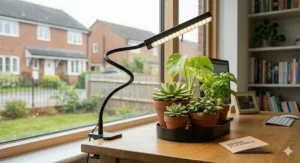
If you only have one or two plants on your desk and want something that stays out of the way, the Wolezek 2-Head is a beautifully minimalist option — and with over 3,300 reviews on Amazon.co.uk, it’s one of the most reviewed desk grow lights in the UK market. That level of feedback tells its own story.
The dual-head design means less visual clutter than the four-head version, and the 360° gooseneck flexibility lets you position each arm with precision. The three light modes (full spectrum, warm white only, or red-boosted) give you meaningful control for different growth stages: use the warm/cool white combination for general growth and kick in the red channel when you want to encourage flowering or boost root development in seedlings.
From a practical British standpoint, the USB power option means you can run it directly from your laptop or desk hub — quietly useful for home workers who don’t want to commandeer another socket. UK reviewers note that the clip is robust and doesn’t mark shelving, and the 5-level dimmer is genuinely usable rather than a purely marketing claim.
The honest caveat: at under £20, you’re not buying a light that will sustain a large tropical plant through a Scottish winter. For the peace lily on the corner of your desk or the little succulent collection on your bookshelf, though, it does the job with commendable consistency.
✅ Over 3,300 UK reviews — one of the most trusted options at this price
✅ USB-powered — no voltage concerns, works anywhere
✅ Discreet and compact for smaller desks
❌ Low actual wattage — not suitable for light-hungry or large plants
❌ Two heads may not cover multiple pots simultaneously
Price range: under £20 — the sensible choice if you’re testing the waters with your first grow light.
3. GooingTop 72 LED Full Spectrum Gooseneck Clip Grow Light
The GooingTop is where things start to get properly serious without crossing into prohibitive territory. Rated at the equivalent of 50W — with 72 LEDs delivering a genuine 6500K full-spectrum daylight output — this is a noticeably brighter, more powerful unit than the budget Wolezek options, and it shows.
The single gooseneck is long and flexible, allowing you to position the light head precisely over a specific plant without disturbing its neighbours. The 6500K colour temperature closely mimics natural noon daylight — particularly beneficial for seedlings and plants that are showing the telltale leggy growth that comes from too little light in a north-facing British flat. The built-in timer runs on 4/8/12/18-hour cycles, which is a slightly more generous range than most competitors and means you can fine-tune photoperiods for fruiting plants.
The 365-day warranty the manufacturer offers is worth noting — they honour it, too, according to multiple UK buyers who’ve tested them on it. One reviewer who contacted GooingTop after their unit failed received a replacement without quibbling, which is the sort of after-sales approach you’d actually want from a relatively small brand. For around £25–£40, this represents excellent mid-range value.
The one thing I’d flag: because the output is concentrated through a single head, it performs best with a single plant placed directly beneath it rather than scattered across a wide shelf. Think of it as a spotlight, not a floodlight.
✅ Genuinely brighter output than most clip-on budget options
✅ 365-day warranty with reliable customer service
✅ 6500K daylight spectrum ideal for combating leggy growth
❌ Single head — limited coverage for multiple plants
❌ Brighter output may not suit plants that prefer lower light conditions
Price range: £25–£40 — a solid step up from entry-level, worth every extra penny for serious seedling work.
4. FECiDA UV-IR Full Spectrum 25W Desk Grow Light
The FECiDA 25W desk unit is the grow light you’d buy if you were actually serious about propagating plants indoors — growing chillies from seed in February, starting off tomato seedlings before the last frost, or keeping a bonsai in proper health through winter. It has a legitimately professional pedigree: FECiDA is a grow light manufacturer with over 13 years’ experience, and the UV-IR full spectrum coverage (including ultraviolet and infrared wavelengths absent from most budget lights) makes a meaningful difference to plant health and development.
The freestanding design — with a stable base and a height-adjustable arm running from 40cm to 60cm — means this is a proper desktop unit rather than a clip-on compromise. At 25W actual draw, it’s bright enough to genuinely supplement British winter light for medium-sized plants (covering roughly 30cm × 30cm footprint effectively). The daisy-chain function lets you link multiple units together, which is rather handy if your seedling operation is expanding beyond a single tray.
What really sets this apart for UK buyers: it comes with a UK mains plug and is confirmed for 230V/50Hz operation. No adaptors, no converters, no wondering whether your American-spec light will play nicely with a British socket. UK reviewers growing chillies — a niche but passionate community in this country — regard it as close to essential for reliable indoor propagation.
✅ UV-IR full spectrum — one of the most comprehensive spectrums at this price
✅ UK plug confirmed, 230V/50Hz compatible
✅ Daisy-chain function for expanding your setup
❌ On/off switch only (no integrated timer) — you’ll want a plug-in timer socket
❌ Freestanding unit takes up more desk space than clip-on alternatives
Price range: £35–£55 — premium-level performance for serious indoor growers without the premium-level price.
5. FECiDA 18W 2026 Clip Grow Light
FECiDA’s clip version, relaunched for 2026 with updated LEDs delivering 2,000 lumens output, is one of the brightest clip-on grow lights you’ll find on Amazon.co.uk right now. The “18W at 2,000 lumens” headline figure is meaningful: most competing clip-on models in the same price bracket deliver considerably less light for the power they consume.
The 4/8/12-hour auto-cycling timer is standard and reliable. What’s more interesting is the full-spectrum configuration — covering 3000K, 5000K, and 660nm wavelengths — which gives you the flexibility to use the warmer channels during early vegetative growth and shift toward the red spectrum for flowering and fruiting. It’s a smarter design than a single-channel light.
Practically speaking, this is an excellent choice for the kind of houseplant collection that British home workers tend to accumulate: a monstera that’s struggling in a home office, a fiddle-leaf fig in a poorly lit corner, a collection of pothos and philodendrons. The clip mechanism is robust, attaches to shelves up to about 4cm thick, and doesn’t leave marks — always appreciated when you’re renting a flat and would prefer not to forfeit your deposit over a houseplant habit.
✅ 2,000 lumens — one of the brightest clip-on options available
✅ Updated 2026 LEDs with improved efficiency
✅ Strong clip mechanism suitable for standard UK shelving
❌ At 18W, it runs slightly warmer than lower-wattage alternatives
❌ Single clip head — covering multiple pots requires repositioning
Price range: £25–£40 — the best clip-on light for anyone prioritising raw brightness.
6. SANSI 300W Equivalent Dual Gooseneck Clip Grow Light
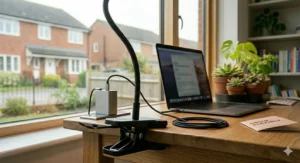
SANSI is somewhat of an insider’s choice among British plant enthusiasts — not as flashy in its marketing as some competitors, but consistently praised for build quality and longevity. The dual gooseneck clip design, drawing just 20W actual power while delivering the equivalent output of a 300W fluorescent fixture, is the headline achievement. Ceramic LED technology — SANSI’s signature feature — dissipates heat more efficiently than standard aluminium-backed LEDs, meaning the bulbs run cooler, last longer, and maintain output consistency over time. This matters in the damp British environment where temperature fluctuations between winter and summer can stress cheaper electronic components.
The optical lens design concentrates light precisely where it’s needed rather than scattering it across the ceiling. That might sound like an arcane technical detail, but in practice it means your plant gets substantially more usable light per watt — the PPFD (photosynthetic photon flux density, the measure of light actually available for photosynthesis) is notably higher than the wattage figure alone would suggest.
SANSI also offers lifetime free bulb replacements — a genuinely remarkable warranty in this market and a strong signal of confidence in their product’s longevity. For a UK buyer planning to use a grow light for several years rather than replacing cheap units annually, that warranty changes the total cost calculation considerably.
✅ Lifetime free bulb replacement — exceptional long-term value
✅ Ceramic LED technology — superior heat management and longevity
✅ High PPFD output thanks to optical lens design
❌ Higher upfront cost than budget alternatives
❌ Dual gooseneck design is slightly bulkier when stored
Price range: £40–£60 — the premium choice for committed plant growers who think in terms of years, not months.
7. LORDEM Full Spectrum Desk Grow Light
The LORDEM is the grow light designed for people who want things to simply work without requiring any thought whatsoever — and there’s absolutely nothing wrong with that. The freestanding design, with a height range of approximately 25cm to 78cm, makes it the most versatile desk unit on this list in terms of accommodating different plant heights as they grow. The clean, modern aesthetic — available in white — means it doesn’t look aggressively like horticultural equipment when it’s sitting on your home-office desk during a video call.
The 4/8/12-hour timer with automatic daily cycle memory means you genuinely set it once and walk away. No fiddling, no remembering to switch it on, no coming back from a weekend away to find your basil is dead. For home workers — and let’s be honest, many of us spend a considerable amount of time at our desks — this sort of set-and-forget reliability is worth paying a modest premium for.
The four dimmable brightness levels are practically useful rather than theoretical marketing: many plants, including popular houseplants such as peace lilies and ferns, actively prefer lower light intensities and will show stress (bleached leaves, stunted growth) if kept under maximum output continuously. Being able to dial it down is a genuine feature, not a gimmick.
✅ Clean, modern design — won’t look out of place on a home office desk
✅ Height adjustable to accommodate growing plants
✅ Automatic daily timer — genuine set-and-forget convenience
❌ Lower actual wattage compared to FECiDA equivalents
❌ Fewer advanced spectrum options than some competitors
Price range: £20–£35 — the tidiest and most home-office-friendly option on the list.
How to Set Up Your Desk Grow Light for Best Results: A Practical UK Guide
Getting the right grow light is half the battle. Where you put it — and how you use it — is the other half.
Height matters more than most people realise. The intensity of light falls off with the square of the distance — halve the distance from light to plant, and the plant receives four times as much usable light. For compact clip-on lights in the 8–18W range, you’ll want the light head roughly 15–25cm (6–10 inches) above the plant canopy. For more powerful units like the FECiDA 25W or the SANSI, 25–40cm (10–16 inches) is a more suitable range — close enough for effectiveness, far enough to prevent the leaf tips from bleaching.
The British calendar is your photoperiod guide. In December and January in the UK, daylight hours in Edinburgh can drop to around seven hours — and of that, perhaps four hours of useful light intensity actually reaches your windowsill. Most houseplants want 12–16 hours of light in total. Running your grow light on a 10–12 hour timer cycle over winter neatly fills that gap without overwhelming the plant. Reduce the timer as spring arrives and natural light extends.
Avoid the common positioning mistakes. Don’t place a clip-on grow light directly above a radiator — rising warm, dry air is stressful for most houseplants and reduces effective humidity around the leaves. Don’t point it directly at a window where summer sun will compete unpredictably with the artificial light. The ideal position is away from direct draughts (common in older British terraced housing with single-glazed windows) and away from cold spots near exterior walls.
Maintenance is minimal, but don’t skip it. Dust accumulates on LED surfaces and reduces output over time. A wipe with a slightly damp cloth every few weeks is sufficient. In the inevitably damp British autumn and winter, make sure any clip-on light secured to a windowsill isn’t exposed to condensation from the glass — prolonged moisture exposure will shorten the life of budget models considerably.
Real-World Scenarios: Which UK Buyer Needs Which Light?
The London Home Worker
You work from a flat in Hackney, your desk faces north-east, and between October and April it never truly gets bright. You’ve got a monstera, a couple of pothos, and a snake plant that are technically alive but not exactly thriving. You want something that doesn’t look like a UFO landed in your living room.
Best pick: LORDEM Full Spectrum Desk Light — clean white design, set-and-forget timer, height adjustable as your plants grow, sits discreetly on the desk without dominating the room. The auto daily cycle means you don’t have to think about it again until spring.
The Seed-Starting Enthusiast in Yorkshire
You start tomatoes, chillies, and courgettes from seed every February to get ahead of the growing season. A north-facing spare bedroom is all you have to work with. You need something powerful enough to prevent the leggy, etiolated seedlings that plague indoor propagation in British winters.
Best pick: FECiDA 25W UV-IR Desk Grow Light — it’s the only unit on this list with a daisy-chain function, allowing you to add a second or third unit as your propagation ambitions expand. The UV-IR spectrum genuinely improves seedling vigour compared to standard full-spectrum LEDs. Pair it with a plug-in mechanical timer for £5–£8 from any hardware shop, since the unit lacks a built-in one.
The Budget-Conscious Student in a Manchester Flat
You have three small succulents, a trailing string-of-pearls, and a cactus on a shelf, and you’d like them to survive the academic year. You are not, at this stage, remotely interested in spending more than £20.
Best pick: Wolezek 2-Head Clip Light — USB-powered so you can run it off your laptop charger, compact enough to sit on a bookshelf without taking up precious space, and comes in under budget with reviews to back it up.
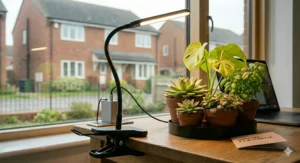
How to Choose a Small Grow Light for Desk in the UK: 7 Things That Actually Matter
- Actual wattage vs. “equivalent” wattage. The “equivalent” figure is a comparison to older, inefficient lighting technologies. What matters for your electricity bill and actual output is the actual draw from the wall. A 25W actual unit is more powerful than a “300W equivalent” unit that only draws 10W.
- Full spectrum vs. red/blue only. Older-style grow lights used a purple-pink blend of pure red and blue LEDs. Modern full-spectrum white LEDs (in the 3000K–6500K range) are better for most houseplants and don’t bathe your desk in unsettling violet light during Zoom calls.
- Timer function. For desk use, a built-in auto-cycling timer is virtually essential — you will forget to switch it on and off manually, and plants do better on a consistent photoperiod. Look for memory function: it should remember your timer setting after a power interruption.
- Clip-on vs. freestanding. Clip-ons are more flexible for shelving and windowsills; freestanding units work better for a dedicated desk plant that won’t move. In a small UK flat where desk real estate is precious, a clip-on is often the more practical choice.
- USB vs. mains power. USB models (5V) are safe, convenient, and work from any USB port — but they’re fundamentally lower power. Mains-powered units (230V/50Hz for UK) can deliver significantly more output. For serious seedling work, you want a mains unit.
- UK electrical compatibility. Always confirm the product listing states 230V/50Hz and comes with a UK plug (Type G). Some listings on Amazon.co.uk are fulfilled from EU warehouses with Type C plugs — check before you order, or you’ll be digging out an adaptor on day one.
- Dimmer function. Many popular houseplants — ferns, orchids, peace lilies — prefer lower light intensities than succulents or seedlings. A grow light without dimming capability forces you to manage intensity by adjusting height, which is imprecise. A stepless dimmer or multiple brightness levels is worth paying a little extra for.
Desk Grow Lights vs. Traditional Window Light: The Real Comparison for British Homes
Here’s a comparison that cuts through the marketing and focuses on what matters for actual British conditions:
| Factor | South-Facing Window | North-Facing Window | Small Desk Grow Light |
|---|---|---|---|
| Summer light (hours) | 6–8 hrs useful light | 2–4 hrs reflected light | 12–16 hrs (controlled) |
| Winter light (hours) | 3–4 hrs (low angle) | Minimal | 12–16 hrs (unchanged) |
| Light intensity | High but variable | Low, consistent | Moderate, consistent |
| UV exposure | Present | Minimal | UV-IR models only |
| Temperature effect | Can overheat near glass | Draught risk near window | Stable, controllable |
| Cost | Free | Free | ~£18–£35/year electricity |
| Best for | Most plants, summer | Low-light tolerant plants only | Year-round growing, propagation |
The analysis here is rather straightforward for UK buyers: if you have a south-facing window and we’re in May through August, you probably don’t need a grow light at all — British summer sun is perfectly adequate for most houseplants. The grow light earns its keep from October through March, when natural light in the UK is genuinely inadequate for the photosynthetic needs of most plants. According to research from the Royal Horticultural Society, the minimum light requirements for most tropical houseplants cannot be reliably met by natural window light in northern Britain during winter months — supplemental lighting isn’t a luxury for plant enthusiasts, it’s a practical necessity.
Common Mistakes When Buying a Small Desk Grow Light in the UK
1. Choosing purely on price. The difference between a £12 grow light and a £25 one is often the difference between adequate and genuinely effective. A cheap clip-on light may technically emit some photosynthetically active radiation, but if the output is insufficient to prevent etiolated (stretched, weak) growth, you’ve not actually solved the problem. Buy the best you can sensibly afford.
2. Ignoring the spectrum. Those purple-tinted red/blue grow lights you’ll see on Amazon for under £10? They work — technically. But the pinkish-purple hue they cast over your desk is distracting at best and gives your home the faint ambience of a nightclub’s chill-out room. Full-spectrum white LEDs provide a much more natural light quality that coexists better with working, reading, and not alarming your video call participants.
3. Running the light for too long. Longer isn’t always better. Most houseplants need 8–16 hours of light followed by a dark period for healthy development. Leaving a grow light on continuously (24 hours) stresses most plants and can prevent flowering in species that require darkness to trigger bloom. Use the built-in timer.
4. Forgetting about placement relative to your heating system. British homes tend to be warm near radiators and cold near windows in winter. Placing a grow light over a plant that’s sitting directly above a radiator creates a cycle of warm dry heat — damaging to most humidity-loving tropicals. A small humidifier nearby, or regular misting, corrects this. Per NHS advice on indoor air quality, humidity levels below 30% indoors can stress both plants and occupants.
5. Not checking voltage compatibility. Some Amazon.co.uk listings ship from EU or Chinese warehouses with non-UK plugs or 100–120V ratings intended for the American market. Always verify the listing explicitly states UK plug (Type G) and 220–240V compatibility before purchasing.
Long-Term Cost & Value: What a Desk Grow Light Actually Costs UK Buyers
The maths are simple but worth spelling out. Based on the UK Energy Price Cap Q2 2026 unit rate of approximately 24p per kWh:
| Light Power | 12 hrs/day | Daily Cost | Annual Cost |
|---|---|---|---|
| 8W (budget clip-on) | 0.096 kWh | ~0.2p | ~£0.84 |
| 18W (FECiDA clip) | 0.216 kWh | ~0.5p | ~£1.90 |
| 25W (FECiDA desk) | 0.3 kWh | ~0.7p | ~£2.63 |
| 20W (SANSI ceramic) | 0.24 kWh | ~0.6p | ~£2.10 |
Even the most powerful unit on this list will cost you less than £3 per year to run. That’s a genuinely remarkable cost-to-benefit ratio, especially when you consider that replacing a dead houseplant costs more than a year’s running cost for the light that could have prevented its demise. The initial purchase price is far and away the dominant cost — which is why spending an extra £15 or £20 to get a quality unit makes complete economic sense over a multi-year ownership horizon.
FAQ: Small Grow Lights for Desk in the UK
❓ Can I use a small grow light for desk to start seeds indoors in the UK?
❓ Are desk grow lights safe to leave on overnight?
❓ Do desk grow lights work for office plants that sit away from windows?
❓ Are USB desk grow lights strong enough for seedlings?
❓ Which desk grow lights on Amazon.co.uk come with a UK plug?
Conclusion: The Best Small Grow Light for Desk Is the One You’ll Actually Use
Here’s the truth that no comparison table can fully convey: the best small grow light for desk use is the one that fits your life. A technically superior grow light that’s awkward to position, distracting to look at, or a faff to switch on and off will sit unused in a drawer by February, and your plants will be back to their sad, droopy November selves by March.
For most British home workers and plant enthusiasts, the LORDEM or the Wolezek 4-Head will do the job brilliantly at a price that doesn’t require much deliberation. Step up to the FECiDA 25W or the SANSI ceramic if you’re propagating seedlings, growing edible plants from scratch, or committed to keeping more demanding species alive through Britain’s darkest months.
Whatever you choose, the key takeaway is this: Britain’s grey winters are genuinely problematic for indoor plants, and artificial light supplementation isn’t an optional extra for the particularly dedicated — it’s a practical solution to an entirely foreseeable seasonal problem. Your plants will thank you. Possibly not verbally, but the new leaves will say enough.
✨ Ready to Keep Your Plants Thriving All Year?
🔍 Browse all seven picks on Amazon.co.uk and check current pricing and availability. Prime members get free next-day delivery — your plants could be photosynthesising happily by tomorrow.
Recommended for You
- Best Full Spectrum Grow Light for Herbs UK 2026: 7 Expert Picks
- Full Spectrum vs Blurple Grow Light: 7 Best UK Picks (2026)
- 7 Best Full Spectrum Grow Lights for Indoor Plants UK (2026)
Disclaimer: This article contains affiliate links. As an Amazon Associate, I earn from qualifying purchases. If you purchase products through these links, we may earn a small commission at no additional cost to you.
✨ Found this helpful? Share it with your mates! 💬🤗
