
In This Article
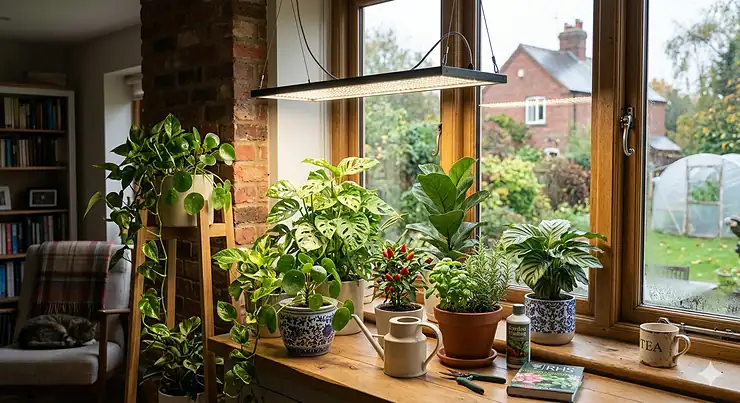
Somewhere around late October, British daylight gives up entirely. The sky goes the colour of a wet flannel by 4pm, your windowsill basil starts looking personally offended, and the chilli seedlings you were so proud of in May begin stretching towards the glass like they’re trying to escape. A full spectrum grow light for indoor plants is essentially a stand-in sun — a single fixture that mimics the complete range of wavelengths a plant would get outdoors, from the blue light that builds sturdy stems to the red and far-red light that pushes flowering and fruiting. Rather than juggling separate “veg” and “bloom” bulbs, one good light carries a plant from seedling to harvest.
What follows isn’t a recycled spec sheet. We’ve dug into what’s genuinely sitting on Amazon.co.uk right now, weighed up which lights cope best with British flats, sheds, and grow tents, and worked out where the money is actually well spent versus where you’re paying for a logo. There’s a fanless 100-watt panel that’ll get a first-time grower through a 60x60cm tent without drama, a Samsung-diode workhorse that hydroponics forums rave about, and — for the houseplant crowd who’d rather not own anything resembling lab equipment — a screw-in bulb that looks at home in a normal lamp.
We’ll cover what PAR and PPFD actually mean (briefly, promise), where UKCA certification matters, and why your January electricity bill should factor into the decision as much as the price tag. By the end, you should know exactly which light suits your space — tent, shelf, or windowsill — without needing a horticulture degree to get there.
Quick Comparison Table
| Light | Actual Power | Coverage | Best For | Price Range |
|---|---|---|---|---|
| Mars Hydro TS600 | 100W | 60x60cm | Beginners, small tents | £50–£70 |
| Spider Farmer SF1000 | 100W | 60–90cm | Quality-focused small grows | £90–£120 |
| VIPARSPECTRA XS1500 Pro | 150W | 60–90cm | Dimmable, expandable setups | £140–£190 |
| Spider Farmer SF2000 EVO | 200W | 70x140cm | Larger 2x4ft tents | £180–£230 |
| Phlizon Pro Series | ~200W | 120x120cm | Big tents, serious yields | £180–£260 |
| SANSI Clip-On Grow Light | 20W | Single pot | Houseplants, propagation | £20–£35 |
| Pianta 18W LED Bulb | 18W | Single lamp | Stylish houseplant lighting | £30–£40 |
Look at that spread for a second and the pattern becomes obvious: power draw climbs from a fanless 100-watt entry panel up to fixtures designed to replace 150-watt HPS lamps, while coverage area roughly tracks wattage. If you’re lighting a single fiddle-leaf fig on a shelf, paying for 200 watts of tent-grade horticultural lighting is like buying a transit van to collect a loaf of bread — the SANSI clip or Pianta bulb earns its keep instead. Tent growers, on the other hand, should match wattage to footprint rather than chasing the biggest number on the box, since an oversized light in a small tent just means wasted electricity and a hotter grow space than you bargained for.
💬 Just one click — help others make better buying decisions too! 😊
✨ Don’t Miss These Exclusive Deals!
🔍 Take your indoor growing setup to the next level with these carefully selected lights. Click on any highlighted product to check current pricing and availability on Amazon.co.uk. These picks will help you find exactly what you need! 🌱
Top 7 Full Spectrum Grow Lights for Indoor Plants: Expert UK Analysis
1. Mars Hydro TS600
The Mars Hydro TS600 is the light most UK grow-tent forums point newcomers towards first, and there’s a reason it’s stuck around. It draws 100W at the wall while delivering 730-740nm red IR alongside 3200-4200K and 5200-6800K white light, and it’s built around a fanless aluminium heatsink design. In practice, that means silent running in a bedroom tent — no whirring fan keeping you up at 2am — and a spectrum balanced enough to take a chilli plant from seed to fruit without swapping bulbs.
What most first-time buyers overlook is that the 2026 version finally added a proper dimming function, so you’re not stuck blasting seedlings at full intensity and frying them. It also carries CE, ETL, RoHS, and UKCA certification, which matters more than it sounds — post-Brexit, a light without UKCA marking is a light you can’t be entirely sure meets UK electrical safety rules. Best for: anyone setting up their very first 60x60cm tent on a tight budget who doesn’t want to think too hard about settings.
✅ Genuinely silent, no fan noise
✅ UKCA certified, straight UK plug
✅ Dimmable on the current version
❌ Coverage is tight for anything beyond 2x2ft
❌ Basic compared to Samsung-diode rivals
Around £50–£70 on Amazon.co.uk — solid value if you’re not chasing maximum yield.
2. Spider Farmer SF1000
If the TS600 is the reliable hatchback, the Spider Farmer SF1000 is the model one trim level up that actually justifies the extra spend. It uses Samsung LM301H EVO diodes rated at 3.14 µmol/J PPE, which in plain English means more usable light per watt of electricity — useful when your tent lives in a spare room with a meter you actually look at. Coverage runs to 2x2ft during flowering and 3x3ft in veg, with full spectrum white, blue, red, and IR diodes covering every growth stage.
What I’d flag for UK buyers specifically: it ships with a dimming knob and the diode layout is arranged to even out PPFD across the canopy, so leggy, light-starved corner plants are less of an issue than on cheaper panels. Spider Farmer backs it with five years of after-sales support through a UK repair centre, which is rare at this price point and worth something if you’re not keen on shipping a faulty unit overseas. Best for: growers who’ve outgrown a starter light and want Samsung-grade reliability without jumping to commercial pricing.
✅ Samsung LM301H EVO diodes
✅ Five-year UK-backed warranty
✅ Even PPFD distribution, less stretching
❌ Still tight for anything past a 3x3ft tent
❌ No app or smart control
Typically £90–£120 on Amazon.co.uk.
3. VIPARSPECTRA XS1500 Pro
The VIPARSPECTRA XS1500 Pro earns its “Pro” tag through optics rather than raw wattage. It draws an actual 150W and uses an optical lens design intended to concentrate light and reduce loss, aiming for uniform PPFD across the whole tent footprint. Translated for the average British spare-room grower: less light wasted hitting the tent walls, more of it actually landing on leaves.
What stands out for UK buyers is the daisy chain feature, letting you connect up to 20 units under one dimmer — handy if you start with one tent and end up, as growers often do, expanding to two. Coverage sits at 3x3ft for vegetative growth and 2x2ft once flowering kicks in, with two units suiting a 4x2ft tent. It’s fanless too, so noise isn’t a factor in a converted box room with thin walls. Best for: anyone planning to scale up their growing space over time rather than staying at one fixed tent size.
✅ Optical lens for uniform coverage
✅ Daisy-chain dimming across multiple units
✅ Fanless, near-silent operation
❌ Pricier than single-tent alternatives
❌ Coverage shrinks notably once flowering begins
Expect around £140–£190, though Amazon.co.uk vouchers occasionally knock this down further — check current pricing before buying.
4. Spider Farmer SF2000 EVO
Step up to a 2x4ft tent and the Spider Farmer SF2000 EVO becomes the sensible next purchase rather than buying two smaller units. It runs the same Samsung LM301H EVO diodes as the SF1000 at 3.14 µmol/J PPE, with a diode arrangement gathered toward the edges for more uniform PPFD, and the dimming knob lets you bring intensity down for seedlings without unplugging anything.
What’s worth knowing before you buy: this is part of Spider Farmer’s SF Series sold through their official Amazon.co.uk storefront, and stock occasionally runs tight given how popular it’s become with UK hydroponics communities — worth checking current availability rather than assuming next-day delivery. It’s built with a standard UK plug and a thick, waterproofed aluminium board for heat dissipation, so damp sheds and unheated box rooms aren’t an immediate dealbreaker. Best for: growers running a proper 2x4ft tent who want serious coverage without stepping into commercial-grade pricing.
✅ Samsung LM301H EVO efficiency
✅ UK plug, built for British mains
✅ Strong reviews from UK hydroponics users
❌ Demand means stock can be patchy
❌ 200W draw adds noticeably to running costs
Around £180–£230 when in stock on Amazon.co.uk.
5. Phlizon Pro Series 2000W
Don’t let the “2000W” in the name alarm you — like most grow light branding, that’s an HPS-equivalent figure rather than what hits your meter. The Phlizon Pro Series LED Grow Light covers a full 4x4ft footprint and uses upgraded SMD LEDs rated at 2.8 µmol/J, with full dimming control built in. For a serious UK hobbyist running a proper grow tent rather than a windowsill operation, this is where you land once you’ve decided indoor growing is a long-term hobby rather than a lockdown whim.
The practical upside for British growers is heat management: a panel this size spreads its diodes over a wide surface area rather than concentrating them, so a 4x4ft tent doesn’t turn into a sauna the way a single hot HID bulb would — genuinely useful if your tent lives in a loft conversion that already runs warm in summer. Best for: growers with an established 4x4ft (120x120cm) tent who want one fixture rather than multiple smaller panels daisy-chained together.
✅ Full 4x4ft coverage from one unit
✅ Dimmable, suits veg and bloom stages
✅ Wide diode spread reduces hotspot risk
❌ Needs proper tent ventilation to manage heat
❌ Overkill for anything smaller than 3x3ft
Generally £180–£260 on Amazon.co.uk, varying by current promotions.
6. SANSI Clip-On Grow Light
Not everyone wants a tent in the spare room — plenty of us just want the Monstera on the bookshelf to stop sulking through January. The SANSI clip-on grow light emits a full spectrum from 380nm to 800nm using white LED diodes rather than the red-blue “blurple” look of older grow lights, at a 4000K colour temperature designed to look natural in a living room.
What I appreciate here, and what the spec sheet won’t tell you, is that it includes a 3/6/12-hour auto on/off timer and four dimming levels, so you genuinely can clip it on, set it, and forget about it — no manually flicking a switch every evening like it’s 1987. The gooseneck and clamp design means it attaches to a shelf or pot rim without extra hardware, which matters in a terraced house where drilling into woodwork for a permanent fixture isn’t always welcome. Best for: houseplant owners with one or two struggling specimens who want supplementary light, not a full grow operation.
✅ Natural white light, not jarring purple
✅ Built-in auto timer, genuinely set-and-forget
✅ Clips on without tools or drilling
❌ Single-plant coverage only
❌ Not powerful enough for fruiting vegetables
Roughly £20–£35 on Amazon.co.uk, making it one of the cheapest entries here.
7. Pianta 18W Full Spectrum LED Bulb
For anyone who’d rather their plant light not look like plant light, the Pianta 18W is the quiet diplomat of this list. It’s an E27 (or B22 with the right base) screw-fit bulb putting out 18W, a warm 3,400K colour temperature, and a PPF of 33.1 µmol/s, with a quoted 50,000-hour lifespan. Screw it into any ordinary lamp — IKEA’s Lersta floor lamp is a popular pairing among UK houseplant communities — and it looks like a normal warm bulb that happens to be doing useful photosynthetic work.
What’s worth flagging before you order: it isn’t compatible with dimmer switches, so if your existing lamp fitting has a dimmer dial, you’ll want a non-dimmable socket or an adapter. The 60° beam angle gives reasonably even coverage across a shelf or small cluster of pots rather than a single tight spotlight. Best for: renters and houseplant collectors who want grow-light benefits without anything that screams “indoor farm” to visiting guests.
✅ Looks like a normal warm-white bulb
✅ Fits standard E27/B22 fittings
✅ Long 50,000-hour rated lifespan
❌ Not dimmer-switch compatible
❌ Too gentle for fruiting or flowering crops needing intense light
Around £30–£40 on Amazon.co.uk, occasionally bundled with a clip fitting.
How to Choose a Full Spectrum Grow Light for Indoor Plants in the UK
- Measure your space first, not your ambition. A 60x60cm tent needs roughly 100W; a 4x4ft tent wants closer to 200–240W. Buying oversized just inflates your electricity bill and tent temperature.
- Check the actual wattage, not the marketing wattage. “2000W” on the box almost always means “HPS-equivalent,” with real draw closer to 150–250W — read the small print before assuming your extension lead will cope.
- Confirm UKCA marking. Post-Brexit, this replaced CE as the relevant UK conformity mark, and its presence is a reasonable proxy for electrical safety testing.
- Prioritise dimming if you’re growing from seed. Seedlings scorch under full-intensity light far more easily than mature plants do.
- Factor in noise. Fanless designs suit bedrooms and box rooms; fan-cooled panels run cooler at higher wattages but hum constantly.
- Decide tent versus houseplant use upfront. A 200W panel is wasted on a single windowsill fern; a clip light won’t touch a fruiting tomato plant in a tent.
Full Spectrum vs Single Colour LED: What Actually Matters
Older “blurple” grow lights used only red and blue diodes, tuned narrowly to chlorophyll absorption peaks. They’re cheaper to manufacture, but they make plants — and the room they’re in — look faintly alarming, and they skip wavelengths like green and far-red that influence stem strength and flowering response. Full spectrum LEDs spread output across the visible range plus a touch of infrared, closer to what a plant gets outdoors on an overcast British afternoon.
The trade-off isn’t purely aesthetic. Single-colour blurple panels can technically deliver higher PAR-per-pound for pure vegetative growth, but full spectrum lights make it far easier to judge plant health by eye — under purple light, a yellowing leaf is nearly impossible to spot until the damage is serious. For most UK hobbyists growing a mix of houseplants, herbs, or a single grow tent, full spectrum is the more forgiving, more versatile choice.
Understanding PAR and PPFD Rating
PAR (Photosynthetically Active Radiation) describes the slice of light a plant can actually use for photosynthesis, while PPFD (Photosynthetic Photon Flux Density) measures how much of that light is landing on a given square metre of leaf surface at any moment. A higher PPFD number generally means more usable light reaching your plants — but only at the distance the manufacturer measured it.
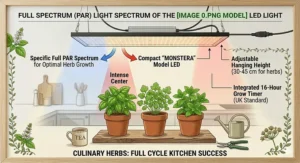
For UK growers, the practical takeaway is simple: don’t compare PPFD figures across two products unless they were measured at the same hanging height, and remember that leafy herbs are happy on lower PPFD (200–400) than fruiting plants like tomatoes or chillies, which want closer to 400–600. If a listing doesn’t mention PPFD or hanging distance at all, treat the numbers on the box with healthy scepticism.
Grow Light Spectrum Chart Explained
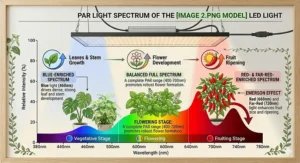
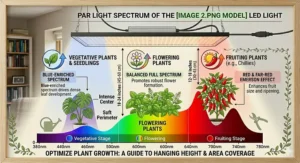
Most full spectrum LED listings quote a handful of wavelength bands rather than the full visible spectrum, and reading these isn’t as daunting as it looks. Blue light (roughly 400–500nm) encourages compact, sturdy growth and is dominant during the vegetative stage. Red light (620–700nm) drives flowering and fruiting. Far-red and infrared (700nm+) influence stem elongation and flowering timing, while white light bands (often listed as 3000K or 5000K) provide the broad-spectrum fill that makes a plant look healthy to the human eye, too.
A genuinely full spectrum light should show measurable output across most of these bands rather than two narrow spikes. If a spectrum chart shows nothing but a blue peak and a red peak with a dead zone in between, that’s blurple wearing a “full spectrum” label — worth a second look before buying.
💬 Just one click — help others make better buying decisions too! 😊
Practical Usage Guide: Setting Up Your Grow Light for British Homes
Getting a grow light running well in a UK home means accounting for a few things American buying guides rarely mention. First, damp: condensation on tent walls is common in unheated box rooms over winter, so keep the light’s driver and any cabling away from direct moisture contact, and consider a small clip fan for airflow even on fanless LED panels. Second, voltage: UK mains run at 230V, and the products covered here all ship with a UK three-pin plug, but always double-check before buying from a non-UK-specific listing.
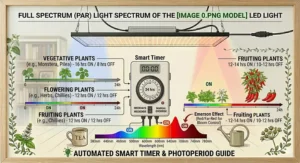
For first-time setup, hang the light at the manufacturer’s recommended distance for seedlings (usually 45–60cm) and lower it gradually as plants mature, rather than starting close and risking leaf scorch. Run a simple plug-in timer for 14–16 hours on, 8–10 off, to mimic a healthy day-length without you needing to remember to switch anything manually. In flats and terraced houses with limited storage, look for lights with detachable hanging kits rather than fixed brackets — they pack down flatter when not in use, which matters when your “grow room” doubles as a guest bedroom.
Real-World Scenarios: Matching the Light to Your UK Growing Situation
The London flat-share herb grower: Limited windowsill space, no room for a tent, wants basil and chilli plants to survive a grey winter. The Pianta 18W bulb or SANSI clip-on covers this neatly — both are discreet, cheap to run, and don’t require justifying a grow tent to flatmates.
The Manchester first-time tent grower: Just bought a 60x60cm tent, wants to start small without overcommitting financially. The Mars Hydro TS600 hits the budget and footprint perfectly, with enough headroom to learn the basics before upgrading.
The Cotswolds hobbyist with a converted shed: Already growing tomatoes and chillies in a 2x4ft or 4x4ft tent, wants higher yields and is willing to spend more. The Spider Farmer SF2000 EVO or Phlizon Pro Series suit this stage, trading higher running costs for noticeably better coverage and output.
Common Mistakes When Buying a Full Spectrum LED Grow Light
The most frequent error is buying on HPS-equivalent wattage rather than actual draw, leading to either overspending on electricity or underpowering a tent. Close behind is ignoring UKCA certification, which matters for safety and for any future warranty claim through a UK seller. Many buyers also skip checking dimmability, then discover their seedlings have scorched within a week of switching the light on at full intensity.
A UK-specific mistake worth flagging: assuming every listing ships with a UK plug. Some third-party sellers on Amazon.co.uk import stock intended for EU or US markets, and a non-UK plug means an adapter purchase you didn’t budget for. Always check the listing specifies a UK three-pin plug before adding to basket.
What to Expect: Real-World Performance in British Conditions
Specs on a box rarely match a damp Tuesday in February. In practice, expect LED grow lights to run noticeably cooler than older HPS or fluorescent setups, which is genuinely useful in homes without reliable central heating in spare rooms — though it also means they contribute less incidental warmth to a cold tent, so don’t expect a grow light to double as a space heater. Humidity in unheated UK properties can also affect electronics over time, so keeping drivers off damp floors is sensible practice rather than excessive caution.
Shorter winter daylight hours mean most UK growers run lights for longer stretches between October and March than the manufacturer’s “typical” cycle assumes, which is worth factoring into running cost calculations rather than treating spec-sheet numbers as gospel.
Long-Term Cost & Maintenance in the UK
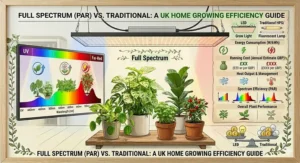
A 100W panel run for 16 hours a day costs roughly £15–£20 a month on a typical UK domestic tariff, scaling up proportionally for higher-wattage units — a 200W light might land closer to £30–£40 monthly through winter. LEDs rated for 50,000+ hours rarely need bulb replacement, unlike older HPS setups that demand a £30–£50 bulb swap every 12–18 months, which evens out the higher upfront LED price over a couple of years.
Replacement parts and warranty support vary by brand: Spider Farmer and Mars Hydro both maintain UK-based repair and warranty channels, which is worth more than it sounds if a unit develops a fault outside the standard 30-day Amazon return window.
UK Regulations, Safety Standards & Legal Requirements
Since the post-Brexit transition, UKCA marking has replaced CE as the relevant UK conformity standard for electrical goods, and a grow light without it should raise questions about whether it’s been properly safety-tested for the UK market. There’s no licensing requirement for running a grow light domestically, but landlords and leaseholders should check tenancy agreements regarding modifications like hanging hooks or additional electrical load, particularly in older properties with limited circuit capacity.
For more detail on what UKCA marking actually covers, the UK Government’s guidance on UKCA marking is the most reliable starting point, and Which? periodically reviews grow lights with UK-specific safety and performance testing worth cross-referencing before a larger purchase.
❓ FAQ
❓ What is a full spectrum grow light for indoor plants?
❓ Do I need a grow light if my room gets some natural light?
❓ Can I use a full spectrum grow light bulb in a normal lamp?
❓ How far should a grow light be from indoor plants?
❓ Are full spectrum grow lights available with fast UK delivery?
Conclusion
There’s no single “best” full spectrum grow light for indoor plants — only the right one for your particular windowsill, tent, or shed. If you’re nursing a couple of houseplants through a grey British winter, the SANSI clip-on or Pianta bulb will do the job without turning your living room into a laboratory. If you’ve committed to a proper grow tent, the Mars Hydro TS600 is a sensible, low-risk starting point, while the Spider Farmer and VIPARSPECTRA options reward growers who’ve outgrown beginner kit and want Samsung-grade reliability. For anyone running a full 4x4ft setup, the Phlizon Pro Series earns its keep.
Whichever you choose, check current pricing and UKCA certification on the listing before buying, match wattage to your actual tent size rather than the biggest number available, and remember that a £50 light run sensibly will usually outperform a £200 light running at the wrong distance or intensity.
✨ Don’t Miss These Exclusive Deals!
🔍 Take your indoor growing setup to the next level with these carefully selected lights. Click on any highlighted product to check current pricing and availability on Amazon.co.uk. 🌿
Recommended for You
Disclaimer: This article contains affiliate links. As an Amazon Associate, I earn from qualifying purchases. If you purchase products through these links, we may earn a small commission at no additional cost to you.
✨ Found this helpful? Share it with your mates! 💬🤗
