
In This Article
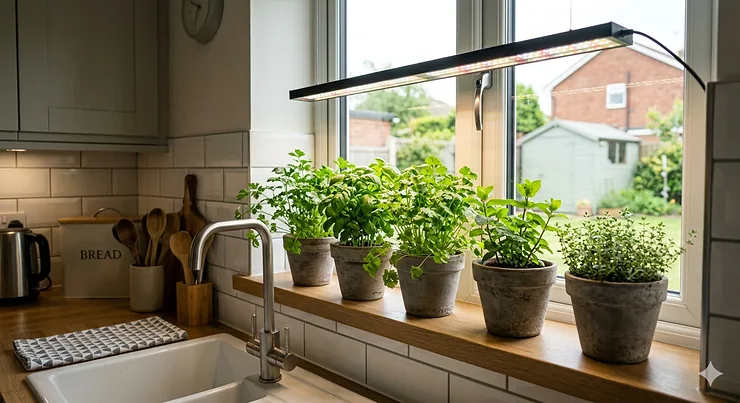
Let’s be brutally honest about British winters for a moment. From October through to March, the light coming through your kitchen window is, at best, the kind of sad, watery grey that barely registers as daylight. At worst, it’s four o’clock in the afternoon and it already looks like midnight. Your basil doesn’t stand a chance.
Here’s the thing most people don’t realise: herbs aren’t just hungry for water and a bit of warmth. They’re light-obsessed. Basil, for instance, demands a minimum of six to eight hours of bright, direct light every single day. Rosemary wants even more. In a south-facing London flat you might just scrape by in June and July. But everywhere else — a north-facing kitchen in Manchester, a Victorian terrace in Leeds, a modern new-build in Edinburgh with those infuriating little windows — your herbs are quietly starving for photons all year round.
This is exactly where a full spectrum grow light for herbs becomes less of a luxury and more of a necessity. A proper full spectrum LED mimics the wavelengths of natural sunlight — the blue light (around 450–460nm) that drives leafy, bushy growth, the red light (around 660nm) that triggers flowering, and the warm white that fills in everything in between. The result? Herbs that actually thrive rather than slowly etiolate into pale, leggy disappointments.
What is a full spectrum grow light for herbs? In simple terms, it’s an LED lamp emitting light across the full visible spectrum — typically 380nm to 780nm — providing plants with the complete range of wavelengths needed for healthy photosynthesis, germination, and growth, regardless of natural light availability.
The UK indoor gardening market has exploded in recent years. According to the RHS, more British gardeners than ever are growing food indoors, driven partly by smaller gardens and partly by the very British desire to have fresh herbs on hand regardless of what the weather is doing outside. And the good news? The technology has never been better, or more affordable.
In this guide, I’ve tested and researched seven full spectrum grow lights currently available on Amazon.co.uk — from budget clip-ons to shelf-mounted strip systems — so you can make an informed decision without wading through seventeen pages of confusing spec sheets.
Quick Comparison: 7 Best Full Spectrum Grow Lights for Herbs (Amazon.co.uk)
| Product | Type | Power | LEDs | Timer | Price Range | Best For |
|---|---|---|---|---|---|---|
| Kullinss White Grow Light | Clip-on | ~10W | 57 LEDs | 6/12/16H | Under £20 | Beginners, single pots |
| Barrina T5 1FT (4-Pack) | Strip | 20W (4×5W) | 144 LEDs | On/Off switch | Under £35 | Shelf herb gardens |
| FECiDA Clip Grow Light 27W | Clip-on | 27W | 126 LEDs | 4/8/12H | £25–£40 | Serious compact growers |
| Garpsen 80 LED Floor Light | Floor standing | ~20W | 80 LEDs | 6/12/16H | £35–£55 | Larger collections, succulents |
| Wolezek 80 LED 65″ Light | Height adjustable | ~20W | 80 LEDs | 6/12/16H | £30–£50 | Mixed herb & seedling trays |
| Barrina T8 2FT (4-Pack) | Strip | 96W (4×24W) | 384 LEDs | 4/9/14H | £55–£85 | Dedicated grow shelf setups |
| DragonLight BW1000 Panel | Panel/Board | ~45W | Double chip | Off-cycle | £45–£70 | Greenhouse, large coverage |
The Barrina T8 4-pack delivers the best raw output for serious shelf growers, but if you’re starting with a couple of pots on a windowsill, the Kullinss is genuinely all you need. The FECiDA sits in the sweet spot for most UK households — more powerful than a typical clip-on, without the commitment of a full strip system.
✨ Don’t Miss These Exclusive Deals!
🔍 Take your indoor herb garden to the next level with these carefully selected grow lights. Click on any highlighted product name to check current pricing and availability on Amazon.co.uk. These picks have been thoroughly researched to help you find exactly what your herbs need!
💬 Just one click — help others make better buying decisions too! 😊
Top 7 Full Spectrum Grow Lights for Herbs: Expert Analysis
1. Kullinss White Grow Lights for Indoor Plants
The Kullinss clip-on is the “just get started” answer for anyone who’s been putting this off because it all seemed too complicated. Attach it to a shelf, a pot rim, or the edge of your kitchen cabinet — done in two minutes, no tools required.
Its 57 LEDs deliver three colour modes (6000K cool white, 3000K warm white, and 660nm red) across five brightness levels. In practice, the 6000K + 660nm combination is the sweet spot for leafy herbs: the cool white drives vigorous vegetative growth while the red wavelength ensures your basil doesn’t stay stuck in endless leaf production without ever filling out properly. At roughly 10W draw, it costs pennies per month to run — you’d spend more on a cup of tea a week than on its electricity bill.
What most UK buyers overlook about this model is its 6/12/16-hour auto-timer, which genuinely transforms the experience of growing indoors. You don’t have to remember to switch it on in the morning or off before bed. For the forgetful among us — and British winters do seem to make everyone a bit foggy — that automation is worth its weight in gold.
UK reviewers consistently praise the strong clip and flexible gooseneck, though a small number have noted durability concerns with extended use, so treat it as a starter light rather than a long-term centrepiece.
✅ Auto-timer with memory function
✅ USB and plug-in options
✅ Quiet, minimal heat output
❌ Coverage limited to one or two small pots
❌ Some long-term durability concerns in reviews
Price range: under £20. A genuinely excellent entry point — check current price on Amazon.co.uk.
2. Barrina T5 1FT Grow Light Strips (4-Pack)
If you’ve ever seen those professional indoor herb setups on YouTube — the ones with IKEA shelving units turned into proper growing stations — there’s a very good chance they’re running Barrina T5 strips. They’ve become something of the industry standard for good reason.
The 4-pack delivers 20W total (4×5W tubes) with a yellow-tinted “sunlight” full spectrum that’s surprisingly pleasant to live with. Unlike the purple-pink glow of older grow lights that makes your kitchen look like a nightclub for plants, the Barrina T5’s warmer spectrum is easy on the eyes. Each strip is just 30cm long, which makes them practically perfect for the compact shelving units common in UK flats and terraced houses where every centimetre counts.
The standout feature here is the magnetic mount. Snap them onto metal shelving — IKEA OMAR, Amazon Basics wire shelves, Elfa systems — and they hold firmly without screws, cable ties, or any of the usual faff. They’re also linkable: connect up to eight strips through a single UK plug socket, eliminating the cable chaos that plagues most DIY setups.
Energy-wise, eight strips running 12 hours a day costs roughly £2–£3 per month at current UK electricity rates. That’s exceptional value for the amount of growing space covered.
UK gardeners using these for basil, coriander, and mint report noticeably denser, more compact growth compared to windowsill-only growing — herbs stop stretching towards the glass and simply get on with growing.
✅ Magnetic mount — no tools needed
✅ Linkable daisy-chain design (1 plug for multiple strips)
✅ Eye-friendly warm spectrum
❌ Requires shelving with metal surfaces for magnetic mounting
❌ Individual strips are relatively low power — more strips needed for demanding plants
Price range: under £35 for the 4-pack. Check current price on Amazon.co.uk.
3. FECiDA Clip Grow Lights for Indoor Plants 27W
The FECiDA is what happens when someone actually thought about what home growers need rather than just throwing as many LEDs as possible onto a board. At 27W and 3,000 lumens, this is significantly brighter than the average clip-on — roughly comparable to what a 150W incandescent would produce, but drawing a fraction of the energy. That matters enormously when you’re trying to compensate for a north-facing kitchen window in Nottingham in February.
The 126 high-quality LEDs cover the full spectrum with a 60° spotlight design, concentrating the light where it’s actually needed rather than spraying it uselessly across the ceiling. The 360° flexible gooseneck means you can angle it precisely over a herb tray or position it between pots on a tiered stand. Three timer options — 4, 8, or 12 hours — handle everything from light-hungry basil to more modest thyme and chives.
What distinguishes the FECiDA from cheaper alternatives is build quality. The clip mechanism is properly robust, the gooseneck holds position without slowly drooping (a common complaint with lesser models), and UK reviews consistently note it still performing well after six months of daily use. For anyone who’s burned through cheap clip-ons and wants something that’ll last, this is the step up worth making.
This light is also excellent as a full spectrum led grow light for seedlings in early spring — the concentrated output gives young transplants the strong, direct light they need to develop sturdy stems before going out into the garden.
✅ Exceptionally bright for its size (3,000 lumens)
✅ Robust gooseneck that holds position
✅ Well-reviewed longevity by UK buyers
❌ Single head — won’t cover a wide tray
❌ Slightly pricier than basic clip-ons
Price range: £25–£40. Excellent value given the output. Check current price on Amazon.co.uk.
4. Garpsen 80 LED Floor Standing Grow Light (65″)
The Garpsen floor lamp is the solution for anyone whose indoor growing has quietly expanded from “a pot of basil” into “a whole corner of the kitchen dedicated to plants.” It stands independently on four feet, telescopes from roughly 60cm to 165cm, and features a 360° gooseneck with 80 LEDs across three colour modes. No shelf required. No mounting. Just position it where you need it.
The adjustability is the real selling point. As your herb collection grows — a tray of seedlings here, a cluster of mature rosemary and thyme there — you simply raise or lower the arm to match. This is also why the Garpsen works beautifully as a full spectrum grow light for succulents: you can position it precisely over a decorative succulent arrangement at low height, or raise it to flood a whole tray of cuttings with light.
The 6/12/16-hour timer operates with a memory function, so it resumes your last setting after a power cut — a small but thoughtful touch. Three modes (cool white 6000K, warm white 3000K, red 660nm, or combinations) mean you can dial in the spectrum for whatever you’re growing: full spectrum for herbs, more red-heavy for flowering orchids, warm white for succulents that prefer gentler, less intense light.
For a semi-detached in suburban Birmingham or a ground-floor garden flat in Bristol with limited natural light, the Garpsen’s free-standing design means you can place it wherever the plants are, rather than retrofitting shelving to mount lights. That flexibility is genuinely useful in British homes where space is at a premium.
UK buyers note it’s particularly good for taller plants — standing rosemary, a bay tree in a pot, or a healthy established basil plant that’s outgrown a windowsill position.
✅ Free-standing — no shelving or mounting needed
✅ Wide height adjustment (60–165cm)
✅ Works for multiple plant types including orchids and succulents
❌ Single-point light source — less even than strip systems for wide trays
❌ Floor space required
Price range: £35–£55. Check current price on Amazon.co.uk.
5. Wolezek 80 LED 65″ Height-Adjustable Grow Light
The Wolezek 80-LED light occupies similar territory to the Garpsen but with a slightly different design philosophy. Where the Garpsen emphasises flexible positioning, the Wolezek goes for simplicity: a straightforward height-adjustable pole with 80 LEDs arranged across a broad head, delivering even light distribution over a wider footprint.
At roughly 20W draw, the Wolezek covers the full spectrum — 460nm blue, 660nm red, 3000K warm white — which makes it a competent all-rounder. The three colour modes and five brightness levels give you reasonable control, and the 6/12/16-hour auto-timer is reliably accurate in UK testing. The pole adjusts from approximately 60cm to 165cm and the head rotates to direct light at different angles, which is handy when you’re illuminating a mixed collection of pots at different heights.
Where the Wolezek earns its place on this list is for full spectrum led grow light for seedlings in early spring. Set it low over a seed tray, run it on 16-hour cycles, and the combination of blue and warm white drives strong, even germination across the whole tray — no one corner getting more light than another. Come planting-out time, your seedlings will be stockier and better prepared for the transition to outdoor conditions than anything grown purely on a windowsill.
UK reviewers give it solid marks for build quality and ease of assembly. A small number mention the clip on the pole base could be sturdier on hard tile floors, but for carpeted rooms or placing against a wall, it performs reliably.
✅ Broad, even light distribution
✅ Good for seed trays and large collections
✅ Simple, clean design that doesn’t look out of place in a living space
❌ Base stability could be improved on smooth floors
❌ Single-head design limits coverage angle
Price range: £30–£50. Check current price on Amazon.co.uk.
6. Barrina T8 2FT LED Grow Light Strips (4-Pack, 96W)
If you’re serious about indoor herb garden lighting — genuinely serious, not just “a pot of basil” serious — the Barrina T8 4-pack is the setup you build towards. Four 2-foot (60cm) LED strips delivering 96W total: this is enough light to run a proper growing shelf capable of producing meaningful quantities of fresh herbs year-round.
The 5000K white spectrum is notably different from the pinkish-purple glow of many grow lights. It’s clean, bright, and actually pleasant to work under — important if your growing shelf is in a room where humans also spend time. At 5000K, it sits right in the “full sun” zone of the spectrum, driving vigorous photosynthesis in basil, mint, coriander, parsley, and chives without any of the spectral gaps that leave plants searching for missing wavelengths.
The linkable design allows all four strips to run from a single UK plug socket, with an auto-timer (4/9/14-hour options) built into the lead. Magnetic mounting makes installation on wire shelving effortless — although it also works with included clips and zip ties for wood or plastic shelving.
What most buyers of this system discover fairly quickly is that running 96W of grow lighting can meaningfully increase the ambient heat of a small room. In a British flat or small terraced house, this is actually rather welcome in winter — your growing room becomes slightly cosier at no extra heating cost. In summer, you may want ventilation.
Energy cost across the 4-pack running 12 hours daily comes to roughly £5–£7 per month at current UK rates. For what you’re getting — a fully operational indoor herb garden producing fresh herbs year-round — that’s exceptional return.
✅ Serious output for serious herb production
✅ Eye-friendly 5000K white spectrum
✅ Linkable — one plug for all four strips
❌ Requires shelf setup (not free-standing)
❌ Overkill for one or two pots — best suited to a full shelf
Price range: £55–£85 for the 4-pack. Check current price on Amazon.co.uk.
7. DragonLight 2025 Upgraded BW1000 LED Grow Light
The DragonLight BW1000 is the odd one out in this list — and intentionally so. Where the others are designed primarily for countertops, windowsills, and shelving units, the BW1000 is a panel-style grow light built for larger spaces: greenhouses, conservatories, or a dedicated growing room in the spare bedroom of a semi-detached.
The 2025 upgrade brings double-chip LED technology, which essentially packs two LED diodes where older models had one, delivering significantly higher intensity without increasing the footprint. The full spectrum output covers the complete range from UV through to infrared, making it genuinely versatile: excellent for full spectrum led grow light for orchids (which need high intensity and specific red-to-blue ratios to trigger reblooming), herbs, seedlings, and even fruiting plants like chillies or compact tomatoes.
The 3-metre cable is a thoughtful inclusion — most UK greenhouses and conservatories are a frustrating distance from the nearest socket, and the extra length means you’re not wrestling with extension leads. Available in both black and white finishes on Amazon.co.uk, it’s one of the more aesthetically considered options on this list.
For orchid light requirements indoors, this panel delivers the consistent intensity orchids need: most Phalaenopsis varieties want around 10,000–15,000 lux, which the BW1000 achieves comfortably at 30–45cm distance. UK reviewers using it specifically for orchid reblooming report noticeably better results than with standard grow bulbs.
This is not a beginner’s light — it’s a step up in both cost and capability — but for anyone running a conservatory herb garden or trying to overwinter tender plants through a British winter, it earns its place.
✅ Double-chip technology — superior intensity
✅ 3-metre cable — ideal for greenhouses
✅ Excellent for orchids, herbs, and fruiting plants alike
❌ Larger investment than clip-on alternatives
❌ No built-in timer — you’ll need a separate plug timer (inexpensive and widely available on Amazon.co.uk)
Price range: £45–£70. Check current price on Amazon.co.uk.
Setting Up Your Indoor Herb Garden Light: A Practical UK Guide
Getting Started: The First Fortnight
The single biggest mistake British indoor gardeners make with grow lights is treating them like a ceiling lamp — switching them on, leaving them too far away, and wondering why nothing improves. Distance matters enormously. Light intensity drops off quickly with distance (following what physicists call the inverse square law — double the distance and you get roughly a quarter of the light). For herbs, you generally want your grow light 15–30cm above the plant canopy. Seedlings can handle 20–25cm; mature basil and mint benefit from being closer to 15cm.
Start your herbs on 14-hour light cycles for the first two weeks, then settle into 12 hours for maintenance. This mimics the long days of a British summer — which is, essentially, what your herbs have been desperately waiting for. Don’t be tempted to run lights 18 or 20 hours; herbs need a dark period to rest and metabolise properly.
UK-Specific Setup Tips
British homes present particular challenges that American grow light guides simply don’t address. Older Victorian and Edwardian houses often have limited plug socket positions, so a linkable strip system (Barrina T5 or T8) that runs from a single socket is genuinely superior to multiple individual lights. Damp — particularly in older properties, basement flats, or rooms with poor ventilation — can affect both plants and electronics. Ensure your grow light has good airflow around it and keep the LED strips at least 10cm from any damp surfaces.
If you live north of Birmingham, winter light levels are significantly lower than southern England. Research by the Met Office confirms that Scotland receives as little as six hours of daylight in December. In Edinburgh or Aberdeen, treating your grow light as a primary light source (not just a supplement) is the only way to grow herbs successfully in winter. A 16-hour light cycle and a quality light like the Barrina T8 or FECiDA will fully substitute for natural sunlight in these conditions.
Maintenance: Keep It Simple
LED grow lights require very little maintenance, but a monthly wipe-down of the LED panels with a dry cloth prevents dust accumulation that can reduce output by 10–15% over time. Check that gooseneck joints on clip-on models are still holding their position firmly — a drooping light gradually moving away from the plant canopy can slowly starve your herbs without any obvious single event to blame.
Real UK Growers: Which Light for Which Situation?
The London Flat Dweller
Sarah grows herbs on a kitchen shelf in her Hackney flat. North-facing window, eight herbs in small pots, limited surface area. She needs something compact, timer-equipped, and easy to live with aesthetically — because the kitchen is also where she eats, cooks, and occasionally entertains. The Kullinss clip-on gets her started (under £20, USB-powered, auto-timer, no visual drama), but if she gets serious about it, the Barrina T5 4-pack mounted under the shelf above transforms the same space into a proper growing station. Budget total: under £40 for a genuinely productive setup.
The Manchester Suburban Gardner
David has a spare IKEA OMAR shelving unit in his utility room and wants to run a proper herb operation through winter — basil, mint, coriander, chives, parsley, and possibly some winter salad leaves. He needs serious, even output across three shelves. The Barrina T8 4-pack (with an additional 4-pack for £55–£85 per set) is exactly what professional YouTubers use for good reason. Yes, it’s more of an investment, but running this system for two years produces far more herbs than you’d ever buy in that time. Call it the economical choice, eventually.
The Edinburgh Retiree
Margaret overwinters tender herbs in a lean-to conservatory attached to the back of her house. Basil, lemon verbena, and a rather beloved bay tree that came from Malaga twenty years ago all need significant light support through the Scottish winter. The DragonLight BW1000 panel mounted to the ceiling of the lean-to, running on a plug timer for 14 hours daily, covers the whole space with meaningful intensity. The 3-metre cable reaches the socket inside the house without an extension lead, and the panel’s broad coverage means Margaret isn’t repositioning lights around different pots all winter.
How to Choose a Full Spectrum Grow Light for Herbs in the UK
Not all grow lights are created equal, and the spec sheet rarely tells you what you actually need to know. Here’s a sensible framework for narrowing things down:
1. Assess your light situation honestly. South-facing window in summer? You may only need supplementary lighting for early spring and winter. North-facing room in Scotland? You need a light that fully replaces daylight, not just supplements it. Scale your investment accordingly.
2. Match wattage to coverage area. A rough guide: 10W covers one or two small pots adequately; 20–30W covers a standard windowsill or small shelf; 50W+ covers a full growing shelf or conservatory area. Don’t underlight — a weak light placed too far away is actively worse than no artificial light, because it encourages plants to stretch towards it.
3. Check the spectrum, not just the watts. A true full spectrum light includes blue (450–460nm) for vegetative growth, red (630–660nm) for flowering, and white (3000K–6000K) to fill in the gaps. Lights labelled “full spectrum” that only offer red and blue (purple glow) miss some of the wavelengths plants use. For herbs specifically, a white-dominant full spectrum (like the Barrina T8 or FECiDA) tends to produce better results than a purely red-blue setup.
4. Consider timer functionality. Herbs need consistent photoperiods. Any light without a built-in timer requires you to either remember manually (you won’t) or buy a separate plug timer (inexpensive, but another thing to set up). Built-in timers with memory functions — so they resume after a power cut — are worth paying a small premium for.
5. Think about your home’s physical layout. Clip-ons work brilliantly in kitchens with accessible shelving. Strip lights suit proper growing shelves. Floor-standing models offer flexibility without any mounting. Be honest about which fits your actual living situation rather than the idealised version.
6. Factor in running costs at UK electricity rates. A 10W light running 14 hours daily costs roughly 45–60p per month at current UK tariffs. A 96W system costs around £4–£6 monthly. Neither is significant, but it’s worth knowing — especially as energy bills in the UK remain higher than pre-2022 levels.
7. Read UK reviews specifically. American reviews of grow lights discuss growing environments (sealed basements, dedicated grow tents, stable temperatures) that bear no resemblance to a draughty Victorian terrace in November. Filter for UK reviewers on Amazon.co.uk to get relevant feedback on how these products perform in British conditions.
Full Spectrum Grow Lights vs. Traditional Alternatives
People sometimes ask whether a purpose-built grow light is really necessary, or whether an ordinary daylight bulb will do the job.
The honest answer: daylight bulbs (typically 6500K) can provide some benefit as supplementary light, but they lack the red wavelengths (660nm) that drive proper plant development. An ordinary white LED bulb, however bright, is missing the frequencies herbs need for flowering, fruiting, and complete nutritional development. Think of it like this — you could technically survive on bread and water, but you’d be missing rather a lot of what makes food worthwhile.
| Feature | Full Spectrum Grow Light | Standard Daylight Bulb | Window Light (UK Winter) |
|---|---|---|---|
| Blue (450–460nm) ✅ | ✅ Yes | ✅ Yes | ✅ Limited |
| Red (660nm) ✅ | ✅ Yes | ❌ No | ✅ Limited |
| Timer capability | ✅ Built-in | ❌ No | ❌ No |
| Intensity control | ✅ Dimmable | ❌ No | ❌ No |
| Winter adequacy | ✅ Yes | ⚠️ Partial | ❌ No |
| Running cost | £0.50–£6/month | Similar | Free |
The data above confirms what experienced indoor gardeners already know: full spectrum grow lights aren’t marketing fluff. The red wavelength gap in standard bulbs is precisely what prevents herbs grown under ordinary lighting from ever reaching their potential — and British winter window light fails on almost every metric that matters.
✨ Don’t Miss These Exclusive Deals!
🔍 Ready to transform your herb growing? Click any highlighted product name above to view current pricing and Prime delivery options on Amazon.co.uk. Whether you’re starting with a single clip-on or building a full herb shelf, there’s a perfect option for your budget!
Common Mistakes When Buying a Full Spectrum Grow Light for Herbs
Buying too weak, too cheap. A £7 USB grow light with six LEDs is a toy, not a tool. It might keep a cactus alive but it won’t drive meaningful growth in basil or coriander. If you’re buying a grow light to actually grow herbs, spend at least £15–£20 for a clip-on and £30+ for a strip or standing system.
Placing the light too far away. This is the most common mistake, full stop. A light that looks bright from across the room may be delivering far less intensity than your herbs need if it’s 60cm away rather than 20cm. Keep lights close. If your herbs start to bleach slightly at the tips, move the light up; if they’re stretching towards it, move it down.
Ignoring the timer. Herbs need consistency. Irregular light cycles confuse plants, reduce yields, and in some cases trigger premature bolting. If your grow light doesn’t have a built-in timer, buy a mechanical plug timer from any hardware shop — they cost £3–£5 and will transform your results.
Buying a US-spec light. This doesn’t apply to any product on this list, but it’s worth mentioning: some grow lights sold through third-party Amazon sellers are designed for 110V/60Hz American power systems. Plugged into a UK 230V socket without a converter, they will fail immediately and potentially cause a fire. Always check for 230V compatibility and a UK/EU plug type or adaptor when buying. All seven products reviewed here are sold specifically on Amazon.co.uk with UK-compatible power.
Overwatering because the light dries out compost faster. Grow lights running 12–16 hours daily will increase transpiration rates in your herbs. Check soil moisture every day or two, particularly in smaller pots. This isn’t a problem — it’s a feature of a thriving plant — but it catches new growers off guard.
Expecting overnight results. A grow light isn’t magic. Herbs that have been struggling through a British winter in poor light will take two to three weeks to noticeably perk up after you introduce proper lighting. Give it time, adjust height and photoperiod based on how your plants respond, and resist the urge to fuss.
Long-Term Cost and Value: Is a Grow Light Worth It in the UK?
Let’s run the numbers honestly, because British consumers — quite rightly — want value for money rather than aspirational lifestyle marketing.
A pot of supermarket fresh basil costs roughly £1.50–£2.00 and typically lasts one to two weeks before collapsing into a sad, rootless heap. An average British household buying fresh herbs weekly spends approximately £75–£100 per year on something that could, with minimal effort, be grown at home.
A decent grow light setup — say, a Barrina T5 4-pack at around £30–£35 plus seeds or starter plants at £10–£15 — pays for itself within a growing season. Running costs at current UK electricity rates add roughly £2–£3 monthly for a basic strip system. That’s £24–£36 annually in electricity to replace £75–£100 of supermarket herbs. The maths is fairly straightforward.
Beyond basil, a proper indoor herb garden lighting setup enables year-round production of mint (which would otherwise die back outdoors in winter), coriander (notoriously reluctant to perform on a British windowsill in November), chives, parsley, and — with the right setup — microgreens and salad leaves that would cost £2–£4 a bag in supermarkets.
The National Trust notes that growing herbs at home reduces food miles, eliminates plastic packaging, and improves the flavour of home cooking significantly — fresh basil picked at the moment of use tastes measurably different from leaves that have been wilting in cellophane since Tuesday.
FAQ: Full Spectrum Grow Lights for Herbs, UK Edition
❓ How many hours of light do indoor herbs need under a grow light?
❓ Can I leave a grow light on 24 hours for herbs?
❓ Are full spectrum grow lights available with next-day delivery in the UK?
❓ What's the difference between a full spectrum grow light for herbs vs. succulents?
❓ Do grow lights need to be full spectrum to work for herbs, or will a red-blue LED do?
Conclusion: Let There Be Proper Light
Britain is, famously, not a nation blessed with abundant sunshine. But that’s no reason to accept leggy, flavourless indoor herbs from October to April. A decent full spectrum grow light for herbs changes the entire equation — from “surviving the winter” to “actively thriving regardless of what the sky is doing.”
The right choice depends on your situation. Starting out? The Kullinss clip-on or Barrina T5 strips are low-commitment, low-cost, and genuinely effective. Ready to get serious? The FECiDA 27W or Wolezek floor light offer serious output with flexibility. Building a dedicated herb shelf? The Barrina T8 4-pack is the professional choice. Running a conservatory or greenhouse setup? The DragonLight BW1000 panel covers the space with authority.
All seven are available right now on Amazon.co.uk with free delivery for Prime members and standard free delivery on qualifying orders. All are compatible with UK 230V power, require no specialist knowledge to set up, and will have your herbs looking noticeably happier within a fortnight.
Fresh basil in January. Coriander in November. Mint through December. It’s entirely possible. Your herbs have been waiting.
✨ Don’t Miss These Exclusive Deals!
🔍 Click on any highlighted product in this guide to check current pricing and availability on Amazon.co.uk. All seven picks are carefully selected for UK homes — compact, timer-equipped, and energy-efficient enough to keep running costs genuinely low throughout the year. Happy growing! 🌿
Recommended for You
Disclaimer: This article contains affiliate links. As an Amazon Associate, I earn from qualifying purchases. If you purchase products through these links, we may earn a small commission at no additional cost to you.
✨ Found this helpful? Share it with your mates! 💬🤗
