
In This Article
It starts, as so many gardening rabbit holes do, with a glow. You peer into your neighbour’s shed and there it is — an eerie purple haze pulsing through the frosted glass. Or you spot a white-lit tent in a YouTube video and wonder why yours looks like a rave venue by comparison. The question of full spectrum vs blurple grow light isn’t just an aesthetic one. It’s a decision that affects your yield, your electricity bill, your ability to spot the first signs of spider mites, and frankly, your quality of life every time you pop your head inside the tent.
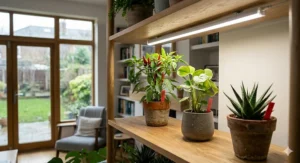
Here’s the quick answer for those who need it: full spectrum LED grow lights produce a broad, balanced output covering the entire photosynthetically active radiation (PAR) range — roughly 400 to 700 nanometres — plus useful near-infrared (IR) and sometimes ultraviolet (UV). They look white or warm white. Plants love them throughout every stage of growth. Blurple lights, by contrast, combine red diodes (typically around 660nm) and blue diodes (around 450nm) to target peak photosynthesis wavelengths directly. They look purple-magenta. They’re cheaper. And they were, until about five years ago, the dominant choice for budget-conscious indoor growers across the UK.
So which actually wins in 2026? It’s not quite the landslide victory the full-spectrum camp would have you believe — context matters enormously. A blurple panel in a sealed propagator running cuttings is a different beast from that same panel trying to flower tomatoes in a 120 × 120cm tent through a British November. We’ve done the research, tested the arguments, and rounded up seven real products currently available on Amazon.co.uk to help you make the right call. Whether you’re growing chillies in a spare bedroom in Sheffield or running herbs on a windowless shelf in a south London flat, this guide has you covered.
Quick Comparison: Full Spectrum vs Blurple at a Glance
| Feature | Full Spectrum LED | Blurple LED |
|---|---|---|
| Light Colour | White / warm white | Purple / magenta |
| Wavelength Coverage | 380–780nm (broad) | ~450nm + ~660nm (narrow) |
| Best Growth Stage | All stages (seed to harvest) | Veg & bloom (separately tuned) |
| Energy Efficiency | High (2.0–2.9 µmol/J) | Moderate (1.2–1.8 µmol/J) |
| Plant Inspection | Easy — colours appear natural | Difficult — everything looks purple |
| Typical UK Price Range | £40–£300+ | £15–£80 |
| Running Cost (per month, 16h/day) | £8–£18 | £5–£14 |
| Amazon.co.uk Availability | Excellent | Good (older stock) |
| Best For | All-round growing | Propagation, tight budgets |
The table above reveals something worth sitting with for a moment. Blurple lights are cheaper upfront, yes — but their lower efficacy (µmol per joule of electricity) means they’re working harder for fewer results. Over a six-month grow cycle at UK electricity rates, the gap in running costs narrows considerably. When you factor in that full spectrum lights generally last longer and require no spectrum-swapping between stages, the value equation shifts firmly in favour of white-spectrum LED technology for most UK growers.
💬 Just one click — help others make better buying decisions too! 😊
✨ Don’t Miss These Exclusive Deals!
🔍 Take your indoor growing to the next level with these carefully selected lights. Click any highlighted product name to check current pricing and availability on Amazon.co.uk — and find the perfect match for your grow space.
Top 7 Full Spectrum vs Blurple Grow Lights: Expert Analysis
1. Spider Farmer SF1000 EVO — Best Full Spectrum for Small Tents
The SF1000 EVO is what happens when a brand takes its already-decent light and quietly makes it better without fanfare. The 2026-updated version uses Bridgelux high-efficiency LEDs in place of the previous Samsung chips, delivering a genuine full-spectrum output spanning 3000K warm white, 5000K cool white, 660nm red, and 760nm IR — all in one fanless, whisper-quiet panel drawing around 100W from the wall.
What does that mean in practice? For a 60 × 60cm to 80 × 80cm grow space — which describes an awful lot of UK tent setups tucked into spare rooms, loft conversions, and understair cupboards — this light delivers enough photon density to carry plants from germination through to a decent flower without ever needing to swap spectrums. It’s genuinely single-light convenience.
UK buyers will appreciate the fanless design. Noise is a real concern in British terraced homes where sound travels with alarming efficiency through walls. The SF1000 EVO runs silently and sits at a temperature that’s perfectly manageable even in a small enclosed tent through summer. The driver runs externally, so heat shedding inside the canopy is minimal.
UK customers on Amazon.co.uk consistently mention clean, compact construction and notably better plant response compared to older blurple panels they’d previously used.
✅ Silent, fanless operation — ideal for noise-sensitive UK homes
✅ Single light for all growth stages — no spectrum-swapping
✅ Excellent heat management in compact spaces
❌ Coverage drops off noticeably beyond 80 × 80cm
❌ No built-in timer or app control at this price point
Price range: around £90–£120 — solidly mid-range and well worth it for small tent growers. Prime-eligible with next-day delivery for many UK postcodes.
2. Mars Hydro TS1000 — Best Budget Full Spectrum All-Rounder
If one light can fairly claim to have converted a generation of blurple sceptics across the UK, it’s the Mars Hydro TS1000. Mars Hydro themselves aren’t shy about it — the product listing on Amazon.co.uk explicitly states it outperforms “old blurple LED lights” by up to 30% in yield per watt. Bold claim, but the real-world feedback from UK buyers supports it fairly convincingly.
The TS1000 draws 150W and uses SMD LED technology to produce a sunlike full spectrum output — 3000K warm white, 5000K cool white, 660nm red, and 760nm IR — with a peak PPFD of 743 µmol/m²/s at 45cm hanging height. It covers up to 80 × 80cm in flower, stretching to a metre square for vegetative growth. The patented reflector is a genuinely clever design touch: it redirects lateral light back down into the canopy, which matters more than it sounds in a tent where every wasted photon is money flying out the window.
For UK growers, there’s another underappreciated advantage. The white light output makes plant inspection straightforward. Spotting early signs of nutrient deficiency, pest damage, or mould — all of which British growers face with more urgency in a damp climate — is simply impossible under blurple glow. The TS1000 lets you actually see your plants as they are.
UK reviewers highlight ease of setup and genuine performance gains over previous blurple setups. One long-term reviewer explicitly noted upgrading from a Mars Hydro 300W blurple, finding the TS1000 decisively superior.
✅ 30% higher yield claims vs blurple — backed by UK user reviews
✅ Fanless, daisy-chain ready, dimmable
✅ Visible, natural-looking light makes plant care far easier
❌ Coverage is slightly smaller than claimed at maximum intensity
❌ No app control or scheduling
Price range: £55–£75 — exceptional value. Arguably the best first full-spectrum light for UK beginners abandoning blurple for the first time.
3. Mars Hydro TSW2000 — Best Full Spectrum for Medium Tents
The Mars Hydro TSW2000 is essentially the TS1000 grown up and given a proper job to do. At 300W true draw with 684 SMD LEDs, it covers a 120 × 120cm area during flowering — which is to say, a proper 1.2m tent running real crops. Its peak PPFD reaches 1122 µmol/m²/s at 45cm, which puts it firmly in the “serious growing” category rather than hobby propagation.
What elevates the TSW2000 above the blurple competition at similar price points is the efficiency. Mars Hydro’s SMD chip arrangement produces more usable photons per watt than older red-blue blurple panels, which means less heat for the same (or better) light intensity. That matters considerably in British summer, when tent temperatures can spike even with ambient temperatures that would seem mild by global standards.
The daisy chain function is worth highlighting for growers running multiple lights. Rather than running several power cables to separate sockets — a real inconvenience in UK homes where power points are often sparse — you can chain up to multiple TSW2000 units from a single socket. Practical and tidy.
UK customer feedback across Amazon.co.uk highlights impressive growth rates, especially for fruiting plants like tomatoes and peppers, which are notoriously hungry for photons through winter. One UK reviewer noted running their TSW2000 for a full autumn-to-spring cycle on tomatoes with electricity running costs they considered acceptable at UK energy rates.
✅ 300W true power — capable of driving flowering plants through British winter
✅ Daisy chain function reduces socket requirements
✅ Excellent heat management relative to output
❌ At 120 × 120cm, exceeds what smaller UK homes can comfortably tent
❌ Driver and cables could be more elegantly integrated
Price range: £130–£180 — premium over budget alternatives, but the efficiency gains make it worthwhile over a full grow cycle.
4. VIPARSPECTRA P1000 — Best Fanless Full Spectrum for Houseplants & Herbs
The VIPARSPECTRA P1000 occupies a sweet spot that doesn’t get nearly enough attention in full spectrum vs blurple grow light discussions: the serious houseplant and herb grower who isn’t building a grow tent but wants proper photons for their kitchen windowsill, propagation shelf, or underlit living room corner.
VIPARSPECTRA’s Pro Series P1000 is a fanless, silent panel producing full-spectrum white light with 600nm red, 3000K warm white, 5000K cool white, and IR. At around 100W true draw, it covers a 75 × 75cm footprint for flowering — ideal for a small shelf setup, a 60cm tent, or a collection of herbs and houseplants that genuinely need more light than a gloomy British winter provides through south-facing windows.
The absence of fans is the key selling point here. Many UK buyers using this light mention running it in living spaces, home offices, or bedrooms where noise from a fan-cooled unit would be genuinely disruptive. The solid aluminium heat sink manages thermal output beautifully and silently. Build quality feels robust, which matters for a light that might sit on a shelf rather than hang in a tent.
On the full spectrum vs blurple question specifically: the P1000 represents the newer generation of thinking. Compared to older blurple panels of similar wattage, UK users report notably healthier foliage colour, better branching, and — perhaps most practically — the ability to actually see the colour of their herbs and leaves while cooking or working nearby.
✅ Completely silent — perfect for living spaces
✅ Solid aluminium construction runs cool
✅ Full spectrum suits herbs, houseplants, and propagation equally well
❌ 75 × 75cm flowering coverage limits ambition
❌ No daisy chain capability at this spec level
Price range: £55–£75 — very competitive for a premium, fanless, full-spectrum panel.
5. VIPARSPECTRA P2000 — Best Full Spectrum for 2×4 Grow Tents
The VIPARSPECTRA P2000 is where VIPARSPECTRA’s Pro Series gets serious. At 200W true draw across a 4×2ft (120 × 60cm) coverage area in flower, it bridges the gap between casual growing and proper production — the sort of light you graduate to when the herb shelf becomes a dedicated grow tent in the spare bedroom.
The P2000 uses high-efficiency SMD LEDs in the same full-spectrum configuration as the P1000, but with substantially greater photon output. The dimming capability via daisy chain allows multiple units to be linked and dimmed simultaneously from a single control — useful for growers in narrow 120 × 60cm tent setups who want scalability without rewiring.
Here’s what the spec sheet won’t tell you, and what matters enormously in the British context: the P2000’s relatively low heat output per unit of light produced is genuinely important in UK grow tents through summer. Many growers in the south of England struggle with tent temperatures between June and August. LEDs like the P2000, which convert electricity to photons efficiently rather than bleeding off excess energy as heat, help keep ambient tent temperatures manageable without running extraction fans at maximum volume (which, in a semi-detached in Surrey, is socially suboptimal at 2am).
UK Amazon.co.uk reviewers highlight strong vegetative response and good flowering density. Several note using it successfully with peppers and tomatoes through British winter months when natural daylight is simply insufficient.
✅ Daisy chain dimmable — scalable for growing operations
✅ Low heat-per-photon ratio — helpful in warm UK summers
✅ Strong performer for fruiting plants through winter
❌ 120 × 60cm flowering footprint is narrow for square tents
❌ Some users find the hanging hardware basic
Price range: £100–£140 — fair for a 200W full-spectrum panel with daisy chain capability.
6. Mars Hydro TS600 — Best Budget Entry Point (Full Spectrum)
Not everyone is ready to spend £100 on a grow light. That’s fine. The Mars Hydro TS600 exists for exactly this situation: the person who wants to move away from an inherited blurple panel or a household bulb, but isn’t yet committed enough to drop serious money on lighting.
The TS600 draws around 100W (±5W) with 240 SMD LEDs, covering a 45 × 45cm bloom footprint and stretching to 60 × 60cm for veg. It’s fanless, which is a meaningful advantage at the price — budget blurple panels often rattle disconcertingly. The full-spectrum output is genuine: 3000K, 5000K, 660nm, and IR, exactly what plants need across the growth cycle.
The key trade-off to understand: unlike the TS1000, the TS600 does not include dimming capability or daisy chain functionality. It’s a plug-in, plug-out unit. If you’re the sort of grower who likes to fine-tune intensity across growth stages, you’ll find that limiting. If you want to set it, forget it, and just see whether your chillies actually survive the winter this year, the TS600 is perfect.
One note for UK buyers specifically: the TS600 comes with a UK plug and runs at 230V, so there are no adapter headaches. Delivery is typically Prime-eligible. It’s the kind of purchase where you risk very little and potentially gain quite a lot compared to the blurple bargain-bin options that litter the lower end of Amazon.co.uk’s grow light catalogue.
✅ Fanless and quiet — no fan buzz
✅ UK plug, 230V ready — zero compatibility fuss
✅ Genuine full spectrum at a budget price point
❌ No dimming or daisy chain — limited flexibility
❌ Bloom coverage area is very small at 45 × 45cm
Price range: £35–£55 — the cheapest sensible entry into full-spectrum growing.
7. Roleadro 75W Full Spectrum — Best for Propagation & Seedlings
The Roleadro 75W is an interesting case study in the full spectrum vs blurple grow light debate, because Roleadro built much of its early reputation on blurple panels before pivoting to white-spectrum designs. This 75W model represents that pivot — and it does a genuinely capable job within its narrow remit.
At 75W true draw, this isn’t a light for serious flowering. But for seedlings, cuttings, clones, or small propagation setups — exactly the kind of task many British growers carry out in the six to eight weeks before the last frost allows outdoor planting — it works well within its limitations. The full-spectrum output covers the seedling’s need for balanced blue (for compact, sturdy growth) and red-shifted warmth (for root development), without the harshness of focused blurple that can stress young plants.
The compact, hanging panel design suits the sort of urban UK growing context where space is genuinely precious. Tucked above a seedling tray in a windowless bathroom, run on a timer overnight when electricity rates drop (a relevant consideration given UK energy pricing), this light can successfully bring cuttings and seedlings to the stage where natural daylight takes over.
UK reviewers on Amazon.co.uk highlight the light’s suitability for succulents, cacti, and herbs — those categories of plant that genuinely benefit from the balanced spectrum without requiring the intensity that fruiting crops demand.
✅ Very compact — fits tight propagation spaces
✅ Suitable for seedlings, cuttings, succulents, and herbs
✅ Quiet, low-heat operation
❌ Completely inadequate for flowering or fruiting at serious scale
❌ Coverage area is genuinely small even for its 75W draw
Price range: £20–£35 — sensibly priced for what it is, provided you understand the limitations.
Understanding the Science: What Full Spectrum and Blurple Actually Do to Your Plants
To genuinely understand the full spectrum vs blurple grow light debate, it’s worth stepping back to first principles. Photosynthesis — the process by which plants convert light into chemical energy — depends on chlorophyll absorbing specific wavelengths. Chlorophyll-a peaks in the blue (around 430nm) and red (around 680nm) regions; chlorophyll-b shifts those peaks slightly but follows the same pattern.
This is why blurple lights were invented. They looked at the absorption spectrum, identified the peaks, and reasoned: “Why waste electricity on the green wavelengths plants mostly reflect back?” Logical. But incomplete.
Here’s what blurple engineering missed. Plants aren’t just running photosynthesis — they’re also regulating morphology, triggering flowering responses, activating stress pathways, and synthesising secondary metabolites (the compounds that make your tomatoes taste of tomatoes and your chillies genuinely spicy). All of these processes respond to a broader range of wavelengths than the narrow blurple peaks provide. Green light, previously thought wasted, actually penetrates deeper into the leaf canopy than blue or red. Far-red (700–750nm) light dramatically accelerates flowering response. And the subtle ratios between wavelengths influence plant structure in ways that a blurple light simply cannot replicate.
The RHS (Royal Horticultural Society) notes in its guidance that balanced light quality is as important as intensity for healthy plant development. Full-spectrum LEDs, by mimicking the broad output of sunlight, allow plants to express their full genetic potential across all growth pathways simultaneously.
Real-World Scenario: Which Light for Which UK Grower?
Let’s move from theory to the kitchen table — or, more accurately, the shed, the spare room, and the understairs cupboard.
Profile 1: The Manchester Flat Dweller Growing Herbs Year-Round
Sarah lives in a second-floor flat in Didsbury. She has a south-facing windowsill but loses viable light between October and March — Manchester’s grey winters are genuine. She wants basil, coriander, and mint running continuously. The VIPARSPECTRA P1000 is her light. Silent, compact, genuinely full-spectrum, it sits on a shelf without being obtrusive and gives her herbs the photon density they desperately need through the depths of winter. A blurple light would technically work but would make her living space look like the inside of a nightclub.
Profile 2: The Sheffield Chilli Grower Running a 1.2m Tent
Marcus is serious about his Scotch Bonnets. He runs a 120 × 120cm tent in the spare bedroom and wants one light to carry plants from seedlings in January through to harvest in September. The Mars Hydro TSW2000 is his answer. At 300W true draw over a 120 × 120cm footprint, it provides sufficient intensity for flowering and fruiting at the PPFD levels chillies demand. The daisy chain option allows him to add a second unit later if he scales up. A blurple light at this tent size would leave the outer canopy genuinely underserved.
Profile 3: The Rural Propagator in the Cotswolds
Janet grows heritage vegetable seedlings from February for her market garden. She runs a propagation rack with multiple shelves and needs reliable, quiet light for dozens of seed trays. The Roleadro 75W on each shelf suits her perfectly. Low running cost, compact form factor, and the balanced full-spectrum output produces compact, sturdy seedlings that transplant well — far better than the old blurple panel she retired two seasons ago, which consistently gave her leggy, stretched seedlings that struggled at transplant.
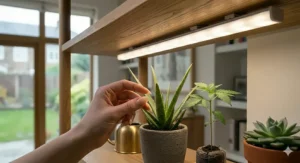
Practical Usage Guide: Getting the Most from Your Full Spectrum Grow Light in the UK
Setting up your light correctly is half the battle. Here’s what to know before your first grow.
Hanging height matters more than you think. Full-spectrum LEDs are efficient, but they’re also intense at close range. For seedlings, start at 60–75cm above the canopy. For vegetative growth, 45–60cm. For flowering, 30–45cm. Adjust based on how your plants respond — tight, compact growth indicates the right distance; stretching toward the light means you need to lower it.
British electricity rates change your calculation. At current UK electricity costs, running a 150W full-spectrum LED for 18 hours per day costs roughly £10–£15 per month. Compare this to an older 300W blurple drawing the same effective photon output — the full-spectrum unit wins on running costs over any grow of meaningful length. Factor this into your budget calculations.
Damp environments require ventilation. UK grow tents — particularly in garages and sheds — can accumulate moisture rapidly. Full-spectrum LEDs run cooler than blurple panels of equivalent output, which reduces condensation slightly, but you still need adequate air exchange. A basic 4-inch inline fan with carbon filter (where needed) is non-negotiable in most British setups.
Timers versus manual switching. UK mains power is reliable but any interruption resets manual timers. Invest in a digital timer with battery backup — available from any UK hardware shop for a few pounds — and your photoperiod remains consistent through the occasional power blip.
Inspect your plants under proper lighting. One genuinely underrated benefit of full-spectrum lights: you can actually see your plants clearly. Yellowing leaves, early signs of pests, powdery mildew developing at the base — all of these are visible under white light. Under blurple glow, everything looks purple and nothing looks alarming until it genuinely is.
How to Choose Between Full Spectrum and Blurple: A Clear Framework
Here’s the decision simplified, because sometimes you just need someone to tell you what to buy.
1. What are you growing? If you’re running seedlings, cuttings, or propagating clones, blurple will serve you reasonably well at lower cost. If you’re growing through to flower and fruit — tomatoes, chillies, herbs you want to harvest regularly — full spectrum is measurably better.
2. What’s your tent or space size? For anything larger than 60 × 60cm in flower, blurple panels struggle to deliver uniform photon density. Full-spectrum LEDs from brands like Mars Hydro and Spider Farmer cover larger canopies more evenly.
3. How long is your grow? Short propagation cycles (6–8 weeks)? Blurple can be cost-effective. Full grow cycles (4–9 months for fruiting crops)? Full spectrum’s higher efficacy reduces running costs enough to offset the higher purchase price.
4. Is noise a factor? Many blurple budget panels include noisy fans. Fanless full-spectrum options (VIPARSPECTRA P1000, Mars Hydro TS600, Spider Farmer SF1000 EVO) are significantly quieter — relevant if you’re growing in a bedroom or living space in a typical UK semi-detached.
5. Do you need to inspect plants closely? Full spectrum, every time. Not a close call.
6. What’s your total budget over 12 months? Calculate purchase price plus estimated electricity cost. At UK energy rates, full-spectrum LEDs consistently win on total cost of ownership over any grow exceeding three months.
Common Mistakes UK Buyers Make When Choosing Grow Lights
Trusting watt claims on budget blurple panels. “300W” on a cheap blurple panel rarely means 300W from the wall — it typically refers to theoretical maximum wattage of the individual diodes if each ran at full power simultaneously, which they never do. Actual draw on a “300W blurple” is often 80–130W. The Mars Hydro TS1000 at a stated 150W actually draws 150W. Compare real watts, not marketing watts.
Ignoring UK plug compatibility. Several grow lights sold on Amazon.co.uk ship with EU (Type C/F) or US (Type A) plugs and a transformer. Always confirm the listing includes a UK Type G plug or a proper UK power supply. Most reputable brands (Mars Hydro, Spider Farmer, VIPARSPECTRA) ship UK-compatible units to Amazon.co.uk, but always check product descriptions carefully.
Buying for the space you have rather than the space you need. A 60 × 60cm blurple panel in a 120 × 120cm tent is an exercise in frustration. Buy light for your actual tent size at flowering coverage — not the optimistic “max coverage” figure manufacturers use.
Ignoring running costs at UK electricity rates. Many buyers fixate on the purchase price and ignore that a less-efficient light running for six months in the UK can cost significantly more in electricity than the price difference between budget blurple and decent full spectrum. Do the maths before you buy.
Dismissing full spectrum as “just marketing.” It isn’t. The science is well-established. Researchers at multiple UK universities including the University of Exeter’s horticultural research groups have documented the benefits of broad-spectrum light for plant development that narrow-band blurple cannot replicate.
The Real Cost of Running Grow Lights in the UK: Full Spectrum vs Blurple Compared
| Light Type | True Wattage | Daily Cost (18hrs, UK rates) | Monthly Cost | Annual Cost |
|---|---|---|---|---|
| Budget Blurple (100W draw) | 100W | ~£0.37 | ~£11 | ~£135 |
| Full Spectrum Entry (100W) | 100W | ~£0.37 | ~£11 | ~£135 |
| Full Spectrum Mid (200W) | 200W | ~£0.74 | ~£22 | ~£270 |
| Full Spectrum Pro (300W) | 300W | ~£1.11 | ~£33 | ~£400 |
| Old HPS 400W (comparison) | 400W | ~£1.48 | ~£44 | ~£535 |
Based on approximate UK electricity rates of ~£0.205/kWh (Q1 2026). Check current Energy Price Cap rates at gov.uk/guidance/energy-price-cap.
The table makes something plain: at equivalent wattage, full spectrum and blurple cost exactly the same to run. The difference is in what you get for that electricity. A full-spectrum LED at 100W delivers substantially more photosynthetically useful light than a blurple at 100W — meaning you need fewer running hours or less wattage to achieve the same plant response. That’s where the real efficiency saving lies, and why the long-term economics favour full spectrum even at slightly higher purchase prices.
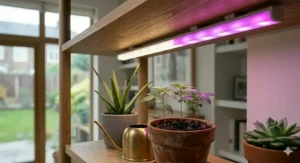
FAQ
❓ Is full spectrum or blurple better for vegetative growth?
❓ Do blurple grow lights still work in 2026?
❓ Can I use a full spectrum grow light for seedlings?
❓ Are grow lights from Amazon.co.uk UK-compatible?
❓ How much does it cost to run a grow light in the UK per month?
Conclusion: Full Spectrum Has Won — But Context Still Matters
The full spectrum vs blurple grow light debate had a clear winner some time around 2021, and the gap has only widened since. Full-spectrum LED technology has become accessible at every price point, from the Roleadro 75W at around £25 to the Mars Hydro TSW2000 at under £180, and at every step the results for UK growers are measurably superior to comparable blurple alternatives.
That said, blurple isn’t worthless. If you’ve already got one, there’s no urgency to replace it unless it’s genuinely underperforming. If you’re propagating cuttings in a sealed environment where you don’t need to see the plants and the cheap price point matters, a decent blurple panel can still earn its keep. What blurple cannot do is carry fruiting plants through a British winter with the efficiency, yield quality, or eye-comfort that modern full-spectrum LEDs deliver so capably.
For UK growers specifically, the full-spectrum advantage is compounded by Britain’s light climate. From October to March, the country operates under conditions that would make even the most sun-loving plant struggle — grey skies, short days, limited intensity through south-facing windows. A quality full-spectrum LED doesn’t just supplement natural light; for much of the British year, it replaces it entirely. That job demands the full toolbox, not two notes played in harmony.
✨ Ready to Upgrade Your Grow?
🔍 Browse the lights mentioned in this guide on Amazon.co.uk for current pricing and availability. Whether you’re starting small with the Mars Hydro TS600 or committing fully with the TSW2000, there’s a full-spectrum option that fits your space, your budget, and your plants.
Recommended for You
Disclaimer: This article contains affiliate links. As an Amazon Associate, I earn from qualifying purchases. If you purchase products through these links, we may earn a small commission at no additional cost to you.
✨ Found this helpful? Share it with your mates! 💬🤗
