In This Article
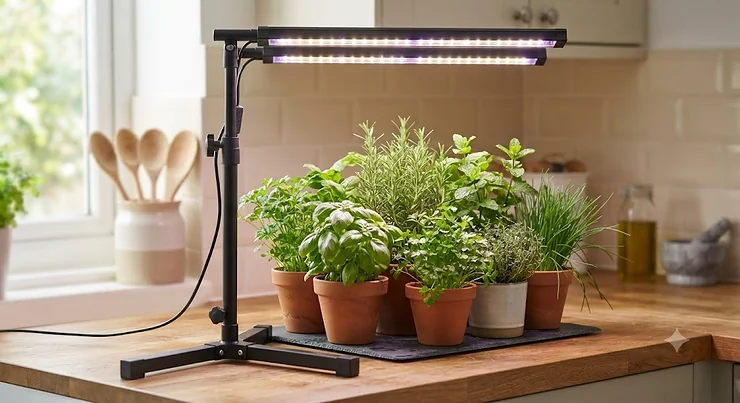
Somewhere between “my seedlings are leggy and pale” and “why does my flowering tent smell of burnt leaves” sits one overlooked culprit: the thing holding your light in the air. An adjustable height grow light stand is exactly what it sounds like — a frame, tripod, pole set or tiered rack that lets you raise or lower your grow light as your plants grow, rather than leaving it bolted at one fixed distance from day one to harvest. That sounds almost too simple to matter, and yet it’s the difference between a seedling that stretches itself thin reaching for light and a stocky, well-lit plant that never has to try.
Reviewers consistently note that the appeal isn’t just convenience — it’s plant survival. Seedlings need the light close; mature plants need it further away and angled differently; grow tent setups need poles that won’t sag under the weight of a 300W fixture six months into a grow. A stand that can’t adjust becomes obsolete the moment your plant changes shape, which for most houseplants and vegetables is roughly every fortnight.
This guide walks through seven genuinely available UK options — from bare-bones foldable racks under £30 to multi-tier plant stands with lights built in — alongside the practical detail Amazon listings tend to skip: how the height ranges translate to real growing distances, what telescopic mechanisms actually feel like to operate one-handed, and which stand type suits a windowsill propagator versus a full grow tent. We’ve also built in a UK-specific angle throughout, covering everything from RHS-endorsed lighting basics to UK electrical safety standards for anything left running on a timer while you’re at work.
Prices fluctuate constantly on Amazon UK, so every figure here is a rough band rather than an exact quote — always check the current price and stock before buying. As with any indoor grow gear, the right stand depends on your plants, your space and how much fiddling you’re willing to do at 7am before work. Let’s get into it.
Quick Comparison Table
| Stand | Height Range | Type | Best For |
|---|---|---|---|
| iPower 4-Head Tripod Grow Light | 11–63.5 in | Telescopic tripod | Seedlings to tall houseplants |
| LBW Tri-Head Grow Light Stand | 15–63 in | Telescopic tripod | Budget beginners |
| HMVPL COB Grow Light Floor Stand | 16.5–75 in | 6-level floor stand | Large or tall plants |
| iPower Foldable Grow Light Rack | Feather-touch adjustable | Bare rack (bulb not included) | Seed-starting on a shelf |
| VIVOSUN Grow Tent Mounting Bars | 24–36 in (also 39–60 in) | Pole/bar stand | Grow tent installs |
| Spider Farmer 4-Tier Plant Stand | Multi-tier adjustable | Tiered rack with tent cover | Multiple plants, mini greenhouse |
| GLOWRIUM Floor Lamp Grow Stand | Adjustable height and angle | Floor lamp stand | Living room or study corners |
Looking at the spread above, the iPower 4-Head Tripod Grow Light and LBW Tri-Head Grow Light Stand dominate the budget-to-mid tripod category because their telescopic legs cover almost the entire seedling-to-mature-plant range in one unit. If your setup lives inside a grow tent rather than on a shelf, though, neither tripod is the right shape — that’s where the VIVOSUN Grow Tent Mounting Bars earn their place, since tripods don’t fit sealed tent frames. Anyone juggling several small pots at once should look past single-light stands entirely and toward the Spider Farmer 4-Tier Plant Stand, which trades footprint efficiency for sheer plant capacity.
💬 Just one click — help others make better buying decisions too!😊
Top 7 Adjustable Height Grow Light Stands: Expert Analysis
Picking the right stand starts with matching the mechanism to your grow, not the other way round. Below is an honest breakdown of seven real, currently listed products, covering their strengths, their compromises, and who each one genuinely suits.
1. iPower 4-Head Tripod Grow Light — widest telescopic range in its class
The headline feature here is the tripod’s reach — extending from just 11 inches to a full 63.5 inches means a single stand can serve a windowsill propagator tray in January and a metre-tall tomato plant by August. Specs-wise, the four-head LED array with 80 diodes runs on a 4H/8H/12H auto-cycle timer with ten dimmable brightness levels, which in practice means you set it once and never touch the plug again until the bulbs need replacing. Based on the spec comparison with similar tripod kits, the wide dimming range matters more than the LED count alone; being able to drop brightness for a fragile cutting rather than blasting it at full power from day one avoids the leaf-scorch that catches out a lot of first-time growers.
This is best suited to anyone who wants one flexible rig rather than committing to a permanent grow tent — renters, windowsill growers, or people experimenting with a single chilli or herb plant before scaling up. Aggregated buyer feedback across similar iPower tripod listings tends to flag the telescopic clamp as the main point of friction: reviewers note it can slip under the weight of the light head if not tightened firmly, so a check-and-retighten habit after the first week is worth building in.
Pros:
- ✅ Covers seedling to mature-plant heights in one unit
- ✅ Ten dimmable levels reduce risk of light stress
- ✅ Auto-cycle timer removes daily on/off hassle
Cons:
- ❌ Telescopic clamp can loosen under the light head’s weight
- ❌ Tripod footprint needs floor space a tent shelf won’t offer
At the time of research this sits in the £35–£50 range on Amazon UK, which represents solid value for a stand-and-light combo rather than a bare frame — though the plastic tripod legs won’t match a metal frame for long-term rigidity.
2. LBW Tri-Head Grow Light Stand — best entry point for first-time indoor growers
The standout here is simplicity: screw the tripod together, adjust the gooseneck, done in under two minutes. The tripod extends from 15 to 63 inches with a 360-degree adjustable gooseneck and 180-degree rotatable panels, so the light angle can be tweaked independently of the height — useful when a plant leans toward a window and needs the light compensating from the side rather than dead overhead. Here’s what to weigh: the tri-head design spreads coverage wider than a single-panel light, but each individual head is less powerful, so density-loving plants like basil or chillies may still want a supplementary light for the densest part of the canopy.
This model is built for beginners rather than serious growers — the emphasis on “easy to use” in the product’s own framing tells you where its priorities sit, and reviewers researching similar tri-head tripods generally back that up, describing quick setup as the main selling point over raw output. What most buyers overlook about tripod-and-gooseneck combinations like this is that the gooseneck itself is often the first part to loosen with repeated repositioning, so treat aggressive daily angle changes with a bit of care.
Pros:
- ✅ Two-minute tripod assembly, no tools needed
- ✅ Independent height and angle adjustment via gooseneck
- ✅ Wide 380–800nm spectrum suits most growth stages
Cons:
- ❌ Individual head output is modest for dense canopies
- ❌ Gooseneck joint can loosen with frequent repositioning
Priced around £25–£40 on Amazon UK, this is one of the cheaper full kits (stand plus light) available, making it a sensible low-risk starting point rather than a long-term flowering setup.
3. HMVPL COB Grow Light Floor Stand — tallest reach for large indoor plants
What immediately sets this apart is its six-level height adjustment spanning 16.5 to 75 inches — tall enough to sit beside a fully grown fiddle-leaf fig or a floor-standing tomato plant rather than a tabletop seedling tray. The 20W COB bulb runs at a CRI of 98+ with a published PPFD figure that outperforms basic strip lights at equivalent wattage, and the 360-degree rotatable head means the beam can be aimed down into a canopy rather than just straight ahead. Based on the spec sheet, the stable metal base and reasonably wide footprint matter as much as the height range itself — a top-heavy tall stand with a narrow foot is a tipping hazard once a plant leans into it, and this design at least tries to counter that with a broader base.
This is the pick for anyone growing genuinely large specimens indoors — think mature houseplants, or vegetable seedlings you intend to keep under light well past the sprout stage. The 4/8/12H timer cycle is a genuine time-saver for anyone who travels or simply forgets to switch lights off. Verified customer review volume specifically for the UK listing was limited at the time of research, so treat any individual longevity claims with a healthy pinch of salt and check current buyer feedback before committing.
Pros:
- ✅ Six height levels covering seedlings to tall mature plants
- ✅ High CRI (98+) for genuinely accurate colour rendering
- ✅ Stable metal base reduces tipping risk
Cons:
- ❌ Larger footprint needs more floor space than a tripod
- ❌ Limited verified UK review history at time of research
Expect a price in the £45–£65 range, which sits toward the upper end of single-light stands but is justified if you’re lighting anything taller than a standard seed tray.
4. iPower Foldable Grow Light Rack — best bare stand for DIY seed-starting
The advantage here is that it’s just the frame — no bulb included, no fixed wattage, no compatibility headache if you already own T5 tubes or your own LED panel. The feather-touch height-adjustment mechanism raises or lowers the fixture with one hand, and the whole thing folds flat for storage between growing seasons, which matters more than it sounds once you’ve tried storing a fully assembled four-foot rack in a UK flat. What most buyers overlook about bare racks like this is that buying the frame separately from the light is usually cheaper overall if you already own compatible tubes, since you’re not paying twice for a bulb you don’t need.
This suits propagators, allotment growers starting seedlings on a shelving unit, or anyone who’s outgrown a windowsill tripod and wants a proper multi-tube rack without committing to a full kit. Aggregated feedback on very similar iPower foldable racks tends to describe the light fixture as working well with plants and being easy to assemble, with buyers specifically satisfied by the height adjustment and resulting seedling growth — though as ever, that’s paraphrased aggregate sentiment rather than a guaranteed individual experience, and it’s worth checking the specific UK listing’s current reviews.
Pros:
- ✅ One-handed feather-touch height adjustment
- ✅ Folds flat for off-season storage
- ✅ Works with your existing compatible tube lights
Cons:
- ❌ No bulb included — extra cost if starting from scratch
- ❌ Sturdiness feels lighter-duty than fixed metal shelving
At around £30–£45 for the frame alone, this is genuinely one of the more cost-effective long-term options if you already have lighting, though it stops being a bargain the moment you have to buy tubes on top.
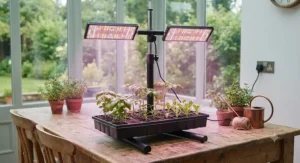
5. VIVOSUN Grow Tent Mounting Bars — the real telescopic pole stand for tents
This is the odd one out on the list, and deliberately so — if your search included “grow light pole stand uk” or “grow tent accessories,” this is very likely what you actually need rather than a tripod. Rather than standing on the floor, these adjustable bars mount across the internal frame of a grow tent, extending from roughly 24 to 36 inches (a 39–60 inch version also exists for taller tents), giving you sturdy horizontal points from which to hang a light on ratchet hooks and adjust its height as the canopy fills the tent. On paper this means no tripod legs competing for floor space with your pots, and — critically for tent growers — no light stand blocking airflow from an inline fan.
Here’s what to weigh: these bars are rated to support a genuinely heavy load when weight is distributed evenly across both bars, but concentrating a single heavy fixture on one bar risks bowing the pole over months of use, so spreading multiple lights or using the tent’s own frame poles as backup support is sensible practice. Reviewers researching similar tent mounting-bar kits consistently flag rust resistance as a genuine strength of zinc-plated designs like this one, a small detail that matters a lot in the humid microclimate a grow tent creates.
Pros:
- ✅ Frees up floor space entirely — no tripod footprint
- ✅ Zinc plating resists corrosion in humid tent conditions
- ✅ Fits standard grow tent pole diameters
Cons:
- ❌ Only works inside a compatible grow tent frame
- ❌ Overloading one bar risks bowing over time
Priced roughly £15–£30 for a pair, this is the cheapest entry on the list — because it’s solving a narrower, tent-specific problem rather than acting as a standalone light stand.
6. Spider Farmer 4-Tier Plant Stand with Grow Lights — best for multiple plants at once
The standout feature is scale: four adjustable shelves, six 18W full-spectrum LED bars built in, and a 1680D Oxford fabric tent cover that zips closed to fully block outside light or opens for observation. Each tier is height-adjustable independently, so seedlings on the bottom shelf and slightly taller cuttings on the shelf above can each sit at their own optimal light distance rather than being forced to share one fixed height. Based on the spec comparison with single-light stands, the real advantage isn’t the light output per shelf — it’s the sheer density of plants you can manage in one footprint, which matters enormously for anyone growing microgreens, herb cuttings or seed trays in a UK flat with limited space.
This is squarely aimed at growers running multiple plants or successive sowing batches rather than a single specimen — think a windowsill herb habit that’s outgrown the windowsill. The double-layer door design, switching between full light transmission and total blackout, is a genuinely practical touch for anyone who wants to check on plants without disturbing a light cycle. What most buyers overlook about all-in-one tiered kits like this is the assembly time; more moving parts means a longer initial setup than a simple tripod, even though day-to-day use afterwards is straightforward.
Pros:
- ✅ Four independently adjustable tiers for multiple plants
- ✅ Built-in full-spectrum lights, no separate bulb purchase
- ✅ Zip-close tent cover blocks or reveals light on demand
Cons:
- ❌ Longer initial assembly than single-stand options
- ❌ Larger overall footprint needs a dedicated corner
At around £110–£160, this sits at the premium end of the list, but the price reflects a complete mini-greenhouse system rather than a single light on a pole.
7. GLOWRIUM Floor Lamp Grow Stand — most living-room-friendly design
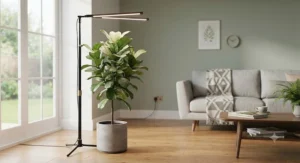
The standout here is aesthetics paired with function — a floor lamp silhouette rather than an obviously agricultural tripod, with adjustable height and angle built into a single stem rather than tripod legs sprawling across the carpet. The 20W full-spectrum panel runs on a 3/9/12H timer, and reviewers researching similar floor-lamp-style grow lights consistently note that the compact base footprint is the main draw for anyone placing a light in a lounge or home office rather than a dedicated grow space. Here’s what to weigh: a single vertical stem is more space-efficient than a tripod, but it also means less lateral stability, so this suits a corner where it won’t get knocked rather than a busy hallway.
This is the pick for plant parents who want their equipment to look intentional rather than improvised — a grow light that could pass for a reading lamp if a guest didn’t look too closely. It’s not built for heavy-duty flowering crops or dense canopies; it’s built for the fiddle-leaf fig or monstera that needs a supplemental boost through a grey British winter. Aggregated review sentiment on comparable floor-lamp grow stands tends to praise the compact footprint while flagging that the light intensity, while adequate for supplementing natural light, isn’t strong enough to be a sole light source for high-light plants.
Pros:
- ✅ Slim floor-lamp design blends into living spaces
- ✅ Adjustable height and angle in one smooth motion
- ✅ Auto timer removes daily switching hassle
Cons:
- ❌ Less stable than a wide-legged tripod
- ❌ Not powerful enough as a sole light for high-light plants
Typically priced in the £35–£55 range, it’s a solid mid-tier choice specifically for supplemental lighting rather than a primary grow setup.
Practical Usage Guide: Setting Up Your Stand for the First 30 Days
Getting a new stand out of the box is the easy part; the first month is where most growers either build good habits or quietly sabotage their plants. Start by positioning the stand so the light sits roughly 12–18 inches above seedlings and 18–24 inches above more established plants — closer for low-output LEDs, further back for high-PPFD fixtures, since scorched leaf tips are far more common than under-lighting in a first grow. On tripod and floor-stand designs, check the height-lock clamp after the first 48 hours; vibration from daily adjustments tends to reveal any slack that wasn’t obvious on day one.
Set your timer for 14–16 hours a day for vegetative growth and dial it back to 10–12 hours if you’re trying to trigger flowering in a light-sensitive species. Rotate pots a quarter-turn every few days if your stand only lights from one angle, since plants reliably grow toward the light source and can end up lopsided otherwise. For tent-mounted pole stands, check the tent’s zip seals for light leaks once the light is running on a dark-cycle timer — even a small gap can disrupt a flowering plant’s photoperiod. The most common first-month mistake isn’t buying the wrong stand; it’s leaving the height fixed at the initial setting for weeks after the plant has visibly grown past it.
Real-World Scenarios: Which Stand Actually Suits You?
Picture three different growers, because the “best” stand genuinely depends on which of these you are. First, the windowsill propagator — someone germinating chilli seeds or starting cuttings on a kitchen counter with no dedicated grow space. For them, a compact telescopic tripod like the LBW Tri-Head Grow Light Stand or the iPower 4-Head Tripod Grow Light makes sense: cheap, foldable, and flexible enough to grow with a single pot from seed to a few inches tall before it needs retiring or upgrading.
Second, the grow tent hobbyist running a 2×2 or 3×3 tent for chillies, tomatoes or ornamentals under a dedicated fixture. Tripod legs simply don’t work well inside a sealed tent frame — floor space is precious and legs get in the way of airflow. The VIVOSUN Grow Tent Mounting Bars solve this specific problem by using the tent’s own structure rather than adding a competing footprint. Third, the small-space multi-plant grower — someone raising a tray of seedlings, several herb cuttings, and maybe a microgreens batch simultaneously in a flat with no garden. The Spider Farmer 4-Tier Plant Stand suits this scenario precisely because it treats “how many plants can I light per square foot of floor” as the design brief, rather than optimising for a single specimen.
Problem → Solution Guide
Problem: Seedlings are stretching thin and falling over. This is almost always a light-distance issue rather than a genetics one — the light is too far away, so the plant elongates trying to reach it. Solution: drop the stand to its lowest practical setting (around 6–12 inches for most seedling trays) and only raise it as true leaves appear.
Problem: Leaves near the light are curling or bleaching. The opposite problem — too close, too intense. Solution: raise the stand a few inches and, if your model has dimmable levels like the iPower tripod range, drop the brightness rather than moving the light further than necessary.
Problem: The tripod keeps drifting down under the light’s weight. This is a clamp-tension issue common to telescopic designs. Solution: retighten the friction clamp fully, and if it persists, a strip of grip tape or rubber washer at the clamp point adds enough extra friction to hold firm.
Problem: My grow tent light is casting uneven shadows. Usually caused by a single-point hanging position rather than distributed support. Solution: switch to a two-bar mounting system like the VIVOSUN bars so the fixture hangs level rather than tilting from one hook.
Problem: I keep forgetting to switch the light off at night. Solution: any of the timer-equipped stands on this list solve this outright — set the cycle once and stop thinking about it.
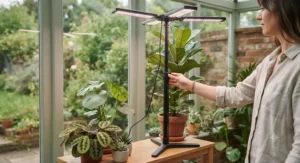
How to Choose an Adjustable Height Grow Light Stand
- Match the height range to your plant’s mature size, not its current seedling size — buying for today’s 4-inch sprout means an expensive second purchase in eight weeks.
- Check whether you need a floor stand, tripod, or tent-mounted pole system — these solve genuinely different space problems and aren’t interchangeable.
- Look for a stable, wide base relative to the light’s weight, since a top-heavy fixture on a narrow foot is a real tipping risk around curious pets or draughty windows.
- Prioritise a built-in timer if you’re prone to forgetting manual switches — consistency matters more to plant health than raw wattage.
- Consider dimmable brightness levels, especially for seedlings and cuttings that can be scorched by full-intensity light from day one.
- Factor in your available floor space honestly — a four-tier stand needs a genuine corner, not just “somewhere in the room.”
- Check the maximum load rating against your actual fixture’s weight, particularly for tent-mounted pole systems supporting more than one light.
Common Mistakes When Buying a Grow Light Stand
The single most common mistake is buying based on the light’s specs alone and treating the stand as an afterthought — a brilliant bulb on a wobbly, non-adjustable mount will underperform a modest bulb on a stable, properly adjustable one. A close second is underestimating how tall a plant will actually get; what most buyers overlook is that “adjustable” only helps if the stand’s maximum height comfortably clears your plant’s expected mature size, with room to spare for further growth. Buyers also frequently skip checking whether a stand is designed for open-room use or tent use — a floor tripod bought for a sealed 2×2 tent often simply won’t fit once you account for the tent’s internal dimensions and existing pole frame. Finally, plenty of first-time growers assume higher wattage always beats a lower-wattage light on a better stand; in practice, correct distance and consistent height adjustment as the plant grows usually matters more than an extra 20W.
Telescopic vs Fixed-Height Stands: What’s the Real Difference
A fixed-height stand, whether that’s a basic shelf bracket or a single-length pole, holds your light at one distance permanently — fine if you’re lighting a plant that’s already at its mature size and staying there, hopeless if you’re growing from seed. A telescopic design, by contrast, extends and retracts through a clamp or ratchet mechanism, letting the same unit serve a two-inch seedling and a two-foot plant months later. What most buyers overlook is that telescopic mechanisms trade a small amount of long-term rigidity for that flexibility — the clamp point is inherently a weaker structural link than a single welded pole, which is why regular tightening checks matter more on tripod designs like the iPower 4-Head Tripod Grow Light than on a fixed metal shelf. For anyone growing more than one crop cycle a year, though, the flexibility almost always wins on total value, since you’re not rebuying a new stand every time your plants change size.
What to Expect: Real-World Performance
On paper, height-adjustable stands sound like a purely mechanical convenience, but the everyday impact is more about consistency than any single dramatic result. Expect to be adjusting the height every 5–10 days during active seedling growth, tapering off to monthly tweaks once a plant reaches maturity. Reviewers consistently note that the biggest practical difference between a good stand and a poor one isn’t light output — it’s how quickly and confidently you can make that adjustment one-handed while holding a pot in the other. A stiff, awkward clamp discourages regular adjustment, which quietly undoes the entire point of buying an adjustable stand in the first place. Expect slightly warmer ambient temperatures directly beneath any full-spectrum LED fixture, and factor a few centimetres of buffer into your minimum height setting to avoid leaf-tip stress in the first week.
Grow Light Stands for Different Growers
Complete beginners are usually best served by an all-in-one tripod kit like the LBW Tri-Head Grow Light Stand, since the light and stand are matched and pre-tested together, removing one variable from an already unfamiliar process. Grow tent enthusiasts running a dedicated tent setup should look past floor stands entirely toward pole-mounted systems such as the VIVOSUN Grow Tent Mounting Bars, which work with the tent’s structure instead of against it. Space-constrained flat dwellers juggling several pots benefit most from a tiered system like the Spider Farmer 4-Tier Plant Stand, which maximises plants-per-square-foot rather than lighting one specimen well. Design-conscious plant parents who don’t want visible “grow equipment” cluttering a living room should consider the GLOWRIUM Floor Lamp Grow Stand, which prioritises blending in over raw output.
Long-Term Cost & Maintenance
The upfront price of a stand is only part of the total cost of ownership. LED bulbs across all seven products here typically carry a rated lifespan in the tens of thousands of hours, meaning bulb replacement is rarely a near-term cost — but running costs from leaving a light on a 12-hour daily cycle add up over a year, and a stand with a built-in timer at least ensures you’re not accidentally paying to run a light with no plant benefit overnight. Cheaper bare frames, like the iPower Foldable Grow Light Rack, shift cost toward whatever bulb you supply separately, which can work out more economical if you already own compatible tubes but adds an upfront cost if starting from nothing. Metal-framed floor stands and tent mounting bars tend to outlast plastic tripod joints, so if you’re planning multiple grow cycles a year rather than a single seasonal project, the slightly higher upfront cost of a sturdier frame is usually the better long-term value.
Features That Actually Matter (And Those That Don’t)
A wide height-adjustment range and a stable, appropriately-sized base matter enormously — these directly determine whether the stand still serves your plant in three months. A built-in timer matters more than most buyers initially rate it, since consistency in daily light hours has a bigger impact on plant health than a marginal difference in wattage. What matters far less than the marketing suggests: the exact LED count on the spec sheet, since two lights with wildly different bulb counts can deliver near-identical PPFD depending on driver efficiency and optics — and cosmetic finishes like colour or “premium” branding on otherwise identical mechanisms, which add cost without adding growing performance. The <a href=”https://www.rhs.org.uk/plants/types/houseplants/artificial-lighting” target=”_blank” rel=”noopener”>RHS’s own guidance on artificial lighting</a> makes a similar point: the fundamentals of matching light to a plant’s actual needs matter more than any single flashy spec.
RHS guidance on artificial lighting for houseplants
Safety and Grow Tent Compliance Guide
Anything running unattended on a timer for hours at a time deserves a proper safety check, and UK electrical guidance is unambiguous on the basics: never daisy-chain extension leads, always check the load rating before plugging in multiple lights or a fan on the same socket, and replace — rather than tape up — any damaged cable. This matters more in a grow tent than most rooms in the house, since the enclosed, humid environment is exactly the kind of “harsher conditions” that increase electrical risk. For anyone running a multi-light tiered stand or several tent-mounted fixtures on one extension lead, it’s worth reading Electrical Safety First’s guidance on extension leads before wiring everything into a single socket. Beyond electrics, check any tent mounting bar’s rated load capacity against your actual fixture weight — overloading a single bar is a slow-motion structural failure rather than an immediate one, so it’s easy to miss until a pole visibly bows.
Benefits vs Traditional Alternatives
| Approach | Adjustability | Plant Safety | Cost Over Time |
|---|---|---|---|
| Adjustable height grow light stand | Full range, tool-free | Reduces scorch/stretch risk | Moderate upfront, low ongoing |
| Fixed shelf-mounted light | None | High risk as plant grows | Low upfront, replacement likely |
| Books/boxes propping up a light | Manual, unstable | High risk of tipping or uneven light | Free but unreliable |
| Hanging from a single chain/hook | Limited, awkward | Uneven light distribution | Low upfront, poor long-term fit |
The comparison makes the case for a proper stand fairly plainly: a dedicated adjustable height grow light stand costs more upfront than propping a lamp on a stack of books, but the ongoing cost of replacing stretched, scorched or lopsided plants tends to exceed that initial saving within a single growing season. Fixed shelf mounts look tidy at first but become a liability the moment a plant outgrows the gap, forcing an early, unplanned upgrade. For anyone growing more than a single houseplant a year, the improvised options simply don’t hold up against a true adjustable stand’s flexibility.
✨ Don’t Miss These Exclusive Deals!
🔍 Take your indoor growing setup to the next level with these carefully selected stands. Click on any highlighted item to check current pricing and availability. These tools will help you grow healthier, stronger plants your family will love! 🌱
Frequently Asked Questions
❓ What is an adjustable height grow light stand?
❓ Can I use a telescopic grow light stand inside a grow tent?
❓ How high should I set my grow light stand for seedlings?
❓ What's the difference between a floor stand and a tripod for grow lights?
❓ Do adjustable grow light stands work for grow tent accessories like fans and filters?
Conclusion
The right adjustable height grow light stand comes down to matching the mechanism to your actual growing space, not just picking the cheapest or most powerful-looking option on the page. A windowsill grower chasing a single chilli plant through its life cycle needs very little beyond a compact telescopic tripod like the LBW Tri-Head Grow Light Stand, while a dedicated tent grower is far better served by pole-mounted bars that work with the tent’s own frame rather than fighting it for floor space. Multi-plant households juggling several pots at once get the most genuine value from a tiered system like the Spider Farmer 4-Tier Plant Stand, since it solves the “how many plants per square foot” problem that a single tripod simply can’t.
Whichever you choose, the habit that matters most isn’t the purchase — it’s actually using the adjustability you’ve paid for. A stand left at its initial height for months defeats its own purpose just as thoroughly as no stand at all. Build in a quick height check every week or two during active growth, keep an eye on the electrical basics if you’re running timers unattended, and the rest genuinely does take care of itself.
✨ Ready to give your plants the light they actually need as they grow? Check current prices and availability on the picks above before they change! 🌿
Recommended for You
- Best Grow Light Stand for Indoor Plants in 2026: 7 Top Picks
- Grow Light With Timer and Dimmer: 7 Best Picks for 2026
- Smart Grow Light With App Control: 7 Top UK Picks 2026
Disclaimer: This article contains affiliate links. As an Amazon Associate, I earn from qualifying purchases. If you purchase products through these links, we may earn a small commission at no additional cost to you.
✨ Found this helpful? Share it with your friends! 💬🤗
