
In This Article
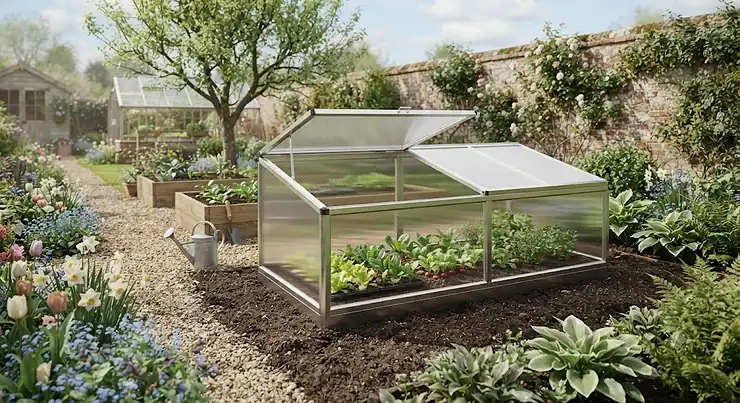
Frost doesn’t knock politely. One October night it just arrives, and every unprotected seedling on the patio wakes up looking like wilted spinach. That’s the entire argument for owning a best aluminium cold frame, distilled into one grim breakfast discovery. A cold frame is the quiet workhorse of British gardening — not glamorous, rarely photographed for anyone’s Instagram grid, but responsible for six or eight extra weeks of growing season that most gardeners simply never claim.
Aluminium has become the material of choice for a reason that has nothing to do with fashion. It doesn’t rot, it doesn’t warp, and it shrugs off the damp that turns timber frames spongy within a few winters. Pair that frame with polycarbonate or toughened glass, and you’ve got a structure that can sit outdoors, essentially unattended, for a decade or more.
This guide walks through seven real, currently available aluminium cold frames on amazon.co.uk, spanning budget plug-in kits through to serious 8ft growing rigs for allotments. Along the way we’ll dig into polycarbonate versus glass glazing, what “lightweight” and “portable” actually mean in practice, which hinges survive a Yorkshire winter, and where the marketing spec sheets quietly leave things out. The RHS’s own guidance on cold frames puts sturdy, adjustable ventilation at the heart of what makes a frame worth owning — and that’s turned out to be the single best filter for separating a genuinely useful frame from an expensive box.
What Is an Aluminium Cold Frame? Quick Comparison
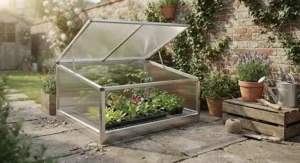
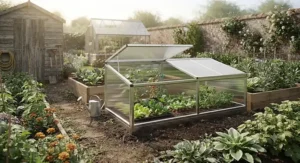
A cold frame is a low, transparent-roofed box that traps daytime warmth and shields plants from frost, wind, and driving rain, functioning as a scaled-down, unheated greenhouse. An aluminium cold frame uses a rust-proof metal frame — usually glazed with polycarbonate or toughened glass — instead of timber, trading a little rustic charm for decades of maintenance-free service.
Here’s how the seven models stack up before we get into the detail:
| Product | Glazing | Best For |
|---|---|---|
| Access 4ft x 4ft Aluminium Cold Frame | 3mm toughened glass | Serious growers wanting durability |
| Elite Min-E-Lite 4×2 Cold Frame | Toughened glass | Compact spaces, wall-mounted use |
| Palram Cold Frame Double | Twin-wall polycarbonate | Budget-conscious families |
| Smart Garden Aluminium GroZone Coldframe | Twin-wall polycarbonate | Weatherproof hinge reliability |
| Relaxdays Aluminium Cold Frame | PP double-skin sheet | First-time buyers, tight budgets |
| Access Mini Garden Cold Frame 2ft x 4ft | 3mm toughened glass | Balconies and small patios |
| Access 8ft x 4ft Large Cold Frame | 3mm toughened glass | Allotments and large kitchen gardens |
Looking across the line-up, there’s a clear split between glass-glazed frames built for permanence and polycarbonate models built for value and portability. The Access 4ft x 4ft Aluminium Cold Frame and Access 8ft x 4ft Large Cold Frame sit at the premium end because toughened glass and a 25-year warranty cost real money to manufacture, while the Relaxdays Aluminium Cold Frame wins on pure affordability for anyone just testing whether cold frame gardening suits them. Budget shouldn’t be the only filter, though — a frame that can’t survive a proper gale is a false economy no matter how cheap it looked in the basket.
💬 Found a model you like already? Scroll down for the full breakdown — or jump straight to checking current prices below.
Top 7 Aluminium Cold Frames: Expert Analysis
1. Access 4ft x 4ft Aluminium Cold Frame — built-in-Britain toughness with a 25-year guarantee
The standout here is longevity: this is a frame designed to outlast the gardener who bought it. Constructed from architectural-grade aluminium and glazed with 3mm toughened safety glass, it’s manufactured in England and backed by a 25-year framework warranty.
That warranty length isn’t just marketing bravado — it reflects genuinely thick-gauge aluminium extrusion and stainless steel fixings rather than the thin pressed metal found on cheaper imports. The sliding side and roof panels give infinitely variable ventilation, from a finger’s width in March to fully open in a July heatwave, and the glass carries enough weight that the roof stays rigid and true in strong winds, unlike the flexible plastic sheeting fitted to some rival cold frames.
Based on the spec comparison with lighter polycarbonate models, this is clearly the frame for someone who wants to plant it once, on soil or a raised base, and forget about replacing it. It suits allotment holders and serious kitchen gardeners more than balcony growers, since toughened glass adds meaningful weight and this isn’t something you’ll be relocating every fortnight. Reviewers of the equivalent Access range consistently report that assembly, while self-managed, is straightforward with the supplied instructions, and that the sliding mechanism keeps working smoothly well beyond the first season.
Pros:
- ✅ 25-year aluminium framework warranty
- ✅ 3mm toughened glass resists wind and snow load
- ✅ Infinitely variable sliding ventilation
Cons:
- ❌ Heavier glass makes repositioning harder
- ❌ Premium price versus polycarbonate rivals
Expect this model to sit in the £350-£450 range depending on retailer and any current promotions — check current price for the latest figure. For anyone growing serious volumes of veg, the durability more than earns back that outlay over a decade of use.
2. Elite Min-E-Lite 4×2 Cold Frame — the tidiest footprint in aluminium and glass
What immediately stands out is the size: at roughly 71cm wide and just over a metre deep in its smallest length, this is the most compact true aluminium-and-glass cold frame on the list, built to tuck against a house wall without dominating a border.
Made from extruded aluminium with a pitched roof and two independently opening roof vents, the Min-E-Lite is glazed with 3mm toughened safety glass as standard, with a 20-year warranty on the frame. The pitched roof design isn’t just cosmetic — it sheds rainwater more efficiently than a flat-lidded box and channels it via integral gutters rather than letting it pool against the seals.
On paper, this means gardeners with a small patio or a narrow side return finally get a frame proportioned for their space rather than a scaled-down version of an allotment model. Two independent vents let you crack open one side while keeping the other sealed, which is genuinely useful during the unpredictable swings of a British spring, when morning sun can tip a closed frame into greenhouse-hot territory by 11am. What the spec sheet won’t tell you, but buyer feedback on comparable Elite ranges consistently notes, is that the powder-coated colour options add several weeks to the lead time versus the plain mill-finish aluminium.
Pros:
- ✅ Compact 71cm width suits small gardens
- ✅ Two independent roof vents for airflow control
- ✅ 20-year aluminium frame warranty
Cons:
- ❌ Smallest growing capacity in this line-up
- ❌ Powder-coated finishes extend delivery times
Prices for this size typically fall around £250-£300, making it a mid-tier investment that punches well above its footprint. It’s a strong pick if space, not budget, is your real constraint.
3. Palram Cold Frame Double — unbreakable polycarbonate without the glass-handling anxiety
The headline feature is safety and simplicity: virtually unbreakable, high-impact polycarbonate glazing set into a rust-resistant aluminium frame, with no toughened glass to worry about cracking during assembly or a stray football strike.
Palram’s twin arch-hinged lids open independently for access and ventilation, and the sloped design lets both sunlight and rainwater run off cleanly rather than pooling. Measuring roughly 42 inches long by 41 inches wide, the double-lidded layout gives enough floor space for two full seed trays side by side, and the crystal-clear polycarbonate panels are UV-protected to prevent the yellowing that cheaper acrylic covers suffer within a couple of summers.
Here’s what most buyers overlook about polycarbonate cold frames generally: the lighter glazing means less thermal mass, so temperatures swing a little faster than under glass — useful for quick venting on a warm afternoon, less forgiving if you forget to close up before a cold snap. Reviewers of Palram’s polycarbonate range frequently mention easy assembly and note the material stays genuinely clear rather than clouding, though a handful flag that the frame benefits from ground-staking in exposed gardens since it’s noticeably lighter than a glass-glazed equivalent.
Pros:
- ✅ Virtually unbreakable UV-protected polycarbonate
- ✅ Two independently hinged lids for ventilation
- ✅ Rust-resistant aluminium frame construction
Cons:
- ❌ Less thermal mass than toughened glass
- ❌ Needs staking down in windy spots
Palram’s double cold frame typically sits in the £60-£90 range, making it one of the best value-for-money picks here if you’d rather not manage glass at all.
4. Smart Garden Aluminium GroZone Coldframe — the weatherproof hinges benchmark
The feature that earns this model its place on the list is its hinge and locking system: a hinged lid secured by four locking stays, engineered specifically to resist wind lift rather than simply sitting on top of the frame.
Made from rust-free aluminium and glazed with twin-wall UV-resistant polycarbonate, the GroZone measures around 108cm wide by 56cm deep by 41cm at its highest point. Twin-wall polycarbonate traps a layer of still air between its two skins, which noticeably improves frost insulation compared with single-skin sheeting, while the four-stay locking lid means you can fix ventilation at a precise, repeatable angle rather than propping it with a brick and hoping.
Based on the spec comparison, this is the frame to choose if your garden catches wind from an open side, since a lid that whips open in a gust doesn’t just chill your seedlings — it can crack a hinge outright over a season of repeated slamming. Reviewers consistently report that the flat-pack assembly is quick, generally under half an hour, though a recurring theme in feedback is that the stays, while effective, require a firmer hand than expected to click into place the first few times.
Pros:
- ✅ Four-stay locking hinges resist wind lift
- ✅ Twin-wall polycarbonate improves frost insulation
- ✅ Quick flat-pack assembly under 30 minutes
Cons:
- ❌ Locking stays feel stiff when brand new
- ❌ Compact depth limits taller plants
Expect a price around £70-£90 for the GroZone, positioning it neatly between the ultra-budget plug-in kits and the premium glass-glazed frames.
5. Relaxdays Aluminium Cold Frame — the plug-in frame that gets you started for under £35
The standout advantage is accessibility: a genuinely low-cost, plug-in aluminium frame with double-skin PP sheeting that assembles without tools, ideal for anyone who has never owned a cold frame and doesn’t want to commit serious money before knowing if they’ll use one.
The frame measures roughly 100cm wide by 50cm deep, with a front height around 40cm rising to 50cm at the back, giving a gently sloped profile that sheds rain. The lid opens across four adjustable levels, so ventilation can be fine-tuned from a crack to fully open, and the aluminium struts slot together with the plastic panelling using a tool-free plug-in system.
What most buyers overlook here is that “budget” doesn’t mean “flimsy in every respect” — the aluminium struts themselves are the same rust-proof material found in pricier frames, it’s the PP sheeting rather than polycarbonate or glass that keeps the cost down. That said, honest reporting matters more than salesmanship: reviewers have noted the panel-to-strut tolerances can feel a little loose, with a common complaint in user reviews describing the fit as “flimsy” and slightly undersized versus the stated measurements, so this suits gentle domestic use rather than an exposed, windswept allotment.
Pros:
- ✅ Tool-free plug-in assembly in minutes
- ✅ Four-level adjustable lid ventilation
- ✅ Lowest entry price in this round-up
Cons:
- ❌ Panel tolerances feel loose to some buyers
- ❌ Less wind-resistant than glazed alternatives
At around £25-£35, this is the cheapest genuine aluminium-framed cold frame on the market, and a sensible low-risk way to trial the whole concept.
6. Access Mini Garden Cold Frame 2ft x 4ft — the most genuinely portable cold frame here
This model’s advantage is manoeuvrability: at 2ft by 4ft, it’s compact and light enough for one person to lift and relocate around a small garden as the sun moves through the seasons, something the larger glass frames on this list simply can’t offer.
Built with the same architectural-grade aluminium framework and 3mm toughened safety glass as its bigger siblings, it carries the same 25-year warranty despite the smaller footprint. Sliding side and top panels give the usual variable ventilation, and because the whole unit is lighter than the 4ft x 4ft or 8ft x 4ft versions, it can sit directly on soil, a raised bed, or paving without needing a permanent home.
On paper this means renters, balcony gardeners, and anyone whose growing space changes from year to year get proper toughened-glass protection without the commitment of a fixed structure. Buyer feedback on the equivalent mini-format frames in this range frequently highlights how easily two people can carry it across a garden fully assembled, though because it’s still glass rather than polycarbonate, “lightweight” here means lighter than its stablemates rather than lightweight in absolute terms.
Pros:
- ✅ Genuinely portable despite toughened glass
- ✅ Same 25-year warranty as larger models
- ✅ Fits balconies, patios and small beds
Cons:
- ❌ Not as light as polycarbonate portables
- ❌ Smaller growing area limits crop volume
Pricing typically falls in the £150-£200 range, a fair premium for glass-grade durability in a genuinely relocatable size.
7. Access 8ft x 4ft Large Cold Frame — maximum growing space for allotment-scale ambitions
The defining feature is sheer capacity: at 7ft 9in long by 4ft wide, this is the largest true aluminium cold frame in the round-up, built for gardeners who are sowing in volume rather than nursing a handful of trays.
It shares the same architectural aluminium construction, 3mm toughened safety glass, and 25-year framework warranty as the smaller Access models, with sliding doors and roof panels that allow the same infinitely variable ventilation from a crack in early spring to fully open by midsummer. The roof panels can also be slid fully open or removed in summer, letting taller crops grow through the top while the sides still offer wind protection.
Here’s what the spec sheet won’t spell out clearly: a frame this size effectively behaves like a low, walk-around growing bed rather than a box you reach into, and it needs a genuinely level, firm base — soil, a raised timber surround, or paving — to sit correctly and keep the sliding panels running smoothly. Reviewers of the larger Access format consistently note it copes well with snow load thanks to the glass weight and rigid framing, and several mention using it to harden off an entire greenhouse’s worth of seedlings at once, which is precisely the scenario it’s built for.
Pros:
- ✅ Largest growing capacity in this round-up
- ✅ Snow and storm-rated toughened glass
- ✅ Roof panels remove for tall summer crops
Cons:
- ❌ Needs a genuinely level, firm base
- ❌ Highest price point of the seven
Budget somewhere in the £600-£700 range for this model — a serious outlay, but one that reflects a structure closer to a small greenhouse than a starter cold frame.
Aluminium Cold Frame With Polycarbonate vs Toughened Glass
Glazing choice matters more than most buying guides admit, and it’s the single biggest factor separating these seven frames beyond size. An aluminium cold frame with polycarbonate glazing, like the Palram Cold Frame Double and Smart Garden Aluminium GroZone Coldframe, uses twin-wall or high-impact sheeting that’s virtually unbreakable and noticeably lighter to handle. A twin-wall polycarbonate lid specifically traps a thin layer of insulating air between its two skins, which measurably slows heat loss on frosty nights compared with a single sheet of the same thickness.
Toughened glass, used on the Access 4ft x 4ft Aluminium Cold Frame, Elite Min-E-Lite 4×2 Cold Frame, Access Mini Garden Cold Frame 2ft x 4ft, and Access 8ft x 4ft Large Cold Frame, wins on light transmission, rigidity, and sheer weight — a benefit rather than a drawback outdoors, since heavier glazing resists wind lift without needing to be pegged down.
| Factor | Twin-Wall Polycarbonate | Toughened Glass |
|---|---|---|
| Weight | Light — easy to relocate | Heavy — very wind-stable |
| Insulation | Better on frosty nights | Good, but loses heat faster |
| Breakage risk | Virtually unbreakable | Requires careful handling |
| Light transmission | Slightly diffused | Maximum clarity |
| Best For | Smart Garden Aluminium GroZone Coldframe, families with children or pets nearby | Access 8ft x 4ft Large Cold Frame, exposed allotment plots |
Reading the table, polycarbonate is the safer, more forgiving choice around children, pets, or windy balconies, while toughened glass rewards gardeners who want maximum light and don’t mind the extra care during assembly. Neither option is objectively superior — the right call depends entirely on where the frame will live and who else shares that space day to day.
Lightweight Cold Frame and Portable Cold Frame Options for Small Gardens
Not every garden has room for a fixed structure, and this is where a genuinely lightweight cold frame earns its keep. Among the seven models here, the Relaxdays Aluminium Cold Frame and Access Mini Garden Cold Frame 2ft x 4ft are the two realistic portable cold frame choices, though they solve the portability problem in different ways.
The Relaxdays Aluminium Cold Frame achieves its light weight through PP double-skin sheeting rather than glass, so a single person can pick it up and shift it around a patio in seconds — ideal for chasing the last patch of afternoon sun as autumn days shorten. The Access Mini Garden Cold Frame 2ft x 4ft takes a different route: it keeps toughened glass for durability and light quality but shrinks the overall footprint, so while it’s not featherweight, two people can carry it fully assembled between beds without dismantling anything.
What most buyers overlook about portability is that it’s not just about carrying the frame — it’s about how quickly it can be repositioned without losing whatever’s growing inside. A frame that needs full disassembly to move isn’t genuinely portable, no matter how light the materials feel in a showroom. If you’re renting, gardening on an allotment with restrictions on permanent structures, or simply prone to rearranging your growing space each spring, prioritise these two over the larger fixed-footprint options in this guide.
✨ Ready to bring the growing season forward? Check current prices on the models above while stock lasts.
How to Choose the Best Aluminium Cold Frame
Picking between seven decent options gets easier with a structured checklist rather than gut instinct alone. Here’s the reasoning, step by step:
- Measure your space first, not the frame. A cold frame that’s technically available in your budget is useless if it doesn’t fit the bed, patio corner, or balcony you actually have.
- Decide glazing priority: safety or insulation. Choose polycarbonate if breakage risk worries you; choose toughened glass if maximum light and thermal mass matter more.
- Check the ventilation mechanism. Sliding panels and multi-stay hinged lids both work, but fixed single-position lids limit your ability to fine-tune temperature on unpredictable days.
- Weigh portability against wind resistance. Lighter frames move easily but need staking; heavier glass-glazed frames stay put but resist relocation.
- Read the warranty length as a durability signal. A 20-25 year aluminium warranty, like those on the Access and Elite Min-E-Lite ranges, tells you the manufacturer expects the frame to survive that long.
- Match size to your actual sowing volume, not an imagined future allotment — an oversized frame you can’t fill wastes both money and garden real estate.
- Factor in base requirements. Larger frames like the Access 8ft x 4ft Large Cold Frame need a genuinely level surface; smaller portables are far more forgiving.
Working through these seven criteria in order — space, glazing, ventilation, portability, warranty, size, and base — tends to narrow seven options down to one or two realistic contenders within a few minutes.
Aluminium Cold Frame Reviews: What Real Gardeners Actually Report
Individual star ratings only tell half the story, so it’s worth looking at the recurring themes across genuine buyer feedback for aluminium cold frames rather than any single five-star review. Reviewers consistently note across this category that assembly quality correlates strongly with price: budget plug-in frames like the Relaxdays Aluminium Cold Frame attract more comments about loose-fitting panels, while premium glass-glazed models such as the Access 4ft x 4ft Aluminium Cold Frame are more often praised for precision and rigidity.
A common thread in reviews of polycarbonate models is genuine surprise at how clear the panels remain after a season or two outdoors — a reasonable worry, since cheaper acrylic alternatives often yellow within a summer, but twin-wall polycarbonate from established brands like Palram and Smart Garden appears to hold its clarity well based on aggregated customer sentiment. On the hinge and lid side, aggregated feedback across the category flags stiff or fiddly stays as a first-use frustration that typically eases after the initial few openings, rather than a persistent fault.
Where verified review data is thinner — for example, granular long-term durability data beyond three or four seasons for some newer polycarbonate models — it’s honest to flag that gap rather than invent a conclusion. What the available data does support consistently is that aluminium frames across price points rarely attract rust complaints, which is precisely the promise the material makes and, by most accounts, delivers on.
Aluminium vs Wooden Cold Frames: Which Should You Buy?
The oldest argument in cold frame shopping is metal versus timber, and it’s worth settling properly rather than assuming aluminium automatically wins. Timber has genuine appeal — it sits into a border more naturally and reads as the traditional choice — but that character generally costs more up front, and it’s exactly the gap that lets aluminium undercut wood on price while still doing the job. Timber also demands ongoing care: annual staining or oiling, periodic checks for rot at ground contact points, and eventual replacement of joints that swell and shrink with damp British seasons.
Aluminium sidesteps nearly all of that maintenance. It won’t warp, split, or attract woodworm, and a powder-coated or mill-finish frame like the Elite Min-E-Lite 4×2 Cold Frame needs nothing beyond an occasional wipe-down across its 20-year warranty period.
| Factor | Aluminium Frame | Wooden Frame |
|---|---|---|
| Maintenance | Minimal — occasional wipe | Annual treatment needed |
| Weather resistance | Excellent, rust-proof | Prone to rot over time |
| Aesthetic | Modern, functional | Traditional, blends into borders |
| Typical lifespan | 20-25 years | 5-10 years untreated |
| Best For | Access 4ft x 4ft Aluminium Cold Frame, low-maintenance growers | Cottage gardens prioritising appearance |
The table makes the trade-off explicit: wood wins on looks and initial character, but aluminium wins comfortably on lifetime cost and hands-off durability. For most practical growers, particularly anyone who’s already juggling a full garden’s worth of seasonal jobs, one less maintenance task tips the decision firmly toward metal.
Weatherproof Hinges and Lid Design: Why This Detail Matters More Than You Think
It’s tempting to judge a cold frame purely on its glazing and frame material, but the hinge mechanism is quietly the part most likely to fail first — and the feature manufacturers spend the least time explaining. Weatherproof hinges need to do two contradictory jobs at once: hold a lid rigidly shut against gusting wind, while still opening smoothly enough that a gardener will actually bother venting the frame on a mild afternoon rather than leaving it sealed and overheating the plants inside.
The Smart Garden Aluminium GroZone Coldframe demonstrates the sturdier end of this spectrum, with a four-stay locking system that fixes the lid at a chosen angle rather than relying on friction or a prop stick. The Access range takes a different but equally weatherproof approach with sliding panels rather than a hinged lid at all, sidestepping wind-lift risk entirely by removing the lever-arm a hinge creates.
Based on the spec comparison, budget frames with simple single-hinge lids and no locking stay are the most vulnerable to wind damage over time, since repeated slamming in gusty conditions gradually fatigues the hinge pin. If your garden sits in an exposed spot — a hilltop plot, a coastal allotment, or simply a notoriously windy corner of an ordinary suburban garden — prioritise a locking or sliding mechanism over a basic hinge, even if it costs a little more upfront.
Practical Usage Guide: Setup, First 30 Days, and Ongoing Maintenance
Getting an aluminium cold frame from delivery box to productive growing space takes more thought than most listings suggest. Start with siting: position the frame facing south or south-west where possible. The RHS’s guidance on siting greenhouses and frames explains that an east-west layout stretches winter light slightly, while a north-south layout suits summer crops that catch sun from both directions through the day. Whichever orientation you choose, avoid deep shade from fences, sheds, or overhanging trees — cold frames rely entirely on captured sunlight, and shade defeats the entire purpose.
During the first 30 days, resist the urge to seal the lid completely, even on a chilly week. New transplants and seedlings need a proper hardening-off routine: crack the lid open for short daytime spells in week one, close it again overnight, then gradually stretch out the open periods over subsequent weeks until the frame can stay open all day before plants finally go outside unprotected. Skipping this step is the single most common early mistake — plants that go from a warm windowsill straight into a fully sealed frame can scorch on the very first sunny morning.
Ongoing maintenance is refreshingly light for aluminium models. Wipe glazing panels with a soft cloth and mild soapy water a couple of times a season to keep light transmission at its best, check sliding tracks or hinge stays for grit build-up before each spring sowing, and inspect the base seal on soil-standing models like the Access 8ft x 4ft Large Cold Frame to make sure slugs haven’t found a gap. None of this takes more than twenty minutes a month, which is precisely the low-maintenance trade-off aluminium is designed to deliver.
Real-World Scenarios: Matching a Cold Frame to Your Garden
The balcony grower. Living in a first-floor flat with a modest balcony, frequency of use is high but space is minimal, and anything permanent is out of the question. The Access Mini Garden Cold Frame 2ft x 4ft suits this scenario well — toughened glass survives exposed high-rise wind better than lightweight polycarbonate, while the compact footprint fits without blocking access.
The budget-conscious first-timer. A gardener with a small back garden and no prior cold frame experience wants to test the concept before committing serious money. Here, the Relaxdays Aluminium Cold Frame is the sensible entry point: low cost, quick assembly, and enough functionality to prove whether cold frame gardening earns a permanent place in the routine.
The allotment grower with volume ambitions. Sowing dozens of trays each spring, with a large plot and daily access, changes the maths entirely. The Access 8ft x 4ft Large Cold Frame matches this frequency and scale, offering enough capacity to harden off an entire greenhouse’s output at once rather than working in small batches.
Matching frame to scenario this way — by frequency of use, available space, and growing ambition — consistently produces a better long-term purchase than choosing on price or appearance alone.
Common Mistakes When Buying an Aluminium Cold Frame
The most frequent error is buying on price without checking base requirements, particularly for larger frames like the Access 8ft x 4ft Large Cold Frame, which genuinely needs a level surface to function correctly — an uneven base leaves sliding panels jamming within weeks. A second common mistake is choosing polycarbonate purely for the lower price without factoring in insulation needs; twin-wall panels like those on the Smart Garden Aluminium GroZone Coldframe perform noticeably better on frosty nights than the single-skin PP sheeting found on ultra-budget models.
Buyers also frequently underestimate size requirements, ordering a compact frame like the Elite Min-E-Lite 4×2 Cold Frame for what turns out to be an ambitious sowing programme better suited to a larger model. Finally, many gardeners overlook ventilation flexibility entirely, assuming any lid that opens is adequate, when in practice a four-stay locking system or infinitely variable sliding panel makes daily temperature management dramatically easier than a single fixed hinge position.
Long-Term Cost and Maintenance: Is Aluminium Worth the Extra Outlay?
Judged purely on sticker price, polycarbonate budget frames win easily. Judged on total cost of ownership across a decade, the picture shifts considerably. A wooden cold frame typically needs re-treating annually and full replacement within five to ten years in a damp UK climate, while an aluminium frame carrying a 20-25 year warranty, like the Access 4ft x 4ft Aluminium Cold Frame or Elite Min-E-Lite 4×2 Cold Frame, spreads its higher purchase price across two to three times the working life.
Cost-per-use tells a similar story. A £400 frame used for eight months of active growing across 20 years works out to roughly £2 a month — considerably cheaper than a £100 timber frame replaced every seven years, once replacement and annual maintenance materials are factored in. The lighter polycarbonate options don’t lose this comparison entirely, though: their lower upfront cost still makes sense for gardeners who might relocate, downsize, or simply want to trial the concept before committing to a decade-long structure.
Features That Actually Matter (And Those That Don’t)
Marketing copy for cold frames leans heavily on adjectives — “premium,” “heavy-duty,” “professional-grade” — that rarely translate into meaningful performance differences. What genuinely matters: warranty length as a proxy for build quality, ventilation flexibility, glazing type suited to your specific garden conditions, and base or ground-fixing options for larger frames.
What matters considerably less than the marketing suggests: powder-coated colour finishes, which add cost and lead time without improving function; decorative bar capping, a purely cosmetic touch; and headline size figures divorced from your actual sowing volume — an 8ft frame you half-fill wastes money the same way an oversized greenhouse does. Reviewers consistently note that functional details like hinge sturdiness and panel fit influence long-term satisfaction far more than finish or colour ever do.
Safety, Weatherproofing and UK Climate Considerations
British weather asks more of outdoor structures than milder climates typically demand, and cold frame safety starts with wind and snow loading rather than glazing choice alone. Toughened safety glass frames in this category are typically built to cope with roughly 0.6 metres of settled snow and storm-force gusts without the roof deforming — a meaningful benchmark for anyone in an exposed or elevated garden.
Positioning matters just as much as the frame itself. According to the RHS’s advice on choosing greenhouses and frames, shelter from cold northerly or easterly winds helps stop spring temperatures dragging down seedling growth, so siting a frame against a wall or fence on the sheltered side of a garden isn’t just convenient — it’s a genuine performance decision. For families with young children or pets, polycarbonate models like the Palram Cold Frame Double remove the glass-breakage risk entirely, which is worth weighing alongside thermal performance when choosing between glazing types.
Finally, always check local guidance if you’re near a boundary or shared access path, since even a low structure can occasionally raise questions around obstruction on tight urban plots — a quick chat with a neighbour or landlord, where relevant, avoids any awkwardness before a single seed goes in.
Frequently Asked Questions
❓ What is the best aluminium cold frame for a small garden?
❓ How much warmer is an aluminium cold frame than outside?
❓ Is polycarbonate or glass better for a cold frame?
❓ Do aluminium cold frames rust over time?
❓ Can I leave an aluminium cold frame outside all year round?
Conclusion
Seven frames, three budgets, and one consistent theme: aluminium earns its reputation as the low-maintenance backbone of UK cold frame gardening, whether you’re working with a £30 plug-in starter kit or a £650 allotment-scale rig. The Relaxdays Aluminium Cold Frame proves the concept doesn’t need to be expensive to be genuinely useful, while the Access 4ft x 4ft Aluminium Cold Frame and Access 8ft x 4ft Large Cold Frame show what two and a half decades of warranty confidence actually looks like in metal and glass.
If portability tops your priority list, the Access Mini Garden Cold Frame 2ft x 4ft and Relaxdays Aluminium Cold Frame deserve first consideration. If weatherproof hinges and frost-fighting insulation matter more, the Smart Garden Aluminium GroZone Coldframe and Palram Cold Frame Double cover that ground convincingly. And for anyone chasing sheer growing capacity, nothing here beats the Access 8ft x 4ft Large Cold Frame. Whichever model fits your garden, six to eight extra weeks of growing season is waiting on the other side of that first sowing.
Recommended for You
- Best Wooden Cold Frame UK: 7 Proven Picks for 2026
- Cold Frame for Hardening Off Seedlings: 7 Best UK Picks (2026)
- Green Aluminium Greenhouse: 7 Best UK Picks for 2026
Disclaimer: This article contains affiliate links. As an Amazon Associate, I earn from qualifying purchases. If you purchase products through these links, we may earn a small commission at no additional cost to you.
✨ Found this helpful? Share it with your friends! 💬🤗
