
In This Article
Somewhere between “I’ll just grow tomatoes on the windowsill” and “I now own a structure with its own postcode” lies the moment every British gardener eventually reaches: buying a greenhouse. It’s a bigger decision than it looks. Get it right and you’ve bought yourself an extra two or three months of growing season, a shelter from slug armies, and a quiet space that smells like tomato leaves and warm soil. Get it wrong and you’ve bought a wobbly plastic tent that the first proper gale turns into abstract art on next door’s lawn.
This guide exists to stop that second outcome. We’ve dug into real specifications, aggregated genuine customer-review sentiment, and cross-referenced expert horticultural advice to bring you the best greenhouses currently available through amazon.co.uk, spanning budget mini growhouses right up to serious UK-manufactured structures. So, what is a greenhouse, really? In practical terms, it’s a glazed or polycarbonate-clad structure that traps solar heat and blocks wind, frost and pests, letting you sow earlier, crop later, and grow things the British climate would otherwise laugh at. Whether you’re weighing up greenhouses for sale for the first time or upgrading from a battered growhouse, the fundamentals below — frame gauge, glazing type, anchoring, and realistic pricing — will make the decision far less of a gamble. According to the RHS, the right structure depends heavily on what you intend to grow and how much light and headroom that requires, so we’ve kept use-case front and centre throughout.
Quick Comparison Table
| Greenhouse | Type | Best For | Price Range |
|---|---|---|---|
| VonHaus Mini Greenhouse 4 Tier | PVC-cover growhouse | Balconies and first-timers | under £70 |
| Outsunny 6x4ft Polycarbonate Greenhouse | Aluminium/polycarbonate walk-in | Budget walk-in growing space | £180-£250 range |
| Canopia by Palram Hybrid 6×8 | Aluminium/polycarbonate hybrid | All-rounder mid-range families | £380-£470 range |
| Vitavia Venus 5000 8×6 | Aluminium with glazing choice | Serious hobby growers | £600-£750 range |
| Halls Cotswold Burford 6×6 | UK-made aluminium, toughened glass | Accessible, safety-first gardens | £900-£1,100 range |
| Halls Cotswold Birdlip 4×8 | UK-made aluminium, toughened glass | Narrow plots, wind resistance | £850-£1,050 range |
| Halls Cotswold Blockley 8×12 | UK-made aluminium, toughened glass | Large-scale growers, allotments | £2,400-£2,900 range |
Looking across this table, there’s a clear pattern: the jump from PVC growhouses to rigid polycarbonate is where a greenhouse starts behaving like permanent garden infrastructure rather than a glorified tent. The bigger jump, from polycarbonate to UK-manufactured toughened glass, is less about growing performance and more about longevity, wind resistance and resale value. If you’re only after a spring seed-starting station, the VonHaus or Outsunny models are genuinely sufficient — don’t let the bigger structures upsell you unnecessarily.
💬 Found a model you like the look of? Compare it against our full breakdown below before you commit.
Top 7 Best Greenhouses: Expert Analysis
1. VonHaus Mini Greenhouse 4 Tier — cheapest genuine entry point
The VonHaus Mini Greenhouse 4 Tier is the one most people buy without quite meaning to — it starts as “just to protect a few seed trays” and ends up doing duty all year round. Standing around 158cm tall with a reinforced, weatherproof PVC cover over a steel frame, it packs four shelf tiers into a compact footprint small enough for a patio, balcony or the side return of a terraced house.
Here’s what that spec sheet actually buys you: the steel frame gives structural rigidity that flimsier all-plastic pop-ups lack, while the roll-up zip door means you can ventilate on mild days without dismantling anything. Because there’s no glazing to break, it’s genuinely low-risk for households with kids or pets nearby. What most buyers overlook about this category is that PVC covers are a consumable, not a permanent fixture — expect to replace the cover every couple of seasons in exposed spots, which is the trade-off for the low upfront cost.
This is squarely a beginner’s or space-constrained gardener’s pick, not a serious cropping structure. Reviewers consistently report that assembly takes well under an hour without tools, and the most common complaint in user feedback is that the cover can flap or tear in sustained wind unless it’s properly secured — which lines up with what you’d expect from a PVC-and-steel design at this price point.
Pros:
- ✅ Genuinely tool-free assembly in under an hour
- ✅ Four tiers maximise vertical growing space
- ✅ Low cost of entry for testing the greenhouse habit
Cons:
- ❌ PVC cover needs periodic replacement
- ❌ Limited headroom rules out taller crops
At under £70, the VonHaus Mini Greenhouse 4 Tier is best value for anyone who isn’t ready to commit garden real estate to a permanent structure yet.
2. Outsunny 6x4ft Polycarbonate Greenhouse — best budget walk-in structure
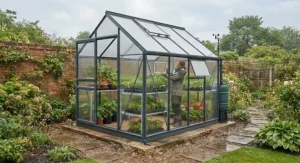
Step up from tiered growhouses and you reach the Outsunny 6x4ft Polycarbonate Greenhouse, a proper walk-in aluminium-framed structure with twin-wall polycarbonate roof panels and a supplied galvanised steel base for extra stability. This is the point where “greenhouse” stops meaning plastic sheeting and starts meaning an actual small building.
The twin-wall roof panels do real work: they diffuse direct sunlight rather than letting it blast straight through, which reduces the scorching that can hit seedlings under clear glazing on a bright April afternoon. Crystal-clear polycarbonate side panels are rated for around 90% light transmission, so you’re not sacrificing much brightness for that protection, and the aluminium frame won’t rust the way a cheap steel alternative might after a wet Yorkshire winter.
Based on the spec comparison with pricier polycarbonate models, the Outsunny delivers most of the practical performance of a Palram-style hybrid at a noticeably lower price, which is exactly why it appears so often on best-value shortlists. Aggregated review sentiment on comparable Outsunny walk-in models is generally positive on ease of build and price, with a recurring theme in feedback being that the supplied ground anchoring is basic and benefits from reinforcement in exposed gardens.
Pros:
- ✅ Twin-wall polycarbonate diffuses harsh direct sun
- ✅ Includes galvanised steel base as standard
- ✅ Roomy enough for staging and multiple grow bags
Cons:
- ❌ Basic supplied anchoring wants upgrading in windy spots
- ❌ Aluminium frame flexes more than steel-gauge premium ranges
Sitting in the £180-£250 price range, this is arguably the best value greenhouse for anyone wanting a real walk-in structure without a four-figure spend.
3. Canopia by Palram Hybrid 6×8 — best all-rounder for mixed light needs
The Canopia by Palram Hybrid 6×8 earns its name honestly: it pairs twin-wall polycarbonate roof panels with crystal-clear polycarbonate side panels, aiming for a “best of both” balance between insulation overhead and visibility at eye level. It’s one of the more recognisable names among UK greenhouses for sale online, and for good reason.
What that hybrid glazing means in practice is that the roof blocks close to 100% of harmful UV and diffuses direct sun to prevent scorch, while the sides let in enough clarity that the interior doesn’t feel like a frosted box. The rust-resistant, powder-coated aluminium frame comes with a galvanised steel base for structural stability, integral guttering to collect rainwater, and a lockable door handle — small details that matter once you’ve got tools and prized plants inside. Palram’s Canopia range has also picked up independent recognition for build quality among European outdoor brands, based on large-scale customer satisfaction surveys.
Here’s what most spec sheets won’t tell you outright: this is a genuinely strong pick for family gardens because there’s no breakable glass anywhere in the structure, yet you’re not sacrificing the bright, airy feel that makes people actually want to spend time in a greenhouse. Reviewers consistently note straightforward panel assembly thanks to the screws-free glazing system, though a recurring theme in feedback is that the sliding door mechanism needs to be kept clean and lubricated to stay smooth over time.
Pros:
- ✅ Roof blocks near-total UV while sides stay bright
- ✅ Includes gutters, vent and lockable door as standard
- ✅ No glass anywhere, ideal for family gardens
Cons:
- ❌ Sliding door needs occasional maintenance to stay smooth
- ❌ Higher price than basic polycarbonate alternatives
At around £380-£470, the Canopia by Palram Hybrid 6×8 is the mid-range benchmark most other hybrid models get compared against.
4. Vitavia Venus 5000 8×6 — best for choosing your own glazing
The Vitavia Venus 5000 8×6 takes a different approach entirely: rather than locking you into one glazing type, it’s sold with a genuine choice between horticultural glass, toughened safety glass, and polycarbonate glazing, all on the same powder-coated aluminium frame. That flexibility is rare at this price tier and worth understanding properly before you buy.
The frame measures roughly 2.57m by 1.93m with a 5m² growing area and a side wall height of about 1.24m, tall enough for staging and reasonably mature plants without stooping. Roof bracing adds structural strength across the whole unit, and the single sliding door is reversible to either side depending on your layout. Based on the spec comparison between the three glazing options, horticultural glass is the cheapest but breaks into sharp shards if it fails; toughened glass costs more but shatters into small, largely harmless fragments; polycarbonate sits at the safest end but sacrifices a little light clarity.
This is squarely aimed at the gardener who’s outgrown a budget model and wants to tailor the build to their own household — toughened glass for families with kids or pets nearby, horticultural glass for adults-only allotments on a tighter budget. What the spec sheet won’t tell you, but experienced growers note, is that this greenhouse must sit on a properly level base or plinth; it isn’t designed to be plonked straight onto uneven soil.
Pros:
- ✅ Choice of three glazing types on one frame
- ✅ Roof bracing adds meaningful structural strength
- ✅ Reversible sliding door suits either side of a plot
Cons:
- ❌ Requires a properly level base or plinth
- ❌ Toughened glass upgrade adds noticeably to the price
Priced around £600-£750 depending on glazing choice, the Vitavia Venus 5000 8×6 rewards buyers who take the time to think through their glazing decision rather than defaulting to the cheapest option.
5. Halls Cotswold Burford 6×6 — best for easy, safe access
British manufacturer Halls built the Halls Cotswold Burford 6×6 around a genuinely clever idea: the Zero Threshold door system, which removes the raised base plinth you’d normally trip over on the way in. For anyone gardening with a wheelbarrow, a wheelchair, or simply tired knees, that’s not a gimmick — it’s the single biggest quality-of-life feature on this list.
All glazing on the Burford is toughened safety glass as standard, built to British Standard BS6206A, meaning it’s designed to break into small, comparatively harmless fragments rather than sharp shards if it’s ever struck hard enough to fail. The aluminium framework and integral base are built to be maintenance-free, the key-operated lock secures tools and plants alike, and two opening roof vents plus integral guttering with 40mm downpipes handle ventilation and rainwater collection properly rather than as an afterthought.
Reviewers consistently note that build quality feels a level above imported budget ranges, and it’s manufactured in the UK by one of the country’s longest-established greenhouse brands, which shows up in the fit and finish of the glazing bar capping. What most buyers overlook is that this quality comes with a 12-year frame guarantee attached, a genuinely useful signal of manufacturer confidence that budget aluminium ranges rarely match.
Pros:
- ✅ Zero Threshold door removes trip hazards entirely
- ✅ BS6206A toughened glass throughout as standard
- ✅ 12-year frame guarantee backs the build quality
Cons:
- ❌ Premium UK manufacturing pushes the price up
- ❌ 6×6 footprint limits large-scale cropping ambitions
In the £900-£1,100 range, the Halls Cotswold Burford 6×6 is the pick for anyone prioritising long-term safety and accessibility over sheer floor space.
6. Halls Cotswold Birdlip 4×8 — best for narrow plots and wind resistance
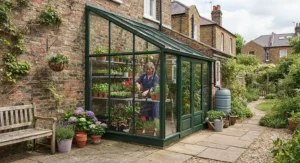
Not every garden has room for a square footprint, and that’s exactly the gap the Halls Cotswold Birdlip 4×8 fills. Its narrow-but-long 4×8 layout suits side returns, fence lines and awkward corners where a 6×6 or 8×6 simply won’t fit, without sacrificing much usable growing length.
The Birdlip ships with 3mm full-length toughened safety glass rather than the smaller overlapping panes some cheaper ranges use, which cuts down on draughts and reduces frame flex in gusty weather — a genuinely relevant consideration given how often British weather warnings mention garden structures. Extra-wide 80mm gutters with 40mm downpipes collect noticeably more rainwater than standard guttering, useful if you’re trying to reduce mains water use for watering cans. The same Zero Threshold door and integral base plinth from the Burford carry across to this model too.
On paper this means you’re getting premium UK build quality in a footprint built for tight spaces, which is a genuinely useful combination — most narrow greenhouses on the market cut corners on glazing or frame strength to hit a lower price, and this one doesn’t. Aggregated feedback on the Cotswold range highlights the glazing bar capping as a stand-out detail, since it keeps glass snug and rattle-free in the frame rather than relying on fiddly wire clips.
Pros:
- ✅ Narrow 4ft footprint suits tight or awkward plots
- ✅ Full-length toughened glass reduces draughts and flex
- ✅ Extra-wide 80mm gutters improve rainwater collection
Cons:
- ❌ Reduced width limits staging layout options
- ❌ Still needs a level, prepared base like other Cotswold models
Around £850-£1,050, the Halls Cotswold Birdlip 4×8 is a smart choice when plot shape, not plot size, is your main constraint.
7. Halls Cotswold Blockley 8×12 — best for serious, large-scale growing
At the top of this list sits the Halls Cotswold Blockley 8×12, a genuinely large structure built for gardeners who’ve moved well past “a few grow bags” territory. This is greenhouse-as-infrastructure: the kind of build allotment associations and serious hobbyists invest in once they know exactly how much they want to grow.
Full-length 3mm toughened safety glazing again meets BS6206A standard throughout, held with glazing bar capping instead of wire clips for a tighter, more vibration-resistant fit. The same 80mm extra-wide guttering and 40mm downpipe system scales up nicely across the longer roofline, meaning rainwater harvesting potential increases roughly in proportion to the extra floor space. The Zero Threshold door system remains standard, which matters even more at this size — wheeling a barrow load of compost through a raised threshold gets old fast on a structure you’ll be using daily.
Here’s what buyers moving up from a smaller model tend not to anticipate: a structure this size needs a genuinely solid, perfectly level base — usually a full concrete or slab foundation rather than a simple plinth — and the assembly is realistically a two-person, multi-day project rather than a weekend job. Reviewers consistently frame the investment in terms of decades rather than years, citing the 12-year frame guarantee and the reputation Halls has built since long before flat-pack polycarbonate kits existed.
Pros:
- ✅ Vast growing area suits allotments and serious crops
- ✅ Wide gutters scale rainwater collection with the roofline
- ✅ Backed by a substantial 12-year frame guarantee
Cons:
- ❌ Requires a proper concrete or slab foundation
- ❌ Significant investment and multi-day assembly
At roughly £2,400-£2,900, the Halls Cotswold Blockley 8×12 is only worth it once you’re certain you’ll actually fill the space — but for growers who will, nothing smaller on this list competes.
Setting Up Your Greenhouse: The First 30 Days
Buying the structure is only step one — how you set it up in the first month determines whether it lasts twelve years or twelve months. Start with the base. Every model on this list performs best on a level, prepared surface: paving slabs, a concrete pad, or a proper timber or steel base plinth designed for the specific greenhouse. Skipping this step is the single most common first-timer mistake, and it’s the root cause of doors that jam, glazing that cracks under stress, and frames that twist visibly within a season.
Next comes orientation. An east-west ridge line captures slightly more winter light, while a north-south orientation suits summer crops like tomatoes best, since both sides get several hours of direct sun. Position it away from overhanging trees — falling debris damages glazing, and shade cuts growth rates noticeably. Once erected, resist the urge to fill it with plants immediately. Spend the first week checking that doors slide freely, vents open and close without sticking, and every glazing clip or bar is properly seated. A common mistake in the first month is overcrowding staging before checking airflow, which quickly leads to fungal problems in humid British summers. Finally, fit any anchoring hardware before the first proper storm arrives, not after — it’s far easier to install ground anchors on day one than to retrofit them once staging and plants are in place.
✨ Ready to compare specific models side by side? Scroll back up to the comparison table above for a quick recap.
Real-World Scenarios: Which Greenhouse Suits You?
Picture three very different gardeners. First, there’s the balcony grower in a first-floor flat with no outdoor ground space at all — for them, the VonHaus Mini Greenhouse 4 Tier is close to the only realistic option, offering four tiers of protected growing without needing a garden. Second, there’s a family with two young kids and a modest suburban garden who want to grow vegetables without worrying about broken glass — the Canopia by Palram Hybrid 6×8 fits that brief precisely, combining decent size with zero glazing risk. Third, there’s the recently retired allotment holder with knee problems who’s finally investing in the structure they’ve wanted for years — the Halls Cotswold Burford 6×6, with its threshold-free door and toughened glass, solves a genuine mobility problem that cheaper models simply don’t address.
None of these buyers should copy each other’s choice, even though all three are shopping under the same search term. Budget, available space, physical access needs and what you actually intend to grow all pull in different directions, and the “best” greenhouse is really the one that matches your specific constraints rather than the one with the most features on paper.
Greenhouse Buying Guide: How to Choose the Right One
- Decide your primary use first. Seed-starting and overwintering need far less space than serious vegetable cropping — don’t buy bigger than your actual growing plans require.
- Measure your plot before you shop. Allow clearance on all sides for guttering, door swing and maintenance access, not just the footprint of the greenhouse itself.
- Pick glazing based on safety needs, not just budget. Households with children or pets should lean toward toughened glass or polycarbonate over standard horticultural glass.
- Check the frame gauge and material. Thicker aluminium and steel-reinforced bases resist wind flex far better than lightweight budget frames.
- Factor in the base or foundation cost separately. Many greenhouses for sale list the frame price only — a proper plinth or slab base is often an additional cost.
- Confirm ventilation provision. At least one roof vent is essential; two or more is preferable for anything larger than a 6×6 footprint.
- Look at the warranty length as a quality signal. A 10+ year frame guarantee, like those from Halls and Elite, generally indicates manufacturer confidence in build quality.
Greenhouse Glazing Types Explained
“What glazing should I choose?” is the single most common question in any greenhouse buying guide, and it deserves a direct answer: it depends on your priorities around light, safety and budget, in that order. Horticultural glass is the traditional choice — thin, cheap, and offering excellent light transmission, but it breaks into sharp shards and needs the most careful handling. Toughened safety glass, built to British Standard BS6206A, costs more but shatters into small, comparatively harmless pieces if it ever fails, making it the safer glass option for family gardens. Polycarbonate, typically in twin-wall form, is virtually unbreakable and diffuses light rather than transmitting it directly, which reduces leaf scorch but slightly softens brightness compared with glass.
| Glazing Type | Light Transmission | Safety | Best For |
|---|---|---|---|
| Horticultural Glass | Highest, clearest | Breaks into sharp shards | Adults-only allotments on a budget |
| Toughened Safety Glass | High, very clear | Shatters into small fragments | Family gardens wanting glass clarity |
| Twin-Wall Polycarbonate | Diffused, slightly reduced | Virtually unbreakable | Families, windy or exposed sites |
The pattern here is a straightforward trade-off between clarity and safety margin, and it maps closely onto the products above: the Vitavia Venus 5000 8×6 lets you pick your position on that spectrum directly, while the Canopia by Palram Hybrid 6×8 and Outsunny 6x4ft Polycarbonate Greenhouse default to the safest end. Gardeners growing light-hungry crops like citrus or Mediterranean herbs may still lean toward glass despite the safety trade-off, since maximum light transmission matters more for those specific plants.
Greenhouse Gauge & Steel Frame: What the Numbers Actually Mean
Frame specifications get thrown around a lot in greenhouse listings, and “gauge” is one of the most misunderstood. In simple terms, gauge refers to the thickness of the metal used in the frame or base — and confusingly, a lower gauge number means a thicker, stronger material, while a higher gauge number means thinner metal. A galvanised steel base built from a heavier gauge sheet resists denting, twisting and rust penetration far better than a thin, high-gauge equivalent, which matters enormously once wind load and years of weather exposure enter the picture.
Aluminium frames, used across most of the greenhouses on this list, are usually described by wall thickness rather than gauge, but the underlying principle is identical: thicker extrusions flex less under wind pressure and hold glazing more securely over time. What most buyers overlook is that a wider, boxier frame profile can matter just as much as raw thickness, since it resists twisting along the frame’s length rather than just resisting a single point of pressure. Reviewers consistently note that budget models with visibly thin, narrow frame sections are the ones most likely to develop misaligned doors or loose glazing after a couple of stormy winters — a problem the UK-manufactured Halls Cotswold range is specifically engineered to avoid through its extra-wide gutter and ridge bar bracing.
Best Value Greenhouse: Price Range & Value Analysis
Value isn’t simply “cheapest price” — it’s cost relative to how long the structure lasts and how well it does its job. Looking at the seven models above, we can group them into rough value tiers rather than just raw price bands.
| Price Tier | Typical Range | Example | Value Verdict |
|---|---|---|---|
| Entry | Under £70 | VonHaus Mini Greenhouse 4 Tier | Excellent value for testing the hobby |
| Budget Walk-In | £180-£250 range | Outsunny 6x4ft Polycarbonate Greenhouse | Best value greenhouse for most first gardens |
| Mid-Range | £380-£750 range | Canopia by Palram Hybrid 6×8, Vitavia Venus 5000 8×6 | Strong long-term value, low maintenance |
| Premium UK-Made | £850-£2,900 range | Halls Cotswold range | Best value only for committed, long-term growers |
Cost-per-use is the metric worth focusing on here: a £220 polycarbonate walk-in used for eight months a year across a decade works out to pennies per week, which is why the Outsunny 6x4ft Polycarbonate Greenhouse so often tops best value greenhouse shortlists. The premium Halls range only becomes genuinely better value than a mid-range model once you factor in a 10+ year usage horizon and the reduced risk of glazing failure — for a gardener who might move house in three years, that long-term value case simply doesn’t have time to play out.
Greenhouses for Sale: Where and How to Buy Well
Beyond Amazon UK, greenhouses for sale turn up through specialist garden building retailers, manufacturer direct-sale sites, and local garden centres — and the buying experience differs meaningfully between them. Amazon listings tend to win on price transparency and delivery speed, letting you compare specs and aggregated review sentiment side by side before committing. Specialist retailers often include installation services, which matters considerably for the larger UK-made structures like the Halls Cotswold Blockley 8×12, where DIY assembly is a genuine multi-day undertaking.
Whichever route you choose, always check current pricing and stock directly on the retailer’s page rather than relying on any figure quoted online, since horticultural pricing shifts with materials costs and seasonal demand. Look closely at what’s actually included in the listed price — base plinths, glazing, and anchoring kits are sometimes sold separately even when product photography implies they’re bundled. It’s also worth checking delivery specifics for larger models; an 8×12 structure typically arrives on a pallet requiring assistance to unload, which some standard delivery slots don’t account for.
Safety, Anchoring & Regulations Guide
A greenhouse that isn’t properly secured to the ground is a liability waiting for the next named storm. The Met Office regularly issues wind warnings across the UK advising people to check and secure loose garden structures before severe weather arrives, and a lightweight aluminium-framed greenhouse without proper anchoring is exactly the kind of structure that advice is aimed at. A dedicated greenhouse anchoring kit — typically ground spikes or spiral anchors for soil, or base-plate fixings for concrete and paving — bolts or straps the base frame securely to the surface beneath it, preventing uplift and lateral movement in gusty conditions.
Spiral ground anchors suit soft soil or lawn sites and are reusable if you ever relocate the structure, while base-plate anchor kits are the better choice on concrete, slabs or decking where you can’t drive a spike into the ground at all. Manufacturer-specific anchoring kits, such as those made for the Palram Canopia range, are generally worth choosing over generic alternatives since they’re engineered to match the base profile exactly — though it’s worth noting these kits typically aren’t rated for the smallest 6×4 footprint models.
On the regulatory side, most standard domestic greenhouses in England, Wales and Scotland fall under permitted development rights and don’t require a planning application, provided they sit behind the front of the house, stay under roughly 2.5m in height near a boundary, and don’t push total outbuilding coverage over 50% of the garden. Larger or unusually positioned structures, and anything in a conservation area or attached to a listed building, can fall outside those limits, so it’s always worth checking your specific circumstances via the Planning Portal before ordering anything at the larger end of this list.
Common Mistakes When Buying a Greenhouse
Even careful shoppers trip up on a handful of recurring errors. The first is buying on footprint alone without checking eave height — a low-eaved structure looks similarly sized on paper but severely limits what you can actually grow, since taller plants and staging both need headroom. The second is underestimating base costs, assuming the listed price includes a plinth or foundation when it frequently doesn’t. The third is skipping anchoring entirely on the assumption that a “solid-looking” structure doesn’t need it — aluminium-framed polycarbonate greenhouses are lighter than they look and genuinely can shift or lift in strong gusts without proper fixing. The fourth is ignoring ventilation until after installation, when in reality a single roof vent is rarely enough for anything beyond a 6×4 footprint. The final, and most expensive, mistake is buying oversized “just in case” — a structure that outstrips your actual growing ambitions costs more upfront, takes longer to erect, and often ends up half-empty by the second season.
Frequently Asked Questions
❓ What is the best type of greenhouse for a UK garden?
❓ Do I need planning permission for a greenhouse?
❓ How much does a decent greenhouse cost in the UK?
❓ Is polycarbonate or glass better for a greenhouse?
❓ Do greenhouses need to be anchored to the ground?
Conclusion
There’s no single “best” greenhouse — only the best greenhouse for your particular plot, budget and growing ambitions. What genuinely separates a good purchase from a regretted one isn’t the brand name on the box; it’s whether the glazing matches your safety needs, the frame gauge suits your local wind exposure, and the base is properly prepared before the first plant goes in. Whether that means the pocket-friendly VonHaus Mini Greenhouse 4 Tier on a balcony or the substantial Halls Cotswold Blockley 8×12 on an allotment, the principles in this guide — glazing type, frame strength, anchoring, and honest budgeting for the base — apply across the entire range. Take the time to match the structure to the actual growing you plan to do, not the growing you might hypothetically do one day, and whichever model you land on should earn its keep for years, not just one enthusiastic spring.
Recommended for You
- Grow Light Rack for Seedlings: 7 Best UK Picks for 2026
- Multi Tier Grow Light Shelf: 7 Best Picks for UK Homes in 2026
- Adjustable Height Grow Light Stand: 7 Best UK Picks 2026
Disclaimer: This article contains affiliate links. As an Amazon Associate, I earn from qualifying purchases. If you purchase products through these links, we may earn a small commission at no additional cost to you. Prices and availability are correct at the time of research and may vary — always check current pricing on the retailer’s page before buying.
✨ Found this helpful? Share it with a fellow gardener! 💬🌱
