
In This Article
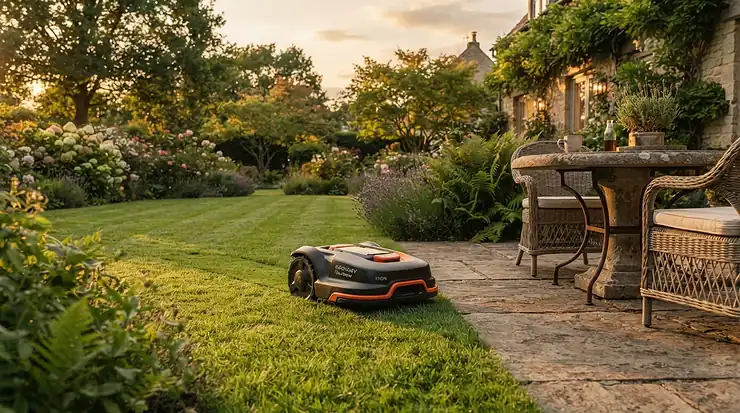
What are robotic lawn mowers? They are battery-powered, autonomous cutting machines that mow on a schedule, return to a charging dock by themselves and leave fine clippings to feed the turf. Boundary is set by a buried or pegged wire, or increasingly by satellite, camera and LiDAR mapping.
Picture a Saturday morning with no pull-cord, no petrol smell and no grass box to empty. That is the promise, and in 2026 it is closer to the truth than it has ever been. Wire-free navigation has matured, apps have become genuinely useful, and BBC Gardeners’ World Magazine’s roundup now treats setup ease as a headline test criterion rather than an afterthought.
But an automatic lawn mower is not a magic wand. A model that suits a flat 300 m² suburban lawn can flounder on a terraced bank, and the cheapest machine on the shelf can be a false economy if the garden is awkward. Below, I compare seven real models across budget, mid-range and premium tiers. I explain robot mower installation, perimeter wire setup and what a robot mower for sloped garden duty really needs. I also cover what to expect from app-controlled mowers and how to think about mower theft protection.
A note on method: specs come from manufacturer and retailer documentation, and review commentary is aggregated from published reviews. Where I couldn’t verify a robust review pool, I say so rather than pad it out.
Quick Comparison Table: Robotic Lawn Mowers at a Glance
| Model | Boundary system | Rated lawn size | Slope handling | Best For |
|---|---|---|---|---|
| Flymo EasiLife 350 | Boundary wire | Level 200–350 m² | Gentle only | Small, flat urban lawns on a budget |
| Gardena Sileno City | Boundary wire | Small to compact lawns | Around 35% | Narrow passages and quiet, compact gardens |
| Husqvarna Automower 305 | Boundary wire | Up to 600 m² | 40% inside the lawn, 15% at the wire | Complex small-to-medium gardens with slopes |
| eufy E15 | Wire-free | Smaller of the E15/E18 pair | 18° (about 32%) | Easy setup with built-in GPS tracking |
| Worx Landroid Vision | Wire-free (camera) | Around 600 m² | Moderate, check listing | Tree-shaded, bordered gardens |
| Segway Navimow i105N | Wire-free (RTK + vision) | About 500 m² | Around 30% | Small, complex lawns with multiple zones |
| Mammotion LUBA mini 2 AWD | Wire-free (vision/NetRTK) | Up to 1,000 m² | Up to 80% | Steep, uneven or terraced lawns |
Read the table as a filter, not a league table. Husqvarna Automower 305 and Gardena Sileno City are the proven, wire-based workhorses. Segway Navimow i105N, eufy E15 and Worx Landroid Vision trade the wire for software, which is faster to set up but leans on sky view or camera performance. If slope is your deciding factor, Mammotion LUBA mini 2 AWD is in a different league on paper, though you pay for it.
💬 Just one click — help others make better buying decisions too!😊
Top 7 Robotic Lawn Mowers: Expert Analysis
Price bands below are indicative only, drawn from retailer listings at the time of research. Prices move constantly, so check the current price before you buy.
1. Flymo EasiLife 350 — cheapest way to test robot mowing
The Flymo EasiLife 350 exists to answer one question: is a robot mower for you? It runs on a boundary wire, keeps noise to a quiet 58 dB and leaves a neatly mulched finish on level lawns of roughly 200–350 m². That 58 dB figure means you can run it at breakfast without the neighbours noticing.
What the spec sheet won’t shout about is what’s missing. There’s no app wizardry and no slope heroics, so this is a machine for flat, tidy lawns with simple layouts. The analytical take: if your garden is a rectangle of grass with a shed at one end, you’re paying for exactly what you need. If it’s a sloping, multi-zone tangle, you’ll outgrow it in a month.
I couldn’t verify a large pool of independent owner reviews for this model, so treat the roundup consensus (simple, quiet, capable on flat ground) as a starting point and read recent buyer feedback on the listing yourself.
Pros:
- ✅ Genuinely quiet at 58 dB
- ✅ Simple controls, minimal learning curve
- ✅ Neat mulched finish on flat lawns
Cons:
- ❌ No app control for remote scheduling
- ❌ Not suited to slopes or complex layouts
Indicative price band: budget, roughly £250–£450. Value verdict: excellent as a low-risk trial, poor if your lawn is anything but flat.
2. Gardena Sileno City — squeezes through 60 cm gaps
Where the Gardena Sileno City earns its place is in awkward gardens. It is reported to cope with slopes of about 35% and to squeeze through passages as narrow as 60 cm. In practice, that means side returns and gaps between borders that defeat wider machines.
Gardena’s own wildlife guidance adds a detail worth knowing. Its Bluetooth app includes a “Mowing in Daylight” setting, and the cutting system waits about five seconds after leaving the dock before the blades start, giving small creatures time to scarper. That’s a thoughtful safety touch, though it’s manufacturer information rather than independent testing.
Here’s what to weigh: this is a boundary-wire machine, so you’ll be doing a proper perimeter wire setup. In return you get dependable, predictable behaviour that doesn’t care about sky view or tree cover. Reviewers of the wire-based class consistently praise that reliability, though I couldn’t verify a model-specific review pool for the City, so check current listings.
Pros:
- ✅ Handles narrow passages down to 60 cm
- ✅ Around 35% slope capability
- ✅ Daylight-only mowing option in the app
Cons:
- ❌ Needs a full boundary wire installation
- ❌ Smaller lawn ratings than the bigger Husqvarna
Indicative price band: mid-budget, roughly £450–£800. Value verdict: strong for compact, fiddly gardens.
3. Husqvarna Automower 305 — the benchmark for small, complex lawns
Few robots have a longer pedigree, and the Husqvarna Automower 305 shows it. It’s rated for lawns up to 600 m², climbs 40% slopes inside the lawn, and manages 15% along the boundary wire. That second number matters, because it tells you where to route the wire on a hillside.
The four-wheel platform, frost guard and weather timer are quiet quality-of-life features. Bluetooth app control through Automower Connect@Home covers scheduling, and it’s hose-washable (IPX5), which you’ll appreciate every autumn. Perceived noise is around 59 dB.
One reviewer called it superb on performance while noting it isn’t as smart as newer rivals, and setup is the price of admission. A German test flagged the high purchase price as its main weakness. My analysis: you’re buying reliability and slope grip, not gadgetry.
Pros:
- ✅ Handles 40% slopes inside the work area
- ✅ Frost guard and weather timer built in
- ✅ Easy to rinse clean with a hose
Cons:
- ❌ Boundary wire installation takes effort
- ❌ Higher price than many wire-free rivals
Indicative price band: £900–£1,300 (installation kit extra). Value verdict: excellent long-term value for wired, sloped gardens.
4. eufy E15 — wire-free with built-in GPS tracking
The eufy E15 brings the wire-free experience down to a friendlier level. Its 203 mm cutting width, 25–75 mm cutting height and 56 dB running noise sit alongside an 18° maximum slope, around 32% in the percentage language most manufacturers use. Charging takes 90–110 minutes and the IPX6 rating covers a good soaking.
The headline for buyers is the safety and security package. Ride-on-Edge cutting reduces strimming, 3D perception spots objects, and 4G-enabled GPS tracking doubles as mower theft protection. Automatic recall in rain or low light rounds it out.
The analytical take: this is a convenience-first machine for families who want map-and-go setup. Independent long-term review data was thin at the time of research, so I can’t quote owner sentiment. Weigh the manufacturer’s claims accordingly.
Pros:
- ✅ Wire-free setup with digital boundary tweaks
- ✅ Built-in 4G GPS tracking
- ✅ Ride-on-Edge cutting trims less afterwards
Cons:
- ❌ 18° slope ceiling limits steeper banks
- ❌ Limited independent long-term review data
Indicative price band: £800–£1,200. Value verdict: good for easy setup; verify lawn size against the E15/E18 split.
5. Worx Landroid Vision — camera navigation for tree-shaded lawns
The Worx Landroid Vision navigates with an onboard camera and AI rather than a wire or an antenna. UK roundups rate it for around 600 m² and highlight it as the most practical wire-free option for tree-shaded or heavily bordered gardens, precisely where satellite systems can struggle.
Setup is famously quick because there’s no boundary to bury. The app handles scheduling, cutting heights and zones, and over-the-air updates mean the machine keeps improving. Worx also states that Landroids default to daytime mowing, which is friendly to hedgehogs.
The catch: reviewers note it’s fussier around very long grass, so give the lawn a manual cut before the first run. Camera systems can also be more sensitive to poor light, so check how the app handles evening and overcast conditions.
Pros:
- ✅ No wire, no antenna, quick setup
- ✅ Copes well with tree cover and borders
- ✅ App updates improve performance over time
Cons:
- ❌ Struggles more with very long grass
- ❌ Vision navigation depends on light conditions
Indicative price band: £700–£1,100. Value verdict: sensible if wire is a deal-breaker and sky view is poor.
6. Segway Navimow i105N — RTK precision for small, complex lawns
Combining RTK satellite positioning with a 140° camera, the Segway Navimow i105N is aimed at small, fiddly lawns of about 500 m². It spots over 150 obstacle types, manages up to 12 zones from the app, runs at 58 dB(A) and carries a three-year warranty. In some UK listings it appears as the i105E.
Aggregated reviews are mostly positive on setup, autonomous mapping and returning to the dock. Common complaints include trouble with thick grass, uneven terrain and slight slopes. A UK-focused review put its maximum slope at 16° (about 29%), so treat it as a gentle-to-moderate-slope machine.
The analytical take: choose it for precision under trees and in narrow corridors, not for hillsides. Antenna placement needs a clear sky view, and as with any wire-free design you’ll still tidy edges occasionally.
Pros:
- ✅ Centimetre-level positioning without a wire
- ✅ Quiet 58 dB(A) operation
- ✅ Three-year warranty and multi-zone scheduling
Cons:
- ❌ Struggles with thick grass and ruts
- ❌ Antenna needs a clear sky view
Indicative price band: £700–£1,000. Value verdict: one of the better mainstream wire-free deals for small lawns.
7. Mammotion LUBA mini 2 AWD — all-wheel drive for steep, rough ground
If you own a hill, meet the Mammotion LUBA mini 2 AWD. Its four-wheel drive is rated for slopes up to 80% (38.6°), it clears obstacles up to 45 mm, and cutting heights of 20–65 mm allow a tighter finish than most rivals. The 1000 version covers lawns up to about 1,000 m².
It uses NetRTK and tri-camera vision, so there’s no antenna to install, with three years of included 4G service. The dedicated edge disc reaches roughly 5.5 cm from walls, though the fixed side disc is its biggest design limitation.
Reviewers praise traction and rough-ground confidence. One noted it missed small, low-profile objects around 1–2 cm tall, so clear the lawn of hosepipe ends and toys first. For sloped, terraced or uneven lawns, this is the standout.
Pros:
- ✅ Up to 80% slope with all-wheel drive
- ✅ 20 mm minimum cutting height for a neat finish
- ✅ Wire-free with included 4G service period
Cons:
- ❌ Highest price of the seven
- ❌ Misses very small objects on the lawn
Indicative price band: £1,200–£1,800. Value verdict: worth it for genuinely difficult terrain; overkill on a flat lawn.
How to Choose Robotic Lawn Mowers: 7 Steps
- Measure your lawn. Choose a rated size at least 20% above your actual area. A mower working at its limit struggles when growth spikes in a wet British summer.
- Decide wire or wire-free. Wire suits trees, heavy rain and complex layouts. Wire-free suits people who hate digging.
- Check slope in percentages. A 25% slope is about 14°; 40% is about 22° and feels far steeper than the number suggests.
- Assess sky view and tree cover. RTK antennas need open sky. Camera or LiDAR designs cope better under canopies.
- Weigh the app. Scheduling, no-go zones and frost or rain handling matter more than gimmicks.
- Check theft features. PIN, lift alarm and GPS are the baseline.
- Read recent reviews. Firmware changes quickly, so last year’s complaint may be fixed.
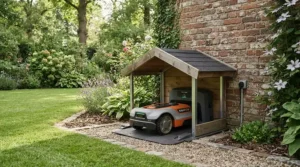
Robot Mower Installation: A Practical First-Weekend Guide
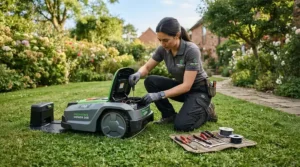
Robot mower installation sounds intimidating, but it’s a manageable DIY job. Wire-free models are usually mapped in under two hours. Wired models take longer, but the grass hides the cable within a few weeks.
Charging station. Put it on level ground with clear approach space. Poor placement causes most long-term docking problems, and a sloped or cramped dock interrupts autonomous operation.
Mapping wire-free models. Mount the antenna where it has clear sky. Drive the mower once around the perimeter using the app, add no-go zones around beds and ponds, then run a test mow.
Perimeter Wire Setup: Getting the Boundary Right
Perimeter wire setup is the most time-consuming stage for wired models, typically a few hours for an average lawn. Lay the wire loosely around the outer edge, including beds and obstacles, and peg it every 30–45 cm on straight runs, closer at corners. Keep it a few centimetres inside the lawn edge, and use a waterproof connector for extensions.
Many installers peg the cable on the surface first, then bury it 1–2 cm deep after several weeks of trouble-free running. If you need a guide wire, run it in a straight line from the dock to a distant point, which helps in narrow passages and larger gardens.
| Factor | Perimeter wire | Wire-free (RTK, vision, LiDAR) |
|---|---|---|
| Setup time | Few hours of pegging | Often under two hours |
| Layout changes | Move the wire | Edit the map in the app |
| Weather and tree cover | Very reliable | Depends on sky view or light |
| Best For | Complex, shaded gardens (Husqvarna Automower 305, Gardena Sileno City) | Fast setup (Segway Navimow i105N, eufy E15, Worx Landroid Vision) |
The table shows the trade-off clearly. Wire is a one-off chore that buys long-term predictability, while wire-free saves the labour but adds dependence on satellite view or camera quality. If your garden is full of tall trees, the wire still wins.
Robot Mower for Sloped Garden: What the Numbers Really Mean
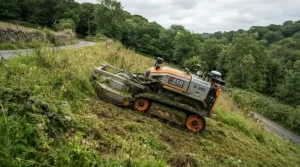
A robot mower for sloped garden use lives or dies on drive type and installation. Two-wheel-drive models tend to struggle when grass is wet. Four-wheel or all-wheel drive, like the Mammotion LUBA mini 2 AWD, changes what is possible.
Notice how slope specs are split. The Husqvarna Automower 305 climbs 40% inside the lawn but only 15% at the boundary wire, so plan wire routes across the top or bottom of a bank, not straight down it.
Husqvarna’s own guidance for steep installs is worth borrowing for any make. Keep about 1.5 m between the boundary and obstacles on steeper sections, provide at least 50 cm of level ground where flat meets slope, and run guide wires diagonally. Setting a systematic pattern at 45° to the slope can also help.
On wire-free machines, keep the virtual edge slightly inside the top of a steep bank, and avoid running it straight down a wet slope where the mower could slip.
Automatic Lawn Mower Features and App-Controlled Mowers: What Actually Matters
Every automatic lawn mower now advertises an app, but the useful features are few. App-controlled mowers earn their keep with scheduling, no-go zones, cutting-height changes and status alerts.
The Segway Navimow i105N manages up to 12 zones, the Mammotion LUBA mini 2 AWD adjusts height from the app, and the eufy E15 pairs scheduling with GPS tracking. The Husqvarna Automower 305 gets Bluetooth control, though the mower’s display handles scheduling if you skip the app. The Worx Landroid Vision adds over-the-air updates.
Features that matter: rain and frost handling, daylight-only scheduling, multi-zone control and tracking. Features that don’t: elaborate dashboards you’ll check twice.
Mower Theft Protection: Layers, Not Silver Bullets
Mower theft protection works best in layers. Manufacturers’ documentation describes PIN codes, lift and tilt alarms, and GPS tracking. Husqvarna’s GeoFence is a GPS-based virtual fence that triggers a local alarm if the mower leaves a set area, and it needs no network connection. Its PIN is required to enable or change it.
GPS tracking is separate and needs connectivity, so check whether your model includes it. The eufy E15 and Mammotion LUBA mini 2 AWD both advertise 4G tracking, and Husqvarna Automower 305 owners get PIN protection.
Practical habits matter more than any single feature:
- ✅ Change the default PIN immediately and avoid 1234
- ✅ Enable alarms and geofencing in the app
- ✅ Fit motion lighting or a camera near the dock
- ✅ If you locate a stolen mower by GPS, pass the location to the police rather than confronting anyone
No feature makes a mower completely theft-proof, but layered protection makes resale hard and recovery easier.
Robotic Lawn Mowers vs Traditional Mowers
| Factor | Robotic lawn mowers | Petrol or push mowers |
|---|---|---|
| Effort | Set-up once, then minimal | Weekly labour |
| Noise | Roughly 56–59 dB on models above | Considerably louder |
| Cutting style | Little and often, mulched clippings | Longer intervals, bagging |
| Upfront cost | Higher | Lower |
| Best For | Regular lawns and busy owners | One-off jobs and rough grass |
Robots cut a little every day, so clippings are fine enough to feed the soil and the lawn stays denser. Push mowers still win for one-off jobs, rough meadow patches and very low upfront cost. If you simply want a lawn kept tidy without thinking about it, the maths favours a robot.
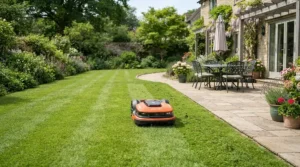
Real-World Scenarios: Matching a Mower to Your Garden
The flat starter lawn (250 m², modest budget). You want a trial run. The Flymo EasiLife 350 is the low-risk option, assuming no slope and few obstacles.
The tree-shaded family garden (400–550 m²). Kids’ toys, a trampoline and mature trees rule out RTK doubt. The Worx Landroid Vision or Husqvarna Automower 305 both make sense, depending on whether you’d rather avoid wire or trust it.
The terraced hillside (700 m² with steep banks). Here the Mammotion LUBA mini 2 AWD earns its premium. Two-wheel-drive machines would spend their lives stuck.
Common Problems and Solutions
The mower won’t dock. Check station levelness and approach clearance. Add a guide wire on wired models.
It keeps getting stuck. Clear small objects and fill ruts. Camera-based machines can miss objects under a couple of centimetres.
Patchy edges. Tidy with a strimmer occasionally. Ride-on-edge designs such as the eufy E15 reduce this.
Signal drops on RTK models. Raise the antenna for a clearer sky view, or consider a wire-based or camera-led alternative.
Alarm keeps triggering. Adjust GeoFence radius or sensitivity, and switch it off before deliberately moving the mower.
Long-Term Cost and Maintenance
The purchase price is only the starting point. Budget for wire and pegs on wired models, replacement blades (the Segway Navimow i105N ships with spare blades), and eventual battery replacement. Running costs are low: the Husqvarna Automower 305 lists mean energy use of about 5 kWh at its maximum rated area.
Clean the underside regularly, since dry clippings build up. Rinse-friendly designs help. Check the wire for cuts after scarifying or aerating, and update firmware on app-connected machines. Over several seasons, avoiding fuel and servicing a petrol mower narrows the gap with a cheaper conventional machine.
Wildlife Safety: Hedgehogs and Robotic Lawn Mowers
Robots and wildlife share gardens, and the risk is real. University of Oxford researchers have developed a hedgehog safety test for robotic lawnmowers, aiming at a certification scheme, after rehabilitation centres reported rising injuries. Hedgehogs roll into a ball instead of fleeing.
Practical steps: mow only during daylight hours, check the lawn before each session, leave long-grass refuges elsewhere, and choose a mower rated above your lawn size so it doesn’t need to work at dusk. Vision or LiDAR systems identify objects before contact, which helps, though none are trained to recognise a curled hedgehog specifically.
Check for UKCA or CE marking as standard on any mower you buy.
FAQ
❓ Are robotic lawn mowers worth the money for a small UK garden?
❓ Can robotic lawn mowers work in the rain?
❓ Do I need a professional for robot mower installation?
❓ How long is the boundary wire set on wired models?
❓ What should I do with my mower over winter?
Conclusion
Choosing among robotic lawn mowers comes down to your lawn, not the brochure. Flat and small? The Flymo EasiLife 350 is a low-risk trial. Fiddly passages and slopes on a wire? The Gardena Sileno City and Husqvarna Automower 305 are dependable. Want wire-free ease? The Segway Navimow i105N, eufy E15 and Worx Landroid Vision each fit slightly different gardens. Genuinely steep ground? The Mammotion LUBA mini 2 AWD is the one that changes the equation.
Whatever you pick, plan your robot mower installation carefully, take perimeter wire setup seriously if you go wired, and switch on every mower theft protection feature from day one. Mow in daylight to keep hedgehogs safe; the Hedgehog Street guidance is worth a read before you press start.
Recommended for You
- Cordless Lawn Mowers: 7 Best Battery Picks For UK Gardens 2026
- Mower For Average Garden: 7 Top-Rated Picks For UK Lawns (2026)
- Lawn Mower Under £300: 7 Best UK Picks For Every Garden (2026)
Disclaimer: This article contains affiliate links. As an Amazon Associate, I earn from qualifying purchases. If you purchase products through these links, we may earn a small commission at no additional cost to you.
✨ Found this helpful? Share it with your friends! 💬🤗
