

In This Article
There’s a particular kind of dread that comes with dragging a petrol mower out of the shed after it’s sat untouched since October — the flooded carburettor, the three-pull-cord tantrum, the fuel can you’re fairly sure has gone stale. Cordless lawn mowers exist precisely to make that ritual disappear. A cordless lawn mower is a battery-powered rotary mower that runs on rechargeable lithium-ion packs instead of mains power or petrol, giving you cable-free mowing with push-button starting and none of the exhaust fumes.

The category has matured fast. Five years ago a cordless mower was a compromise you made for a small, flat lawn. In 2026, brushless motors and bigger lithium-ion packs mean a well-chosen battery lawn mower can genuinely take on the damp, unruly grass that turns up after a typical British week of drizzle, then charge back to full in under an hour. That shift matters because the decision now hinges less on “should I go cordless” and more on which voltage, battery size and ecosystem actually suits your plot.
This guide walks through seven real, currently available cordless mowers spanning entry-level to premium, decodes what battery voltage and amp-hours actually mean for your Saturday morning, and digs into the charging times, running costs and maintenance realities that Amazon listings tend to gloss over. Along the way we’ll cover the practical side too — the RHS mowing guidance on cutting heights is a useful anchor here, because even the best cordless mower will disappoint you if it’s set up wrong.
Whether you’ve got a pocket-sized courtyard lawn or a sprawling rear garden that eats batteries for breakfast, there’s a configuration below that fits. Let’s get into it.
Quick Comparison Table
| Mower | Voltage / Battery | Cutting Width | Recommended Lawn Size | Price Range | Best For |
|---|---|---|---|---|---|
| LawnMaster CLMF2434G | 24V, 2×4.0Ah | 34cm | Up to 300m² | Under £250 | Budget buyers wanting two batteries |
| Einhell GE-CM 18/33 Li | 18V, 4.0Ah | 33cm | Up to 200m² | Under £200 | Existing Power X-Change owners |
| Bosch Rotak 18V-34 | 18V, 4.0Ah | 34cm | Up to 200m² | £200-£260 range | Small, tidy suburban lawns |
| Worx WG779E.2 | 40V (2x20V), 2.0-4.0Ah | 34cm | Up to 400m² | £200-£300 range | Best all-round value |
| Makita DLM432Z | 36V (2x18V LXT) | 43cm | Up to 575m² | £250-£350 range (body only) | Makita LXT tool owners |
| Bosch Rotak 18V2-43 | 36V (2x18V), 2×4.0Ah | 43cm | Up to 500m² | £329-£389 range | Best build quality and design |
| EGO Power+ LM1903E-SP | 56V, 5.0Ah | 47cm | Up to 800m² | £550-£650 range | Larger or sloped gardens |
Looking at the spread above, the jump from 18V-24V models to the 36V-40V mid-tier is really about how much lawn you can cover before the battery taps out, while the 56V EGO Power+ LM1903E-SP sits in a different league entirely thanks to its self-propelled drive and near-petrol torque. The Worx WG779E.2 stands out as the value sweet spot because its PowerShare batteries do double duty across strimmers and blowers, and the Bosch Rotak 18V2-43 earns its higher price through genuinely premium fit and finish rather than just a bigger spec sheet.
💬 Just one click — help others make better buying decisions too!😊
Top 7 Cordless Lawn Mowers: Expert Analysis
1. LawnMaster CLMF2434G — best budget pick with two batteries included
The standout here is that LawnMaster ships this mower with two 24V 4.0Ah batteries rather than the single pack most rivals include at this price. Specs-wise, that means roughly 30 minutes of cutting per battery, so around an hour of total runtime once you swap packs, across a recommended area of up to 300m² with a 34cm cutting width. The six-position cutting height adjustment (20-70mm) and included mulching plug give it genuine flexibility for a mower this cheap.
Who is this for? Based on the spec comparison, this is the right call for anyone with a small-to-medium lawn who doesn’t want to be caught out mid-cut with a flat battery, since the spare pack is effectively free insurance against exactly that scenario. Reviewers consistently report that the 32-litre Redi-bag collector is easy to empty and that assembly takes only a few minutes out of the box, though a few note the plastic-and-alloy build feels a touch flimsy compared with metal-decked machines. The lack of a visible battery gauge on the handlebar is a mild frustration flagged in aggregated feedback, since you can’t check remaining charge without stopping.
Pros:
- ✅ Two 4.0Ah batteries included as standard
- ✅ Six cutting heights covers spring growth to summer trims
- ✅ Compact and lightweight for storage in a small shed
Cons:
- ❌ No battery level indicator on the handlebar
- ❌ Only one charger supplied for two batteries
At a price point comfortably under £250, this represents strong value for anyone prioritising runtime over premium materials.
2. Einhell GE-CM 18/33 Li — best for buyers already in the Power X-Change ecosystem
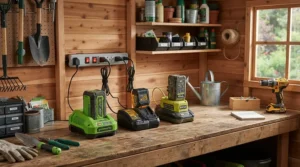
What immediately stands out is that this mower’s 18V 4.0Ah battery is interchangeable with more than 200 other Einhell Power X-Change tools, so if you already own an Einhell drill or hedge trimmer, this mower effectively arrives half paid for. The brushless PurePOWER motor carries a 10-year warranty when registered, and it’s rated for lawns up to 200m² with five cutting heights from 25-65mm and a 30-litre grass box.
This is best suited to smaller gardens and to households who have already bought into the Einhell battery platform, because the single-battery configuration is genuinely limiting once you move beyond a modest plot. Aggregated owner reviews are candid about this trade-off: several buyers on retailer review pages report the battery lasting only 20-25 minutes in practice rather than the theoretical maximum, and note the grass collection basket needs frequent emptying on anything but a small lawn. On the plus side, the BBC Gardeners’ World Magazine review of the closely related GE-CM 18/30 model praised it as remarkably inexpensive and easy to use for what it is.
Pros:
- ✅ Battery shared across the entire Power X-Change range
- ✅ Lightweight brushless motor with 10-year warranty option
- ✅ Genuinely budget-friendly entry point
Cons:
- ❌ Runtime falls short of claims on longer or thicker grass
- ❌ Small grass box means frequent stops on medium lawns
Priced under £200 in most kit configurations, it’s best treated as a small-lawn specialist rather than an all-rounder.
3. Bosch Rotak 18V-34 — best for tidy, regularly maintained suburban lawns
The stand-out feature is Bosch’s GrassCombs system, which lets the cutting deck get right up to fence lines and border edges without leaving an untidy strip behind. It runs on a single 18V 4.0Ah battery, covers up to roughly 200m², and offers five cutting heights between 25-65mm alongside a collapsible 35-litre grass bag that folds flat for storage.
Bosch positions this specifically for homeowners who mow on a routine basis rather than letting the lawn get away from them, and that framing matches the hardware: a single battery of this size simply isn’t built for reclaiming an overgrown plot after a fortnight’s holiday. What most buyers overlook about this model is that the brushless motor with Syneon technology is doing real work to extend runtime per charge compared with older brushed Bosch models, even though the headline spec sheet doesn’t make that obvious. It’s a sensible, low-drama choice if your lawn care routine is already disciplined.
Pros:
- ✅ Edge-to-edge cutting via GrassCombs reduces strimming
- ✅ Foldable handle and collapsible bag save storage space
- ✅ Brushless motor improves efficiency over older Rotak models
Cons:
- ❌ Single battery limits use on overgrown or larger lawns
- ❌ 34cm width means more passes on wider plots
Sitting in the £200-£260 range as a kit, it’s a fair-value pick for anyone who mows little and often.
4. Worx WG779E.2 — best all-round value and ecosystem flexibility
The headline feature is IntelliCut technology, which automatically ramps torque up when the mower senses thicker or damp grass and dials it back down again to conserve charge — a genuinely useful bit of engineering rather than marketing fluff. It runs on twin 20V PowerShare batteries combining to 40V, is rated for lawns up to 400m², and offers six cutting heights from 20-70mm with a cut-to-edge deck design that trims closer to borders than most rivals.
Based on the spec comparison, the real draw here is battery interchangeability: Worx PowerShare batteries also power the brand’s strimmers, blowers, and even some power tools, so a household building out a garden toolkit gets more value from every battery purchased. Independent reviewers at Gardeningetc and Real Homes both awarded this mower close to full marks, praising its quiet operation and consistent cutting power, while noting the 4.0Ah batteries can take up to four hours for a full charge if you opt for the higher-capacity pack.
Pros:
- ✅ IntelliCut automatically manages power for tougher grass
- ✅ PowerShare batteries cross-compatible with other Worx tools
- ✅ Consistently rated highly across multiple independent reviews
Cons:
- ❌ 4.0Ah battery variant has a lengthy charge time
- ❌ Cutting width modest for gardens over 400m²
In the £200-£300 range depending on battery capacity, this is our pick for buyers who want dependable performance without premium pricing.
5. Makita DLM432Z — best for households already invested in Makita 18V LXT tools
What sets this apart is that it runs on two standard Makita 18V LXT batteries wired in series, meaning anyone who already owns Makita drills, saws or other 18V tools can mow the lawn without buying a single new battery. Sold as a bare tool, the DLM432Z offers a wide 43cm cutting width, 13 cutting height settings from 20-75mm, a 50-litre grass bag with a fill indicator, and a 3,600rpm motor that Makita rates for lawns up to 575m².
This is squarely aimed at tradespeople and serious DIYers rather than casual buyers, because purchasing the LXT batteries and charger separately can quickly erase any headline saving on the bare-tool price. Here’s what to weigh: if you’re already sitting on two or more 18V LXT 5.0Ah packs, this becomes one of the cheapest ways into a capable 43cm cordless mower on the market, but starting from zero on the Makita platform makes rival all-inclusive kits a better first purchase. Owner feedback on the electronic brake and soft-start feature is consistently positive, citing smoother startup than cheaper rivals.
Pros:
- ✅ Shares batteries with the entire Makita 18V LXT range
- ✅ Wide 43cm deck covers ground quickly
- ✅ Electronic brake and soft start reduce jarring startup
Cons:
- ❌ Sold body-only — batteries and charger cost extra
- ❌ Not economical unless you already own LXT batteries
Body-only pricing sits around £250-£350, but factor in roughly £150-£200 more for a pair of compatible batteries and a charger if starting fresh.
6. Bosch Rotak 18V2-43 — best build quality and design
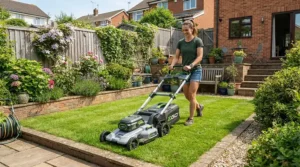
This model actually won an iF Design Award, and it shows in details like the magnetically-held deflector guard that lets you empty the grass bag one-handed. Two 18V batteries combine to deliver 36V performance, it’s rated for lawns up to 500m², and it offers a generous six-step cutting height range from 30-75mm alongside a 40-litre grass collector and a telescopic, foldable bail-bar handle.
Based on the spec comparison against the smaller Rotak 18V-34, the twin-battery layout genuinely changes what this mower can handle: Bosch’s own guidance says the combined 36V output keeps the blade from bogging down in dense or slightly overgrown grass, which single-18V mowers in this price bracket typically can’t claim. What most buyers overlook about this model is how much of the premium goes toward acoustic engineering rather than raw power — it’s noticeably quieter in use than its power output would suggest, which matters more than people expect once you’re mowing on a Sunday morning with neighbours either side.
Pros:
- ✅ Twin-battery 36V system handles denser grass confidently
- ✅ iF Design Award-winning build and one-handed bag removal
- ✅ Notably quiet operation for its power class
Cons:
- ❌ Among the pricier twin-18V options on the market
- ❌ Two batteries to keep charged rather than one
Kit pricing typically runs £329-£389, which is justified if long-term build quality matters more to you than chasing the lowest sticker price.
7. EGO Power+ LM1903E-SP — best for larger or sloped gardens needing self-propulsion
The defining feature is EGO’s 56V Arc Lithium battery, which the brand claims delivers 40% more power than a standard 40V pack, paired with genuine self-propelled drive that takes the physical strain out of pushing a mower up an incline. It covers a 47cm cutting width, is rated for lawns up to 800m², includes a 55-litre grass collector, and offers seven cutting height positions from 25-80mm.
This is the mower to reach for if your garden slopes, if it’s genuinely large by UK standards, or if you simply don’t want mowing to feel like a workout. Based on the spec comparison, the rapid charger is a serious differentiator too, taking the 5.0Ah battery from empty to full in around 30-40 minutes rather than the two-to-four-hour wait typical of budget models — practically the difference between finishing the lawn in one sitting or coming back tomorrow. Aggregated reviewer sentiment is strongly positive on cut quality and self-propelled control, with the five-year mower warranty and three-year battery warranty repeatedly cited as reassurance for the higher outlay.
Pros:
- ✅ Self-propelled drive handles slopes with minimal effort
- ✅ Rapid charger cuts downtime to around 30-40 minutes
- ✅ Five-year mower and three-year battery warranty
Cons:
- ❌ Most expensive mower in this line-up by some margin
- ❌ Overkill for small or flat gardens under 300m²
At £550-£650 in the standard kit, this is a premium buy best justified by a genuinely demanding garden.
Cordless Mower Battery Life: What the Numbers Actually Mean
Manufacturer runtime claims are measured under close to ideal conditions — dry, short, previously-cut grass on flat ground — so treat any advertised figure as a ceiling rather than an average Saturday. In practice, a battery lawn mower’s real-world runtime depends heavily on grass length, moisture and how often you’re forced to lift the cutting deck to clear clumps. The LawnMaster CLMF2434G‘s claimed 30 minutes per battery, for instance, assumes reasonably maintained grass; step into damp, ankle-high growth after a fortnight away and that figure drops noticeably.
What most buyers overlook is that amp-hours (Ah), not just voltage, determine how long a single charge lasts — a 4.0Ah battery roughly doubles the runtime of a 2.0Ah pack at the same voltage, all else being equal. This is why the Worx WG779E.2 can be bought with either capacity: reviewers at Gardeningetc found the 4.0Ah version pushed runtime up toward 55 minutes versus roughly 35 minutes on the smaller pack. If your lawn regularly takes longer than 30 minutes to cut, either budget for a spare battery or size up to a mower rated for a larger area than your actual plot, since headroom protects you against the worst-case damp-grass scenario.
Mower Battery Voltage Explained: 18V vs 36V vs 40V vs 56V
Voltage broadly tracks with torque — how much resistance the blade can push through before it bogs down — rather than with runtime directly, which is the single most common point of confusion buyers bring to this category. An 18V single-battery mower like the Bosch Rotak 18V-34 is entirely adequate for a well-kept 150-200m² lawn cut weekly, but ask it to chew through overgrown spring grass and the motor will visibly labour.
| Voltage Class | Typical Recommended Area | Handles Damp/Long Grass? | Example Model |
|---|---|---|---|
| 18V (single battery) | Up to 200m² | Struggles | Bosch Rotak 18V-34 |
| 24V | Up to 300m² | Fair | LawnMaster CLMF2434G |
| 36V-40V (twin battery) | 400-575m² | Good | Worx WG779E.2, Makita DLM432Z |
| 56V | Up to 800m² | Excellent | EGO Power+ LM1903E-SP |
The table makes the pattern clear: doubling up to two 18V batteries, as both the Makita DLM432Z and Bosch Rotak 18V2-43 do, is really a cost-effective way of reaching 36V performance without needing to invest in a whole new battery platform. The EGO Power+ LM1903E-SP‘s 56V system sits apart because EGO built the entire architecture around that voltage from scratch rather than doubling up existing packs, which is part of why it commands a premium price. For most standard UK gardens, the 36-40V bracket represents the genuine sweet spot between capability and cost.
Charging Time: How Long You’ll Actually Wait Between Cuts
Charging time varies more than most buyers expect, and it’s rarely mentioned prominently on Amazon listings. Budget single-battery mowers with basic chargers, like the Einhell GE-CM 18/33 Li, typically take around 60-90 minutes for a full charge. Mid-range twin-battery kits vary depending on charger type: the Worx WG779E.2‘s standard charger can take up to four hours with the higher-capacity 4.0Ah packs, while premium options like the EGO Power+ LM1903E-SP include a genuinely rapid charger that restores a 5.0Ah battery in roughly 30-40 minutes.
This matters practically because a slow charger effectively caps you to one mowing session per day unless you own a spare battery. The LawnMaster CLMF2434G‘s two-battery bundle sidesteps this by letting one charge while the other works, even though only a single charger is supplied — you simply plan to swap and recharge rather than run both simultaneously. If your household mows on a tight weekend window, prioritise either a fast charger or a spare battery over chasing marginally higher cutting width; it will save you more frustration in practice.
Lithium-Ion Mower Comparison: Battery Chemistry and Longevity
Every mower in this round-up uses lithium-ion battery technology rather than the older lead-acid or nickel-cadmium packs, and that choice underpins most of what makes modern cordless mowing viable. Lithium-ion cells hold far more energy per kilogram than older chemistries, don’t suffer badly from the “memory effect” that used to degrade partially-charged batteries, and lose capacity only gradually across hundreds of charge cycles rather than failing abruptly.
Reviewers consistently note that batteries from EGO, Makita and Bosch retain a healthy percentage of their original capacity after several seasons of typical domestic use, provided they’re stored correctly over winter — ideally at a partial charge in a cool, dry space rather than left fully depleted or bone dry in a freezing shed. Where lithium-ion mower comparison gets interesting is battery management systems: EGO’s “Keep Cool” technology and Einhell’s three-LED charge indicators are both attempts to protect cell health and extend usable lifespan, features that cheaper unbranded imports typically skip entirely. If longevity matters to you as much as initial price, favour established brands whose battery management software has a track record, since a failed pack several years down the line often costs nearly as much to replace as buying a whole new budget mower.
Garden Power Tool Ecosystems: Why Your Next Battery Choice Locks You In
This is the section Amazon listings never mention, and it’s arguably the most financially significant decision in this entire buying process. Once you buy into a battery platform — Bosch’s 18V POWER FOR ALL, Worx’s PowerShare, Einhell’s Power X-Change, or Makita’s 18V LXT — every subsequent cordless tool you buy in that ecosystem, from strimmers to hedge trimmers to leaf blowers, can share the same batteries and chargers.
Here’s what to weigh: the Makita DLM432Z looks expensive as a standalone purchase because it’s sold body-only, but for a tradesperson who already owns four or five Makita 18V tools, it’s arguably the cheapest 43cm mower on this list. Conversely, someone starting from zero gets far better immediate value from an all-inclusive kit like the Worx WG779E.2 or the Einhell GE-CM 18/33 Li, because the battery and charger costs are already baked into the price. Before buying, it’s worth asking not just “which mower is best” but “which ecosystem do I want my garden shed to run on for the next decade,” because that answer will shape every future purchase, from strimmer to chainsaw.
How to Choose a Cordless Lawn Mower
- Measure your lawn first. Pace out roughly how many square metres you’re cutting, since every spec sheet above references recommended area — buying under-specced is the single most common mistake.
- Be honest about slopes. If your garden has any meaningful incline, prioritise self-propelled options like the EGO Power+ LM1903E-SP rather than a push mower that will tire you out.
- Check what batteries you already own. If you’ve got Makita, Bosch or Worx power tools in the shed already, that ecosystem should heavily influence your mower choice.
- Prioritise amp-hours over voltage for runtime. A higher-Ah battery at the same voltage class will simply run longer between charges.
- Factor in charging speed. A rapid charger matters more if you mow on a tight schedule; a slow charger is fine if you’ve a spare battery or flexible timing.
- Consider grass box size relative to lawn size. Larger lawns generate more clippings, and a small collector means more stopping and emptying trips.
- Weigh mulching as an alternative. Many models, including the LawnMaster CLMF2434G and Bosch Rotak 18V2-43, include mulch plugs that return clippings as lawn nutrients, cutting down on emptying entirely.
Common Mistakes When Buying a Battery Lawn Mower
The most frequent error is buying based on cutting width alone, ignoring the recommended lawn area rating entirely — a wide 43cm deck on an underpowered battery still struggles through overgrown grass just as much as a narrow one. A close second is underestimating charging logistics: buyers who assume they’ll get one uninterrupted mowing session per charge are often disappointed when damp spring grass halves the advertised runtime.
Another common misstep is ignoring ecosystem lock-in until after purchase, then discovering that a “cheap” bare-tool mower actually costs considerably more once batteries and a charger are added. Finally, many buyers skip checking storage requirements: lithium-ion packs degrade faster if left on charge indefinitely or stored at full charge through a cold winter, so a mower that seems fine in its first season can disappoint by its third if care instructions are ignored.
Cordless Lawn Mowers vs Petrol Mowers
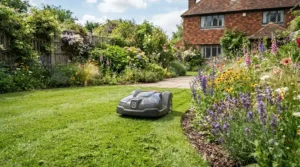
This is where a genuinely detailed comparison earns its place, because the decision isn’t as one-sided as cordless marketing sometimes suggests.
| Factor | Cordless Mowers | Petrol Mowers |
|---|---|---|
| Startup | Instant push-button | Pull cord, can flood |
| Noise | Significantly quieter | Loud, requires ear protection for prolonged use |
| Maintenance | Minimal — no oil, filters or spark plugs | Regular servicing, oil changes, fuel storage |
| Running cost | Electricity only | Petrol plus servicing |
| Runtime per session | Limited by battery (25-60 mins typical) | Effectively unlimited while fuelled |
| Best For | Small-to-medium regularly maintained lawns | Very large or heavily overgrown plots |
Reading the comparison above, cordless clearly wins on convenience, noise and ongoing maintenance cost for the overwhelming majority of UK gardens, which tend to be modest by international standards. Where petrol still has a genuine edge is on very large plots or seriously neglected, waist-high grass, where an unlimited fuel tank beats even the 800m² rating of the EGO Power+ LM1903E-SP. For anyone mowing a typical semi-detached or terraced garden on a weekly or fortnightly basis, though, the case for petrol has become genuinely hard to make in 2026.
What to Expect: Real-World Performance in a British Garden
Specs on paper rarely translate directly to a wet Tuesday in April, so it’s worth translating them into what you’ll actually experience. A 36-40V mower like the Worx WG779E.2 will comfortably handle the first cut of the season on the highest blade setting, as the RHS recommends for long or overgrown grass, without bogging down or stalling repeatedly.
Where the difference between voltage classes becomes obvious is on damp grass after rain — a scenario that’s more the rule than the exception in a typical British spring. Lower-voltage single-battery mowers like the Einhell GE-CM 18/33 Li will need more frequent stops to clear clumped, wet clippings from the deck, while twin-battery and 56V machines push through with noticeably less strain on the motor. Expect noise levels across this whole category to sit well below a petrol mower — quiet enough that you won’t need to apologise to neighbours for a Sunday morning cut, and quiet enough that you can actually hear the birdsong the RHS points out mowing at the right height helps protect in the first place.
Practical Usage Guide: Setup, Maintenance and Getting the Most From Your Mower
Getting a new cordless mower off to a good start takes maybe twenty minutes and saves you real hassle later. First, fully charge the battery before its first use even if it arrives partially charged, since manufacturers calibrate battery management systems around a complete initial cycle. Second, set the cutting height to the highest position for your first mow of the season, then gradually lower it over subsequent cuts — the RHS’s one-third rule (never remove more than a third of the grass blade height in a single cut) applies just as much to a battery mower as to any other type.
For ongoing maintenance, clean the underside of the deck after every few cuts to stop compacted grass from affecting blade performance, and inspect the blade itself every month or two during the growing season for nicks or dulling. A common mistake in the first thirty days is leaving the battery on charge continuously “just in case” — most lithium-ion packs prefer being removed once fully charged rather than trickle-charged indefinitely, which extends their working life by several seasons. Finally, before winter storage, charge the battery to roughly 40-60% rather than 100% or empty, and store it somewhere dry and frost-free; this single habit does more for long-term battery health than almost anything else you can do.
Real-World Scenarios: Which Mower Fits Your Garden
Consider three household types. First, a couple in a terraced house with a compact 120m² courtyard-style lawn, mowed fortnightly and budget-conscious: the Einhell GE-CM 18/33 Li or Bosch Rotak 18V-34 both suit this perfectly, since a single battery comfortably covers the area and the lower price reflects genuinely modest needs.
Second, a family with a 350m² semi-detached back garden, mown weekly through the growing season, wanting reliability without overspending: the Worx WG779E.2 is the strongest fit here, combining enough runtime and cutting width for the area with a battery platform that extends usefully into strimmers and blowers as the garden toolkit grows. Third, a household on a sloped, 600m²-plus plot who finds mowing physically tiring and mows less frequently than they’d like as a result: the EGO Power+ LM1903E-SP‘s self-propelled drive and 800m² rating directly solves the actual problem, which is effort rather than simply cutting width, making the higher price genuinely justified rather than indulgent.
Safety, Recycling and Battery Regulations in the UK
Lithium-ion batteries are safe in normal use, but damaged, crushed or improperly disposed of packs are a genuine and growing fire risk — UK fire services have reported hundreds of waste-related fires linked to lithium-ion batteries in recent years. Never dispose of a mower battery in household rubbish or standard recycling; instead, take it to a dedicated battery recycling point, a household waste recycling centre, or back to the retailer, several of whom operate take-back schemes under UK electrical waste regulations. Guidance from Humberside Fire and Rescue Service is clear that batteries should never go in general waste bins, since crushing during collection can trigger short-circuiting and fire.
While using the mower itself, standard garden power tool safety applies: always wear sturdy footwear, clear the lawn of stones and debris before cutting, and remove the safety key (most cordless mowers, including the LawnMaster CLMF2434G, include one) whenever the mower is left unattended, particularly around children. Store spare batteries away from direct sunlight and extreme heat, and always use the charger supplied by the manufacturer rather than a third-party alternative, since mismatched chargers are a common cause of battery degradation and, in rare cases, fires.
Long-Term Cost & Maintenance: Total Cost of Ownership
| Cost Factor | Cordless Mower (5-year estimate) | Petrol Mower (5-year estimate) |
|---|---|---|
| Purchase price | £200-£650 | £150-£500 |
| Fuel/electricity | Roughly £5-£15/year | Roughly £40-£80/year in fuel |
| Servicing | Minimal — occasional blade sharpening | £40-£80/year typical service cost |
| Replacement battery (if needed) | £60-£150 once, around year 3-5 | N/A |
| Overall 5-year estimate | Noticeably lower for most households | Higher due to fuel and servicing |
The table shows that even accounting for an eventual replacement battery, cordless mowers tend to work out cheaper over a five-year span once fuel and regular servicing costs are factored in for the petrol alternative. Premium models like the EGO Power+ LM1903E-SP carry a higher upfront cost but its five-year mower warranty meaningfully de-risks that outlay, while budget picks like the LawnMaster CLMF2434G minimise upfront spend at the cost of a shorter expected battery lifespan. Either way, the maintenance-cost gap versus petrol is the single strongest financial argument for going cordless if you mow regularly across multiple seasons.
FAQ
❓ How long does a cordless lawn mower battery last per charge?
❓ What voltage cordless mower do I need for a medium garden?
❓ Can I use any battery charger with my cordless lawn mower?
❓ Are cordless lawn mowers powerful enough for long or wet grass?
❓ How much does a decent cordless lawn mower cost in the UK?
Conclusion
Cordless lawn mowers have crossed a genuine threshold in 2026 — for the vast majority of UK gardens, they’re no longer a compromise but the sensible default. The right choice comes down to matching voltage and battery capacity honestly to your actual lawn size, being realistic about slopes and grass conditions, and factoring in which battery ecosystem will serve you best as your garden toolkit grows over the years.
Budget buyers get genuine value from the LawnMaster CLMF2434G‘s twin-battery bundle or the Einhell GE-CM 18/33 Li‘s ecosystem pricing. Households with a typical family garden are well served by the Worx WG779E.2‘s all-round balance, the Bosch Rotak 18V-34 for tidier plots, or the Bosch Rotak 18V2-43 if premium build quality matters. Makita tool owners have a near-unbeatable value case in the Makita DLM432Z, while anyone with a larger or sloped garden will find the EGO Power+ LM1903E-SP‘s self-propelled power genuinely transformative rather than a luxury.
Whichever model fits your garden, the shift away from petrol and cables brings real, lasting benefits: less maintenance, lower running costs, and a Saturday morning that starts with a button press instead of a wrestling match with a pull cord.
Recommended for You
- Mower For Average Garden: 7 Top-Rated Picks For UK Lawns (2026)
- Lawn Mower Under £300: 7 Best UK Picks For Every Garden (2026)
- Cloche Tunnel For Vegetables: 7 Best Picks For UK Plots (2026)
Disclaimer: This article contains affiliate links. As an Amazon Associate, I earn from qualifying purchases. If you purchase products through these links, we may earn a small commission at no additional cost to you.
✨ Found this helpful? Share it with your friends! 💬🤗
