
In This Article
Somewhere between “I fancy growing my own tomatoes” and “why is my shed full of rotten timber” sits a decision most British gardeners eventually face: what to actually build the thing out of. An aluminium greenhouse is a metal-framed growing structure, usually glazed with glass or polycarbonate, prized for resisting rust and needing almost no upkeep beyond an occasional wash. That’s the whole pitch in one sentence, and it’s largely true — which is precisely why aluminium dominates the UK market from allotments to show gardens.
Choosing the best aluminium greenhouse for your own plot, though, is a messier question than any single “top pick” article usually admits. A 6×4 mini greenhouse solving a balcony’s worth of seedling problems has nothing in common with a wind-braced premium structure built to survive a coastal storm, and pretending otherwise does readers no favours. So this guide does the unglamorous work: seven real, currently sold aluminium greenhouses, pulled apart by size, glazing, frame treatment and genuine review sentiment, with honest opinions on who each one actually suits. As the RHS notes in its own greenhouse guidance, aluminium is usually the material of choice for a glasshouse in Britain’s climate — we’ll show you exactly which aluminium greenhouse earns that reputation, and which just borrows it.
Whether you’re kitting out a first allotment plot or replacing a wooden structure that’s finally given up the ghost, read on for the comparison, the commentary, and the practical detail Amazon’s listing pages simply don’t give you.
Quick Comparison Table
| Product | Frame Finish | Best For | Price Range |
|---|---|---|---|
| Palram Canopia Harmony 6×8 | Rust-resistant silver/grey aluminium | Best all-round beginner greenhouse | £500-£650 range |
| Vitavia Venus 6×8 | Anodised, corrosion-resistant aluminium | Best for coastal or exposed gardens | £550-£750 range |
| Halls Popular 6×8 | Mill-finish or powder-coated aluminium | Best classic British budget pick | £450-£600 range |
| Outsunny 6×6 Walk-In | Galvanised-base aluminium frame | Best Amazon bestseller on a budget | £280-£380 range |
| Gardebruk Sunlight 6×6 | Aluminium frame, galvanised base | Best low-cost polycarbonate alternative | £270-£360 range |
| Elite Titan 700 | Core-Vect thick-section aluminium | Best premium, storm-resistant build | Around £1,600-£1,900 |
| Kingfisher GHPRO 4 Tier | Lightweight aluminium mini-frame | Best for balconies and small spaces | £45-£75 range |
Looking at the spread above, there’s no single “best aluminium greenhouse” crown to hand out — it depends entirely on your garden and your patience for assembly day. Budget-conscious first-timers gravitate toward the Outsunny 6×6 Walk-In or Gardebruk Sunlight 6×6, both of which get you a full-size walk-in structure for under £400. Gardeners near the coast or on an exposed hillside, where corrosion resistance genuinely matters rather than being a nice-to-have, should look harder at the Vitavia Venus 6×8 and its anodised frame, or step up to the Elite Titan 700 if wind loading keeps you up at night. Meanwhile, anyone without a garden at all shouldn’t dismiss the Kingfisher GHPRO 4 Tier — a mini greenhouse solves a genuinely different problem to the other six.
💬 Just one click — help others make better buying decisions too!😊
Top 7 Aluminium Greenhouses: Expert Analysis
1. Palram Canopia Harmony 6×8 — best all-round beginner greenhouse
The Palram Canopia Harmony 6×8 has become something of a default recommendation for first-time greenhouse owners, and there’s a reasonable case for that reputation. Its rust-resistant aluminium frame sits on a galvanised steel base, with crystal-clear polycarbonate panels rated to transmit over 90% of available light while blocking UV — meaning your seedlings get glasshouse-quality brightness without the breakage risk of actual glass. Based on the spec comparison with rival mid-range models, the sliding-panel glazing system is worth flagging specifically: it locks panels into an aluminium track rather than clipping them on, which tends to hold up better in gusty gardens than clip-fit alternatives.
Who is it for? Honestly, most beginners. The 96-inch length and roughly 73-inch width give a genuine walk-around interior rather than a glorified cold frame, and the included vent window with magnetic door catch covers the ventilation basics without extra spend. Reviewers consistently note that the twin-wall roof and single-wall sides strike a sensible balance between insulation and light — a compromise some rival models get wrong in one direction or the other. The main grumble in aggregated feedback is that the galvanised base, while sturdy, needs a genuinely level surface to sit square; skipping that step is the single most common assembly complaint. Available in silver, grey and green frame finishes, this sits in the £500-£650 range depending on colour and current stock, and represents solid value for a first proper greenhouse.
Pros:
- ✅ Sliding polycarbonate panels resist wind better than clip-fit designs
- ✅ Galvanised steel base adds real structural stability
- ✅ Available in three frame colours to suit different gardens
Cons:
- ❌ Requires a genuinely level base or the door can bind
- ❌ Single vent window is modest for warmer months
2. Vitavia Venus 6×8 — best for coastal or exposed gardens
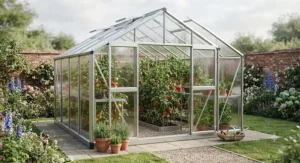
If your postcode sits anywhere near salt air, the Vitavia Venus 6×8 deserves a longer look than most budget alternatives. Its defining feature is an anodised aluminium frame rather than the plain mill-finish aluminium found on cheaper models — anodising seals the metal’s surface electrochemically, so instead of dulling to a rough grey over a few UK winters, the frame stays smooth and bright for the long haul. What most buyers overlook about anodising is that it’s not just cosmetic; a sealed surface resists the pitting that eventually weakens a frame’s structural bar, which matters more in a saline or heavily polluted atmosphere than a sheltered inland garden.
Beyond the frame treatment, the Venus ships with 3mm toughened safety glass as standard, a positionable single sliding door that can hang left or right depending on your layout, and roof braces plus corner plates for extra rigidity — TÜV-approved, for what that’s worth to a nervous buyer. Reviewers consistently flag delivery handling as the weak point of the ownership experience rather than the structure itself, with breakages during transit turning up more than once in aggregated feedback; ordering the optional steel base plinth alongside it, which several retailers bundle in, is worth doing regardless since an unlevel Venus will rack out of square quickly. Available in silver anodised or powder-coated green, prices sit in the £550-£750 range across the 5 available sizes.
Pros:
- ✅ Anodised frame resists corrosion better than mill-finish rivals
- ✅ Toughened glass as standard, not an optional upgrade
- ✅ TÜV-approved design with roof and corner bracing
Cons:
- ❌ Raised door threshold can be awkward for limited mobility
- ❌ Reviewers report inconsistent delivery packaging for glass panes
3. Halls Popular 6×8 — best classic British budget pick
Nearly thirty years on sale tends to mean a design has been stripped down to what actually matters, and the Halls Popular 6×8 is exactly that: a no-frills, low-maintenance aluminium frame with diagonal bracing, a smooth-running sliding door, integral gutters and a single roof vent. The spec sheet won’t tell you this, but user reports suggest the appeal here isn’t any single standout feature — it’s the total absence of anything to go wrong. There’s no automatic vent motor to fail, no complex glazing clip system, just glass or polycarbonate held in with rubber gaskets on a frame that’s been essentially unchanged for a generation.
Based on the spec comparison with other entry-level ranges, the base area of roughly 5.0 square metres and 1.22m eaves height put it squarely in “first greenhouse” territory rather than a serious growing operation — fine for tomatoes, salad crops and overwintering, less fine if you’re planning a professional-scale propagation setup. Aggregated review sentiment is consistently positive on delivery speed and packaging quality, with occasional notes about missing small parts like door knobs or glazing clips, which is a minor but recurring theme worth budgeting a spare trip to the hardware shop for. Available in silver, forest green or black powder-coated finishes across four lengths, with a 12-year frame warranty as standard, it typically sits in the £450-£600 range.
Pros:
- ✅ Simple diagonal-braced frame with almost nothing to break
- ✅ 12-year manufacturer warranty included as standard
- ✅ Three powder-coated colour options beyond plain silver
Cons:
- ❌ Single roof vent limits airflow in a full British summer
- ❌ Small hardware like glazing clips occasionally missing on delivery
4. Outsunny 6×6 Walk-In — best Amazon bestseller on a budget
For sheer popularity on Amazon’s own greenhouse category, the Outsunny 6×6 Walk-In is hard to ignore, and on paper this means it’s the aluminium greenhouse most UK buyers will actually encounter first. It combines an aluminium frame with a galvanised steel foundation and UV-protected polycarbonate panelling, using a snap-in panel system that’s genuinely quicker to assemble solo than the clip-and-gasket approach used by heritage British brands. A five-level adjustable window and integrated rain gutters round out the practical features, and the roughly 190cm x 193cm footprint gives a proper walk-around interior rather than a cramped lean-to.
Here’s what to weigh before buying, though: this is a lighter-gauge structure than the Halls or Vitavia ranges, and reviewers consistently note that a solid, level base and firm ground anchoring are non-negotiable rather than optional extras — several aggregated reviews describe the frame “racking” in strong gusts when set up on soft lawn without anchoring. That’s not a design flaw so much as the honest trade-off for the price point. For anyone in a moderately sheltered garden who wants a full-size walk-in structure without spending £500-plus, it remains a sensible starting point, sitting in the £280-£380 range depending on colour and current promotions.
Pros:
- ✅ Fast snap-in polycarbonate panel assembly for solo builders
- ✅ Five-level adjustable window for genuine ventilation control
- ✅ Full walk-in footprint at a genuinely budget price point
Cons:
- ❌ Lighter frame gauge needs firm anchoring in exposed spots
- ❌ Less rigid than heritage British aluminium ranges in high wind
5. Gardebruk Sunlight 6×6 — best low-cost polycarbonate alternative
Sitting alongside Outsunny in the budget bracket, the Gardebruk Sunlight 6×6 takes a broadly similar approach — aluminium frame, galvanised steel base, polycarbonate glazing — but with a slide door and window configuration that several buyers find marginally easier to operate one-handed. Reviewers consistently note that a common complaint in user reviews is fiddly initial assembly instructions rather than any fault with the finished structure, which tracks with what you’d expect from a value-focused European import brand: the parts are decent, the paperwork could be better.
What most buyers overlook about this model is that its polycarbonate panels are specifically UV-stabilised rather than generic clear plastic, meaning they’re less prone to the yellowing that ruins cheaper greenhouses’ light transmission after a couple of summers. On paper, this means the Sunlight should age better than its rock-bottom price suggests, provided the frame itself is anchored properly — the same caveat that applies to every lightweight aluminium walk-in in this bracket. As a straightforward alternative to the Outsunny for anyone who prefers a different brand or is chasing the cheapest available price on a given week, it’s a genuinely comparable option, typically priced in the £270-£360 range.
Pros:
- ✅ UV-stabilised polycarbonate resists yellowing over time
- ✅ Galvanised base included as standard, not an add-on
- ✅ Competitively priced against similar budget walk-ins
Cons:
- ❌ Assembly instructions are frequently criticised as unclear
- ❌ Frame gauge is comparable to other budget models, not premium-grade
6. Elite Titan 700 — best premium, storm-resistant build
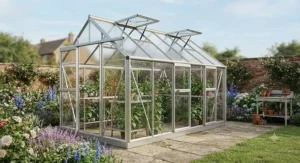
At the opposite end of the spectrum sits the Elite Titan 700, a British-manufactured greenhouse built around what Elite calls Core-Vect technology — box-section aluminium bars measuring around 56mm thick, compared with the 25-32mm sections typical of standard ranges. The spec sheet won’t tell you this in plain English, but that difference roughly triples structural rigidity and pushes wind resistance up toward 90mph-plus, versus 45-60mph for a typical budget greenhouse. If you’ve ever watched a cheaper structure flex alarmingly in a January storm, this is the spec that actually fixes it.
Based on the spec comparison with entry-level models, the Titan 700’s low-threshold double sliding doors, 10-blade louvre vent, ridge canopy seal and full-length toughened glass all point toward genuine engineering rather than marketing dressing — and the 20-year warranty backs that up with real confidence. Reviewers and industry commentary consistently frame the price premium as reflecting real material differences rather than brand markup, given the frame weighs significantly more than budget equivalents of the same footprint. This is not a greenhouse for a casual first-time grower on a tight budget; it’s for anyone in an exposed rural or coastal spot who has already replaced one flimsy structure and doesn’t intend to do it twice. Bespoke lengths are available, with the 7×6 model sitting around £1,600-£1,900 including delivery, before any powder-coated colour upgrade.
Pros:
- ✅ Core-Vect box-section aluminium roughly triples standard rigidity
- ✅ Low-threshold double doors and 10-blade louvre vent as standard
- ✅ 20-year warranty reflects genuine long-term confidence
Cons:
- ❌ Significant price premium over standard 6ft or 8ft ranges
- ❌ Needs a precisely level, reinforced base to justify the investment
7. Kingfisher GHPRO 4 Tier — best for balconies and small spaces
Not every garden — or balcony, or patio — has room for a walk-in structure, and the Kingfisher GHPRO 4 Tier solves an entirely different problem to the six greenhouses above it. It’s a compact aluminium-framed mini greenhouse with four shelf tiers and a clear cover, standing roughly waist-to-shoulder height, designed purely for hardening off seedlings, propagating cuttings and giving frost protection to potted plants rather than full-scale cultivation. Here’s what to weigh: this isn’t a scaled-down version of a walk-in greenhouse, it’s a different product category entirely, and comparing it directly to the Elite Titan on value would be a category error.
Reviewers consistently describe it as an easy, no-tool assembly job that punches well above its price for balcony growers and allotment holders who just need extra shelf space for trays. A common complaint in aggregated feedback is that the lightweight aluminium frame can genuinely get uncomfortably warm to the touch in direct summer sun, so gloves are sensible during any midday adjustments, and the structure needs anchoring or weighting in open, windy spots since its low mass makes it more prone to toppling than a full-size greenhouse. As a stopgap or a permanent solution for space-poor gardeners, it remains one of the best-reviewed products in its specific niche, typically available in the £45-£75 range.
Pros:
- ✅ Genuinely no-tool assembly in well under an hour
- ✅ Four usable shelf tiers in a tiny footprint
- ✅ Ideal budget entry point for balconies and patios
Cons:
- ❌ Frame can become hot to the touch in direct sun
- ❌ Needs anchoring or weighting against wind due to low mass
Practical Usage Guide: Setting Up Your Aluminium Greenhouse
Getting the base right matters more than any single feature on the spec sheet. Before a single panel goes up, level the ground to within a few millimetres across the entire footprint — even a slight slope will leave a sliding door binding permanently, and it’s the single most common first-month mistake across every brand covered above. Concrete slabs, paving or a proper galvanised steel base plinth all outperform bare soil; if you must anchor into soil, concrete the ground stakes in rather than simply driving them in, since an unanchored aluminium greenhouse genuinely can lift clean off the ground in a serious gust.
In the first 30 days, resist the urge to overload shelving before the frame has settled and every bolt has been checked for tightness — aluminium frames flex slightly under load initially, and a follow-up tightening pass after a fortnight catches anything that’s worked loose. Ventilation is the next most common early mistake: closing a greenhouse up completely on a sunny March day can push internal temperatures into the 30s°C within an hour, scorching young seedlings, so get into the habit of opening vents and doors whenever the sun’s properly out, even in cooler months. For ongoing maintenance, a soapy water wash once or twice a year keeps both glazing and frame performing well, and the RHS advice on greenhouse heating is worth reading before your first proper winter, since draught-proofing and bubble-wrap insulation make a bigger difference to a heating bill than most people expect.
Real-World Scenarios: Which Aluminium Greenhouse Suits You?
Picture a first-time allotment holder with a modest budget and a reasonably sheltered plot: the Outsunny 6×6 Walk-In or Gardebruk Sunlight 6×6 make the most sense here, giving a full working greenhouse for under £400 while the grower figures out whether the hobby sticks. Contrast that with a family in a coastal Cornish village who lost a previous timber greenhouse to rot within four winters — for them, the anodised frame on the Vitavia Venus 6×8 or the storm-rated Elite Titan 700 earns its higher price tag through decades rather than years of service, particularly given how corrosive salt-laden air is to unprotected metal and timber alike.
Then there’s the urban balcony gardener with no outdoor footprint bigger than a few square metres, propagating herbs and chillies through a London flat’s summer — the Kingfisher GHPRO 4 Tier fits that brief precisely, where a full-size structure simply wouldn’t. And for the classic suburban gardener with a modest 6×8 plot who wants dependable, unfussy performance without chasing every feature, the Halls Popular 6×8 or Palram Canopia Harmony 6×8 both deliver exactly what’s promised without over-specifying for a need that doesn’t exist. Matching the greenhouse to the actual garden — not the biggest budget available — consistently produces happier owners than buying the most expensive option “to be safe.”
Problem → Solution: Common Aluminium Greenhouse Headaches Solved
Frame flexing or racking in wind: almost always traced back to an unlevel or unanchored base rather than a frame defect — add a galvanised steel base plinth or concrete the perimeter, as several retailers explicitly recommend for exactly this reason.
Sliding door jamming after a few months: usually caused by minor ground settlement pulling the frame slightly out of square; a follow-up levelling check and a light silicone spray on the door track resolves most cases without needing replacement parts.
Condensation and fungal problems in winter: typically a ventilation issue rather than a build quality one — open vents on any mild, dry day rather than sealing the structure completely, as trapped humidity does more damage to overwintering plants than a brief cold draught.
Polycarbonate yellowing after a couple of summers: most common on budget panels without UV stabilisation; models like the Gardebruk Sunlight specifically address this with UV-stabilised polycarbonate, so checking that spec before buying avoids the problem entirely.
Small missing parts on delivery (glazing clips, door knobs): a recurring theme in aggregated reviews across several brands — photograph the unopened box on arrival and contact the retailer promptly, since most offer free replacement parts within a set window.
✨ Ready to stop guessing and start growing? Compare current prices on today’s top-rated models below.
How to Choose the Best Aluminium Greenhouse
- Match the size to your actual garden, not your ambition. A 6×8 suits most family gardens; anything larger needs genuine planning around access and shading from nearby fences or trees.
- Decide between glass and polycarbonate early. Glass gives the clearest light and a traditional look; polycarbonate is lighter, safer around children, and better insulated, though it diffuses light slightly.
- Check the frame finish, not just the frame material. Mill-finish aluminium is cheapest but dulls over time; anodised or powder-coated finishes cost more but resist corrosion and hold their colour for years.
- Budget for a proper base from day one. A galvanised steel base or concrete pad isn’t an optional extra — it’s what keeps the door running smoothly and the frame square for the life of the structure.
- Read the warranty terms, not just the headline years. Most cover the frame against manufacturing defects but explicitly exclude wind damage or glazing — know what you’re actually covered for.
- Weigh ventilation features properly. A single roof vent is adequate for a 6×4; anything larger benefits from double vents or an automatic vent opener to avoid summer overheating.
- Factor in delivery and site access. Larger premium greenhouses arrive on pallets and need clear access; check delivery terms before committing, especially for rural or restricted postcodes.
Aluminium Greenhouse vs Wooden Greenhouse: Which Wins?
The aluminium greenhouse vs wooden debate tends to get framed as a straight durability contest, but that undersells what’s actually a set of different trade-offs. Aluminium doesn’t rust; instead it forms a natural oxide layer that protects the metal, making it a genuinely sound choice for coastal gardens where salt air corrodes steel and rots timber within a handful of seasons. Wood, by contrast, needs regular treatment and can rot if humidity gets into joints — but a well-maintained cedar or pressure-treated softwood frame can last decades and blends into a cottage garden in a way plain aluminium rarely does.
| Factor | Aluminium Greenhouse | Wooden Greenhouse |
|---|---|---|
| Maintenance | Minimal — occasional wash | Regular treatment/painting needed |
| Corrosion/rot resistance | Excellent, natural oxide layer | Prone to rot without upkeep |
| Weight | Lightweight, easier to erect | Heavier, sturdier in high winds |
| Aesthetic | Modern, slimline glazing bars | Traditional, blends into gardens |
| Best For | Low-maintenance, exposed gardens | Cottage gardens, DIY-inclined owners |
The table makes the trade-off plain: if minimal upkeep and corrosion resistance are the priority, aluminium wins comfortably, and it’s why the seven models above dominate current UK sales. But a gardener who genuinely enjoys maintenance as part of the hobby, and prioritises a traditional look over convenience, may still find a well-built timber structure the better fit — Which?’s greenhouse buying guide reaches broadly the same conclusion when weighing material choice against garden style and climate.
Common Mistakes When Buying an Aluminium Greenhouse
The single biggest mistake is buying on footprint alone without checking eaves height — a greenhouse under 1.5m at the eaves restricts which plants you can actually grow standing upright, and the RHS specifically recommends 1.8m or more for serious use. A close second is skipping the base budget entirely, assuming the greenhouse “comes with everything,” when in most ranges the galvanised base or concrete pad is a separate line item that transforms stability. Buyers also frequently underestimate delivery logistics for anything above a 6×8 footprint, only discovering at the door that a structure this size arrives on a pallet requiring clear, level access — not a problem to discover on delivery day.
Finally, plenty of first-time buyers assume “aluminium” automatically means “premium,” when frame gauge varies enormously between a budget walk-in and a Core-Vect premium model — the material is the same, but the engineering behind it is not. Reading the actual bar thickness and bracing specification, rather than trusting the word “aluminium” alone, avoids a mismatch between price paid and durability received.
Corrosion-Resistant Frames and Powder-Coated Aluminium Explained
Not all aluminium finishes perform equally, which is exactly why the corrosion-resistant frame conversation matters more than it first appears. Plain mill-finish aluminium — the cheapest option — will still oxidise on the surface and can develop a rough, dull grey texture over several UK winters, even though it won’t rust through like steel. Anodising, as used on the Vitavia Venus, is an electrochemical process that thickens and seals that natural oxide layer, meaningfully slowing surface degradation and keeping the metal bright for longer.
Powder-coated aluminium takes a different route entirely: a dry pigment is electrostatically applied and then cured under heat, bonding a tough, coloured finish directly to the metal. On paper, this means powder-coated frames get two benefits at once — the corrosion resistance aluminium already has, plus a durable colour that won’t flake or peel the way traditional paint can. What most buyers overlook is that powder-coated finishes also add a small but real cost premium over plain silver, typically £150-£250 depending on model and length, which is worth budgeting for if garden aesthetics matter to you as much as longevity.
Long-Term Cost & Maintenance: Is a Low-Maintenance Greenhouse Frame Worth It?
Total cost of ownership rarely gets discussed honestly in greenhouse marketing, but it’s where aluminium’s low-maintenance greenhouse frame reputation genuinely earns its keep. A budget timber structure might cost less upfront than any of the seven aluminium models above, but factor in annual wood treatment, occasional panel or joint replacement, and a realistic 12-15 year lifespan before major rot sets in, and the total spend over two decades frequently overtakes even the premium Elite Titan 700. Aluminium’s main ongoing cost is simply glazing replacement if a pane cracks, plus an annual soapy-water wash — genuinely minimal compared with the sanding, treating and repainting a wooden equivalent demands.
Where aluminium does cost more over time is heating efficiency, since the metal conducts heat away faster than timber framing, meaning anyone running a heated greenhouse through winter should budget slightly more for insulation measures like bubble wrap glazing or draught sealing. Weighed against decades of avoided maintenance labour and replacement costs, though, most gardeners come out ahead financially by year five to seven of ownership — sooner if their garden sits somewhere genuinely exposed to wind, rain or salt air.
Safety, Regulations and Planning Permission Guide
The good news for most UK gardeners is that a standard aluminium greenhouse counts as permitted development and doesn’t need planning permission, provided it sits behind the front wall of the house, stays under the relevant height limits (generally 2.5m at the eaves within 2m of a boundary, or up to 4m for a dual-pitched roof set further back), and doesn’t push total garden outbuilding coverage beyond 50% of the plot. Full details, including the exceptions for listed buildings, conservation areas and National Parks, are set out clearly on the Planning Portal’s outbuildings guidance, and it’s worth a five-minute check before ordering anything unusually large.
On the physical safety side, never anchor a greenhouse with simple ground spikes on soft soil alone — concrete footings or a bolted concrete/paved base are essential, since an unanchored structure can genuinely become airborne in a serious storm. Toughened safety glass, standard on several models above, is worth prioritising over horticultural glass anywhere children or pets have access, since it shatters into small, blunt fragments rather than dangerous shards if broken.
FAQ
❓ Does an aluminium greenhouse rust in the rain?
❓ What is the best size aluminium greenhouse for a small garden?
❓ Do I need a base for an aluminium greenhouse?
❓ Is polycarbonate or glass better for an aluminium greenhouse?
❓ How long does a powder-coated aluminium greenhouse last?
Conclusion
There isn’t a single best aluminium greenhouse that suits every garden, and any article claiming otherwise is skipping the honest bit. What the seven models above do share is the underlying case for aluminium itself: minimal maintenance, genuine corrosion resistance, and a lifespan that, base and anchoring permitting, comfortably outlasts most timber equivalents. Where they differ is in exactly the details that matter for your specific plot — frame gauge, glazing type, colour finish, and whether you need a full walk-in structure or a compact mini greenhouse for a balcony.
If you take one practical lesson away, let it be this: spend as much attention on the base and anchoring as you do on the greenhouse itself. Every recurring complaint across every brand traces back to an unlevel base, insufficient anchoring, or skipped ventilation — problems that no amount of frame quality can fully compensate for. Get those fundamentals right, match the size and budget to your actual garden rather than an aspirational one, and any of the seven aluminium greenhouses covered here should reward you with years of productive, low-fuss growing.
✨ Found the right greenhouse for your garden? Check today’s prices before they change! 🌱
Recommended for You
- Traditional Glass Greenhouse: 7 Brilliant UK Buys for 2026
- Best Glass Greenhouse UK 2026: 7 Top Picks Tested & Compared
- Polycarbonate vs Glass Greenhouse: 7 Top UK Picks for 2026
Disclaimer: This article contains affiliate links. As an Amazon Associate, I earn from qualifying purchases. If you purchase products through these links, we may earn a small commission at no additional cost to you.
✨ Found this helpful? Share it with your friends! 💬🤗
